


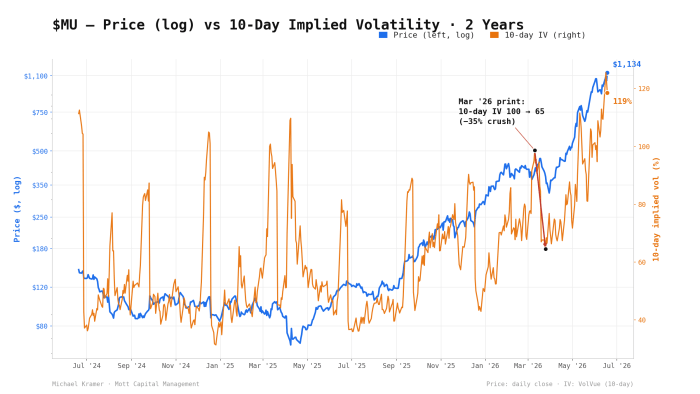
Micron (MU) reports after the close on June 24, and the setup looks a lot like it did back in March — when the stock fell hard in the days after results, even though the numbers were good. What matters most this time isn’t really whether earnings are good or bad. It’s how the options market is positioned going in. And like last quarter, it’s positioned very heavily toward calls.
Implied volatility is at a two-year high, so both calls and puts are expensive right now. The problem is that once a company reports, that volatility is likely to fall sharply. In March, the 10-day implied vol went from about 100% down to 65% in just a couple of days. When that happens, options premiums decay no matter which way the stock goes — so you’re paying a lot for a call or a put that starts losing value the moment results come out.
On top of that, the biggest level of call gamma — the call wall — sits at $1,200, while the put wall is all the way down at $900. With the stock around $1,135, there’s much less room for the upside than for the downside. And in a positive gamma regime, market makers tend to sell into the stock as it rises toward $1,200, which can pin it right around the call. So even if Micron reports great numbers, it may have a hard time getting much above $1,200 to $1,220 — and anyone who bought calls above there needs a big move just to break even.
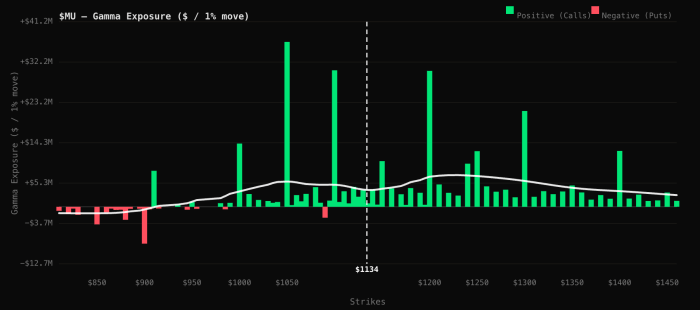
That’s why the risk looks skewed. The upside is fairly limited around $1,200, but the downside — once the volatility comes out and all that call positioning starts to unwind — runs toward the zero-gamma area and maybe the put wall. That’s a decline of somewhere between 15% and 20%. None of this says the results are going to be bad. It’s that the way the options are positioned makes it hard for the stock to go up after results and pretty easy for it to fall — a lot like March, except this time the stock has more than doubled and has a lot more to give back.



Comments
Log in or sign up to join the conversation.