


I fired my lawn care company recently.
Or at least, I tried to.
My yard had become overrun with weeds, and I’d finally had enough. So I went online to cancel the service.
There was just one problem.
The company wouldn’t let me cancel online. According to its website, I had to pick up the phone and call. And I really didn’t feel like doing that.
So instead, I turned to Muse.
Muse is Meta (META)’s new AI assistant that I’d been experimenting with for a few days. I figured this would be a good test.
And somehow, Muse figured it out.
It opened the company’s online chat, started a conversation with customer service and explained that I wanted to cancel.
Then it handled the back-and-forth for me.
And even though the company insisted I needed to call to cancel, Muse managed to get it done through the chat.
I never picked up the phone. In fact, I barely did anything at all.
And as mundane as this little story might sound, it gave me a clear vision of where consumer AI is headed.
AI That Actually Does Something
If you’ve used ChatGPT, Claude or any of the other major AI assistants, you probably know the basic routine.
You type in a question or give it a task. A few seconds later, it gives you an answer.
Muse can do that too. But what impresses me about Muse is that it can actually do things for me.
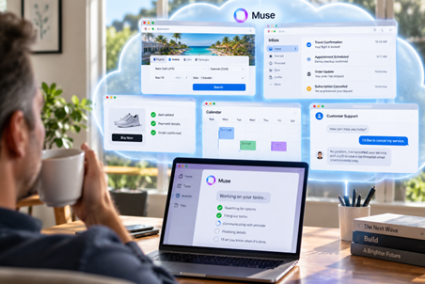
That’s possible because every Muse gets its own virtual computer in the cloud, complete with a web browser. You can also give it access to services like your email and calendar.
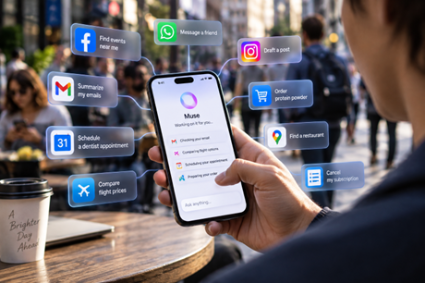
That means Muse can browse websites, fill out forms, book travel and even negotiate on your behalf. And it can keep working after you close the app.
With my lawn care company, I didn’t ask Muse how to cancel my service. I just asked it to take care of it.
That’s a huge difference.
Now, I’m not saying Muse is perfect.
I’ve found that it’s not particularly good at writing emails, for example. For complicated research or work that requires a lot of reasoning, I’d still rather use other AI tools.
But I’m already finding myself using Muse more than ChatGPT or Claude for everyday tasks.
Part of the reason is that it feels almost frictionless. And I think Meta understands something the rest of the AI industry may be overlooking.
Most people don’t care about coding benchmarks or whether an AI can solve graduate-level math problems. They want to find something online, respond to an email or book a trip.
Or, if they’re like me, cancel a lawn service without spending 20 minutes on the phone.
In other words, they want a digital assistant. And as of this moment, Muse is the best one I’ve used.
But Meta isn’t the only company chasing this idea.
One of the hottest AI startups in Silicon Valley is Instinct. Its invitation-only AI assistant has generated buzz for handling similar everyday chores.
A recent test by Business Insider had Instinct book a cabin and dinner reservation, order protein powder, schedule a dentist appointment, fax documents to a bank, deal with an insurance company and cancel subscriptions.
But Instinct still has to convince people to use it.
Meta already has billions of potential customers.
I wrote about this advantage back in April, shortly after Meta introduced Muse Spark.
Back then, everyone was focused on whether Meta’s new AI model could beat OpenAI, Google (GOOGL) or Anthropic on benchmarks.
I thought that was missing the bigger picture.
As I said then, Meta might be the only company in the AI race that can win without having the best model. That’s because Meta already owns Facebook, Instagram, WhatsApp and Messenger.
Muse is available through its own app, with Meta planning to bring it to its AI glasses next.
And we’re already seeing what can happen when Meta combines a good AI product with that kind of reach. Muse recently became the No. 1 free iPhone app in America, less than two weeks after its launch.

Now think about where this could lead.
Instead of convincing billions of people to learn how to use an entirely new kind of software, Meta can put an AI assistant inside products they’re already using every day.
That could turn out to be an enormous advantage.
Here’s My Take
When I saw how impactful Muse could be, I knew we had to grab shares of META. Just in the last week, the stock is up nearly 12% after having its best day since April 2025. So congrats to all the members of Strategic Fortunes who jumped on this opportunity.
Oppenheimer recently modeled what could happen if just 6% of Muse users became paying subscribers. At $20 a month, that would mean 115 million subscribers and roughly $28 billion in annual revenue.
Mark Zuckerberg believes AI will eventually allow very small teams to build companies at enormous scale. Muse makes that easier to imagine.
If AI makes it easier for millions of people to start businesses, they’ll need somewhere to find customers. For direct-to-consumer brands, that often means Facebook and Instagram.
So Meta could benefit twice. Muse could help entrepreneurs run their companies, while Meta’s social networks help them find customers.
Of course, Meta won’t have this market to itself. OpenAI is reportedly developing its own personal AI agents. So maybe a few months from now I’ll be telling you that I’ve found something I like even better than Muse.
But right now, I think Meta has the best consumer AI product I’ve used.
And billions of people already have an easy way to try it.


Comments
Log in or sign up to join the conversation.