

Over the past week I’ve shown you some exciting ways that artificial intelligence is changing science.
Scientists have used it to discover a biological system we didn’t know existed and design a drug that might be able to turn back our biological clock.
And yesterday, I showed you how AI searched through 1.7 million possibilities to find potential new weapons against antibiotic-resistant bacteria.
Those three incredible breakthroughs might never have happened without AI.
But are they isolated examples, or are we witnessing the beginning of something much more profound?
This week’s chart gives us a compelling answer.
AI Drug Discovery Is Exploding
This week’s chart was created using data from Stanford University’s 2026 AI Index. It tracks the number of scientific papers published each year on the use of AI for drug discovery.
And it helps you see why I’m so bullish on AI in biotech.
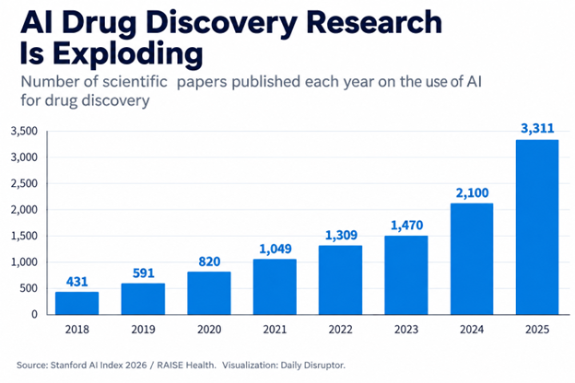
In 2018, researchers published just 431 papers on AI drug discovery. Last year, they published 3,311.
But the right side of the chart is where things really start to accelerate.
Since ChatGPT took the world by storm in late 2022, the number of papers published each year has nearly tripled.
Something is clearly happening here.
And I believe it’s because AI is becoming much more useful for biology.
Researchers are now building AI models that can predict the shape of proteins, design entirely new molecules and even simulate how cells might respond to a drug.
At the same time, the biological data available to train these systems has also exploded.
Stanford reports that some training datasets that once contained hundreds of thousands of biological examples now contain tens of millions. One new dataset contains measurements from more than 100 million individual cells, while another contains more than 9.8 billion genes gathered from genetic material found in the environment.
That gives AI a much bigger map of biology to explore.
And a lot more money is now being poured into that exploration.
According to McKinsey, investment in AI-enabled drug discovery more than doubled from $4.1 billion in 2023 to $8.4 billion in 2025.
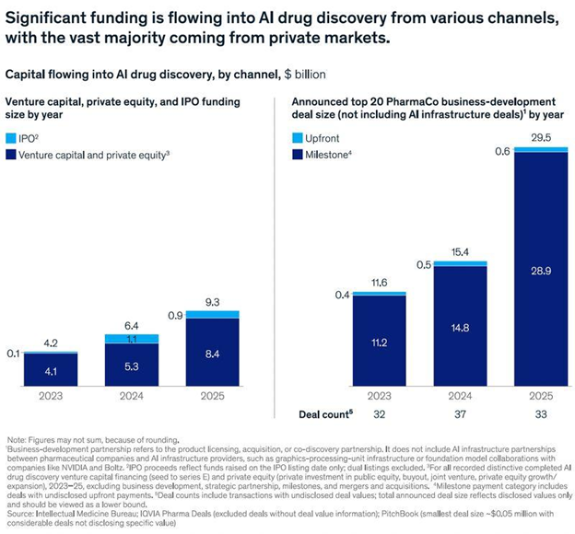
That’s a lot of money chasing the idea that AI can help us discover better drugs faster. But it should pay off in spades if those drugs actually work.
And so far, the signs have been promising.
Historically, about 40% to 60% of drugs entering Phase I clinical trials successfully make it to the next stage. But among drugs discovered with the help of AI, early studies have found Phase I success rates of 80% to 90%.
Now, I want to be careful with those numbers.
The sample of AI drugs is still relatively small. And making it through Phase I doesn’t mean a drug will ultimately reach your medicine cabinet. Phase I is primarily about establishing safety and how a drug behaves in the human body.
But the results haven’t been quite as impressive in Phase II trials, when researchers begin testing whether a drug actually works. There, AI-discovered drugs have performed closer to the historical average.
So it’s far too early to say that AI has solved drug discovery.
But AI-designed drugs are now making their way into laboratories and human clinical trials. And some of the world’s largest pharmaceutical companies are betting that this is where the future of medicine is headed.
Novo Nordisk (NYSE: NVO) is a great example.
The company behind Ozempic and Wegovy has more than 600 AI and digital specialists and over 30 strategic AI partnerships. And this year alone, it has announced major AI collaborations with OpenAI, Anthropic and Amazon (AMZN) aimed in part at accelerating drug discovery.
Meanwhile, AI biotech Iambic Therapeutics just filed to go public. Its most advanced AI-developed cancer drug is already in human trials, and the company has partnerships with some of the world’s largest drugmakers.
In other words, the surge represented on this week’s chart isn’t happening in isolation.
Here’s My Take
I believe we’re only starting to see where all of this could lead now that scientists have a new way to explore biology.
The biggest advantage AI brings to science is that it can search through millions of genes, proteins and molecules far faster than any team of humans ever could.
Of course, most of those searches won’t uncover a new biological system, a potential anti-aging drug or a new way to fight antibiotic-resistant bacteria.
But some will.
And with thousands of researchers now using AI to explore places we barely had time to look before; I believe we’re going to start seeing a lot more discoveries like the ones I shared with you this week.
Comments
Log in or sign up to join the conversation.