

Yesterday, one of the most important figures in the AI revolution did something shocking.
Jensen Huang, the co-founder and longtime CEO of Nvidia (NVDA), resigned amid a growing scandal involving allegations of multiple affairs and Chinese espionage.
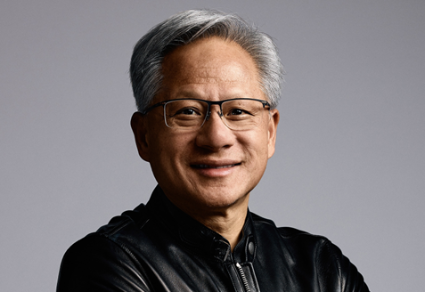
And Wall Street didn’t know what to do with this news.
Nvidia shares initially plunged as investors tried to understand what his departure could mean for the company he spent more than three decades building.
But I believe the consequences could reach far beyond Nvidia’s shareholders.
That’s because Huang transformed Nvidia from a maker of video game graphics chips into the driving force behind today’s AI boom. Yet suddenly, at a critical moment for the industry, the company powering much of the AI revolution is facing its future without him.
So what happens to the AI boom without Jensen Huang?
The answer could have enormous implications for the future of artificial intelligence and the American economy.
The Man Behind the AI Boom
Why is Huang’s departure such a big deal?
Consider how much Nvidia has changed in just a few years.
At the beginning of 2022, the company was worth roughly $300 billion. Earlier this year, its market value approached $6 trillion.
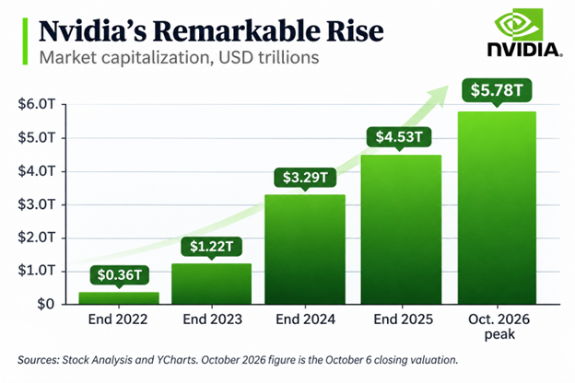
That incredible growth came from Nvidia’s position at the center of the AI revolution.
Companies like Microsoft (MSFT), Google (GOOGL), Amazon (AMZN) and Meta (META) are spending enormous sums building data centers filled with powerful processors. And Nvidia supplies many of the chips that train and run their AI models.
But Huang has also turned the company into one of the biggest financial backers of the AI industry.
Nvidia recently reported approximately $164.5 billion in financial commitments that include investments and agreements supporting AI data centers.
In other words, Nvidia isn’t just selling chips to companies building AI infrastructure. It’s also helping some of those companies pay for it.
This helps them continue to expand while creating more demand for Nvidia’s chips.
But there’s a potential problem with this arrangement.
If Nvidia becomes less willing to finance new projects, some companies could struggle to raise money. That could slow the construction of new data centers, even if demand for AI continues to grow.
Goldman Sachs estimates that annual U.S. spending on AI-related hardware and intellectual property could reach $1.4 trillion by the end of 2027, up from more than $900 billion by the end of this year.
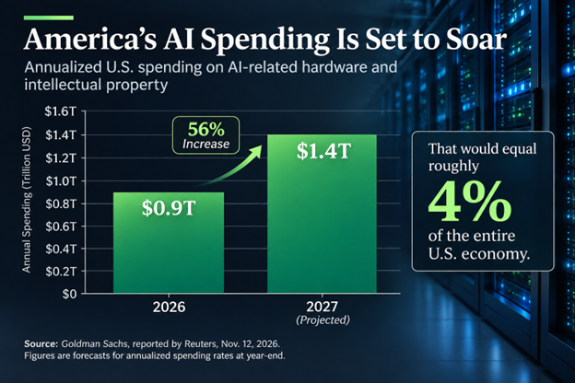
This represents roughly 4% of the entire U.S. economy.
And that money isn’t just going to technology companies.
Building a modern AI data center requires construction workers, electricians, steel, concrete, cooling equipment and enormous amounts of electricity. It also requires transformers, power cables and other equipment.
So when AI companies invest billions of dollars in new infrastructure, that spending supports businesses and jobs throughout the economy.
And if those investments slow down, the effects could spread well beyond Silicon Valley.
That’s why Huang’s departure could have such a big impact.
You see, Huang wasn’t simply running a successful chip company. He was helping coordinate an enormous expansion of America’s computing infrastructure.
Reuters reports that Nvidia’s suppliers in Asia are already wondering whether his successor will be as aggressive about expanding production and investing in new projects.
And as I’ve explained before, this is happening while communities across America are pushing back against new data centers over concerns about electricity costs, water consumption and their impact on local neighborhoods.
Nvidia’s unexpected leadership change is happening just as these challenges are ramping up.
In a seemingly positive move, the company’s longtime chief financial officer, Colette Kress, has stepped in as interim CEO while its board searches for a permanent replacement.

She’s been with Nvidia since 2013 and helped oversee its transformation into an AI powerhouse.
What’s more, Nvidia’s next generation of chips has already been designed, and its customers have already made plans to spend billions of dollars on new data centers equipped with them.
Those orders aren’t going to disappear overnight simply because Huang isn’t the CEO anymore.
And it’s not like he was a cult-of-personality leader like Steve Jobs or Elon Musk.
Still, the longer-term picture is less certain.
Huang had an unusual ability to anticipate where computing technology was headed and convince other companies to invest alongside Nvidia.
Finding someone who can do that just as well won’t be easy.
And with so much of America’s AI expansion tied to Nvidia’s success, that challenge could have consequences for the broader economy.
Here’s My Take
Jensen Huang’s departure won’t end the AI revolution.
Nvidia still has some of the world’s best engineers, an enormous technological advantage and customers willing to spend billions on its products.
And I expect demand for AI computing power will continue to keep growing.
But this week’s events have exposed a risk that investors and policymakers can’t ignore.
America has committed enormous resources to AI infrastructure. And much of that investment depends on a relatively small group of companies.
AI will keep advancing regardless of who leads Nvidia. But the companies financing and building the AI boom could face some difficult adjustments.
That’s why I’ll be watching to see whether Nvidia’s new leadership can maintain the relationships Huang spent years building.
But the circumstances surrounding Huang’s departure raise another concern that I find equally troubling. In fact, it could have enormous consequences for America’s ability to stay ahead in the AI race.
I’ll get into it in our next issue.



Comments
Log in or sign up to join the conversation.