

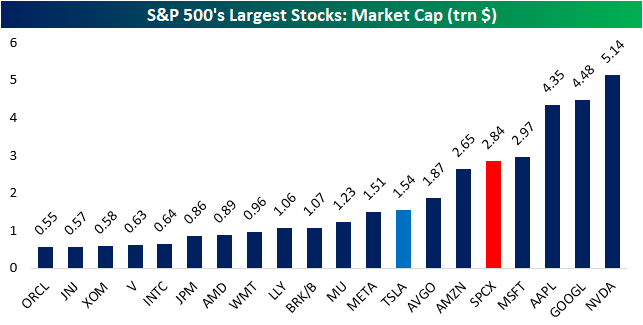
Since its record-breaking IPO last week, SpaceX (SPCX) has been the talk of the town, and understandably so, as the company debuted with a market cap above $1 trillion. As the company trades up another 11.5% as of this writing today, its market cap is now greater than $2.8 trillion. In the chart below, we put SPCX in the mix with the S&P 500's largest companies, or those with market caps above $500 bn; as we have covered in depth previously here and here, SPCX is not yet a member of any major index, and the prospect of it joining the likes of the S&P 500 isn't guaranteed despite the large market cap. Today's move higher puts SPCX ahead of Elon Musk's other company, Tesla (TSLA), by well over one trillion dollars, and it is now passing Amazon (AMZN) to rank as the fifth-largest US company behind Microsoft (MSFT).
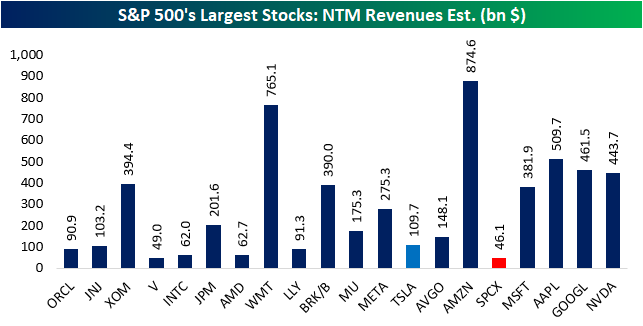
While SPCX has quickly rocketed to become one of the largest companies in the world in terms of market cap, the underlying fundamentals are an entirely different story. As shown below, relative to those other mega-caps, SPCX has miniscule revenue on a blended forward basis. Its $46 bn of estimated NTM revenues are more similar to the likes of Visa (V), which trades with a market cap of $580 bn, and is not even half of what Tesla (TSLA) is estimated to have for the coming year.
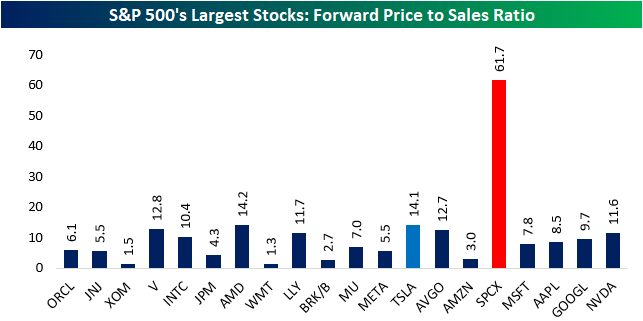
Given this, its valuation on a forward price-to-sales basis is astronomical relative to these mega-cap peers. The stock is trading with a 61.7 forward P/S ratio. That compares to an average P/S ratio for the other mega-caps shown of 7.91.
To expand out the universe of stocks, of the Russell 3,000 members, only 64 stocks have higher P/S ratios than SpaceX, and the two largest of those with market caps of $68.25 bn and $46 bn are Rocket Lab (RKLB) and Strategy (MSTR), respectively. In other words, SpaceX is expensive relative to a wide universe and mega-caps alike.
Of course, equities are inherently forward-looking. And to play devil's advocate to the fact that the valuation is extremely lofty, the company possesses a unique moat of space exploration in addition to having other high-growth avenues of business, namely AI. The other side of the coin of the high valuation is that markets are pricing the potential for substantial growth.


Comments
Log in or sign up to join the conversation.