


Markets are coming back following yesterday’s brutal selloff as cheaper crude sparks Treasury and equity market rebounds. The dip-buying occurs as investors react more favorably to earnings reports of cyclically oriented firms that are benefiting from healthy activity on the heels of Mag7 members Google (GOOGL) and Tesla (TSLA) being punished by Wall Street. Today’s session is emblematic of the rotation that is driving a broadening in stock performance: all sectors are in the green. Indeed, the Dow Jones Industrial is leading the domestic benchmarks while the large-cap tech-heavy Nasdaq 100 is slightly lower driven by sharp losses in semis as analysts consider whether appetites for substantial AI capital expenditures will remain insensitive to elevated costs for compute, memory, data center construction, etc. The economic calendar also supported the Friday recovery, as flash PMIs depicted a surge in services outlays amidst the World Cup matches and the USA’s 250th birthday. New Home Sales, additionally, beat to the upside while builders continued to rely on concessions and discounts to drive closings, a favorable development for an inflation picture that is complicated by burdensome energy charges, business investment buoyancy, tight labor supply, robust consumer spending, budget deficit expansions and to a lesser extent, tariffs.
Returning to trading action, commodities are sinking minus precious metals, which are rallying on relaxed Fed hike wagers after fixed-income watchers realized that they got way too ahead of themselves by seriously considering a lift at next week’s rate decision. The dynamic has yields and the greenback descending as financial conditions loosen. Elsewhere, premiums for volatility protection instruments are softening in light of the risk-on winds, and those offensive attitudes are helping prediction market transactions although cryptocurrencies are tanking.
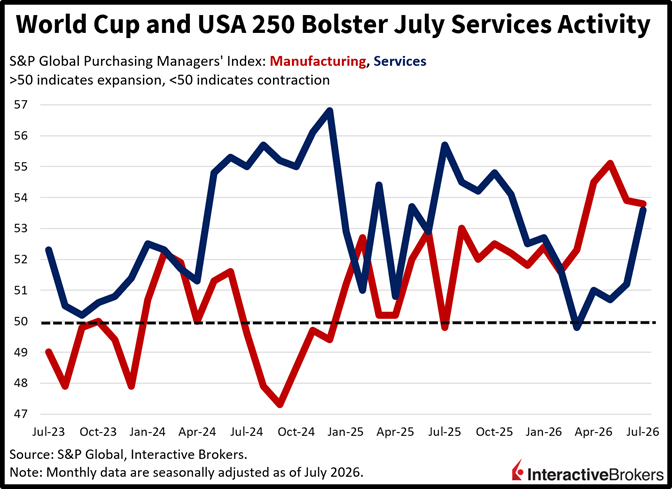
World Cup and USA 250 Bolster July Services Activity
July economic activity in the services sectors expanded at the quickest pace in eight months, as World Cup matches and the USA 250 Independence Day celebration bolstered discretionary spending. Indeed, the S&P Global Purchasing Managers’ Index (PMI) accelerated strongly to 53.6 from 51.2 and blew past expectations of 51.5. Improved demand, hiring and confidence lifted the gauge well ahead of the contraction-expansion threshold of 50, but the growth was accompanied by heavy inflation. Manufacturing was a different story, however, slipping to 53.8 from 53.9 while missing the 54.5 median estimate. Factory outputs and inventories slowed in response to orders softening and deliveries took longer due to Middle East related supply-chain disruption delays. On the bright side, goods producers expanded payrolls.
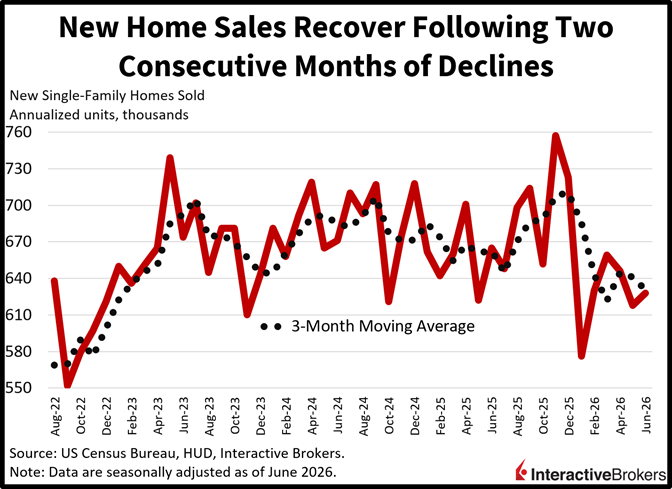
New Home Sales Recover
New home sales recovered last month from four-year lows, rising for the first time since March, but builders continued to face problems moving inventory against the backdrop of elevated valuations and rising mortgage rates. The headline figure of 628k seasonally adjusted annualized units represented a 1.6% month-over-month (m/m) increase while surpassing the estimate of 610k as well as the upwardly revised 618k from May. The South, Northeast and Midwest saw gains of 9.9%, 3.6% and 2.5% m/m, while the West experienced a 22.4% plunge. Listing levels softened from May’s 9.4 months of supply, although only minimally to 9.3. Meanwhile, it’s quite evident that sellers resorted to discounts and concessions to drive transactions, as the average and median sales prices decreased from 412k and 525k to 398k and 475k.
Fed Hike Expectations Became Excessive
Today’s market rebound is being helped by quelled Fed hike expectations following a session in which the fixed-income complex substantially tightened its outlook for the central bank. An increase at next week’s interest rate decision is still possible, as odds stand at 36%, but the disinflationary trajectory is still intact although it’s worsened. Indeed, July’s Consumer Price Index is running at 3.3%, as the first half of the month carried subdued gasoline costs, helping generate a continued deceleration from the 4.2% and 3.5% levels of May and June. The descent is emblematic of inflation that can quickly improve if or when President Trump finds a way to peace in the Middle East, as slow cost momentum in housing valuations and rents continues to offer a glass-half full perspective for monetary policy doves. Furthermore, if you believe like I do that this lift in oil is temporary, then duration is significantly undervalued and picking up longer-term Treasury bonds could benefit portfolios tremendously as animal spirits enter the seasonally week months of August and September. These government debt instruments have several paths to heavy capital gains that include AI prospects disappointing, geopolitical tensions diminishing, Chair Warsh sustaining a hawkish posture that flattens the curve and/or economic data turning south.
International Roundup
Eurozone Business Activity Increases After Three Stagnant Months
Overall business activity in Europe moved into expansion in July with the S&P Global Flash Eurozone PMI Composite moving from the no-change level of 50 to 51.9 and surpassing the economist consensus estimate of 50.3. The print, a five-month high, breaks a three-month streak of no growth. It was supported by broad gains as follows:
The Flash Eurozone Services PMI Business Activity Index climbed from 49.4 to 51.6, which is also a five-month high. Economists anticipated a result of 49.8.
The Flash Eurozone Manufacturing Output PMI Index advanced from 51.7 to a 52-month high of 53.
The Flash Eurozone Manufacturing PMI ascended by 0.6 points to 52, a three-month high and above the economist consensus estimate of 51.5.
A broad uptick in output was supported by a renewed increase in new orders, increased staffing and a slight decline in supply chain disruptions. Manufacturing output growth was the fastest since March 2022. Additionally, Germany, which is the region’s largest economy, experienced business growth for the first time in four months while the ongoing decline in France moderated. More broadly, the rate of decline in export orders for European businesses slowed.
Input inflation for manufacturers was another tailwind, easing to the slowest pace since February while services firms experienced no change in cost pressures. Yet, pre- production inventories expanded after 41 consecutive months of declines.
In another positive development, sentiment for both manufacturing and services strengthened, largely a result of gains in Germany and France that offset a slight reduction among other countries. Confidence, furthermore, was the loftiest in five months but still below levels prior to the Middle East war.
Japan Activity Also Experiences Broad Gains
Business activity growth in Japan hit a five-month high this month with the Flash Japan Composite PMI Output Index jumping from 52.8 to 53.1. July is also the 16th consecutive month of expansion. The gain was driven by manufacturing, with the sector’s output index hitting 56.1 following June’s 54.3 level. The PMI gauges for overall manufacturing and services business activity, however, slipped from 54.8 and 52.2 to 45.7 and 51.9. Despite those metrics sinking, the composite strengthened due to manufacturing production hitting its steepest increase since February 2014. Meanwhile, overall employment rose at an unchanged rate from June but marked 34 consecutive months of payroll expansion. Capacity pressures persisted as illustrated by the strongest backlog accumulation since February, which was an all-time record month. Also in July, orders from overseas improved for goods but continued to weaken for services. Input cost pressures were robust, although the rate of inflation was the slowest since April. Looking ahead, business views weakened in response to uncertainty about the US-Iran war and the conflict’s impact on energy prices.
While Annualized Inflation Picks Up
Japan’s National CPI depicted stickers growing 1.7% y/y in June after May’s 1.5%. When excluding fresh food, the y/y print softened to 1.6%, but extracting both food and energy resulted in the same reading as the headline. Conversely pressures eased on a monthly basis with the index up 0.3%. For May, it posted a 0.4% gain.


Comments
Log in or sign up to join the conversation.