

This Thursday, October 22, is a big day for China’s wealthiest families. It’s the deadline Beijing gave them to declare and pay years of back taxes on money held in offshore trusts without a penalty.
I’ve said many times that government policies are a precursor to change. This particular policy—clamping down on wealth—is playing out in real time, and one of the first places it’s showing up is the luxury market.
Beijing Widens the Net
On July 24, China’s Ministry of Finance and State Taxation Administration announced that putting assets into an offshore trust, and earning income through one, are taxable events. The rate is 20%, and it applies not just when assets go in but also when they earn income and when the trust is wound down. Families have 90 days to settle up on income earned before this year.
Why now? Simply put, local governments in China are short on cash. Land sales, once a major source of revenue, have collapsed along with the property market. Beijing needs money, and the country’s rich have kept a lot of theirs out of reach for years.
Consider that China has no inheritance tax, no gift tax and no real estate tax. Analysts at Barclays and Bank of America expect the net to widen from here, to offshore interest income, property gains and overseas stock. Since May, banks and brokerages in Hong Kong have also been restricting mainland clients from buying stocks overseas.
And it isn’t stopping with billionaires. Frank Chen, a Shanghai-based journalist, was recently informed by tax officials that his funds in the Hong Kong Mandatory Provident Fund (MPF), the city’s compulsory retirement savings program, were being categorized as a “type of offshore trust.”
When the tax bureau starts asking about your pension, you think twice before buying a Hermès Birkin handbag.
Luxury Feels the Squeeze
Chinese shoppers account for roughly a fifth of all luxury purchases worldwide. For nearly two decades, they were the industry’s growth engine.
Luxury brands’ own numbers show a recovery was underway this year despite China’s property slump and slowing economy. LVMH’s sales in Asia outside Japan, adjusted for currency swings, grew 7% in the first quarter and 4% in the second quarter.
Then came the third quarter, when Beijing rolled out its new rules. Sales in the region fell 5%. Mainland China was down by double digits, and Chinese shoppers spent less abroad too.
Alexis Bonhomme, who heads Shanghai-based consultancy Trinity Asia, told Reuters that the 20% levy is now hitting spending by the ultra-wealthy, a group that had held up better than middle-class shoppers.
Jewelry sales point the same way. Retail sales of gold, silver and jewelry in China fell 17.5% year-over-year in August, following a 3.4% dip in June, according to Bloomberg data.
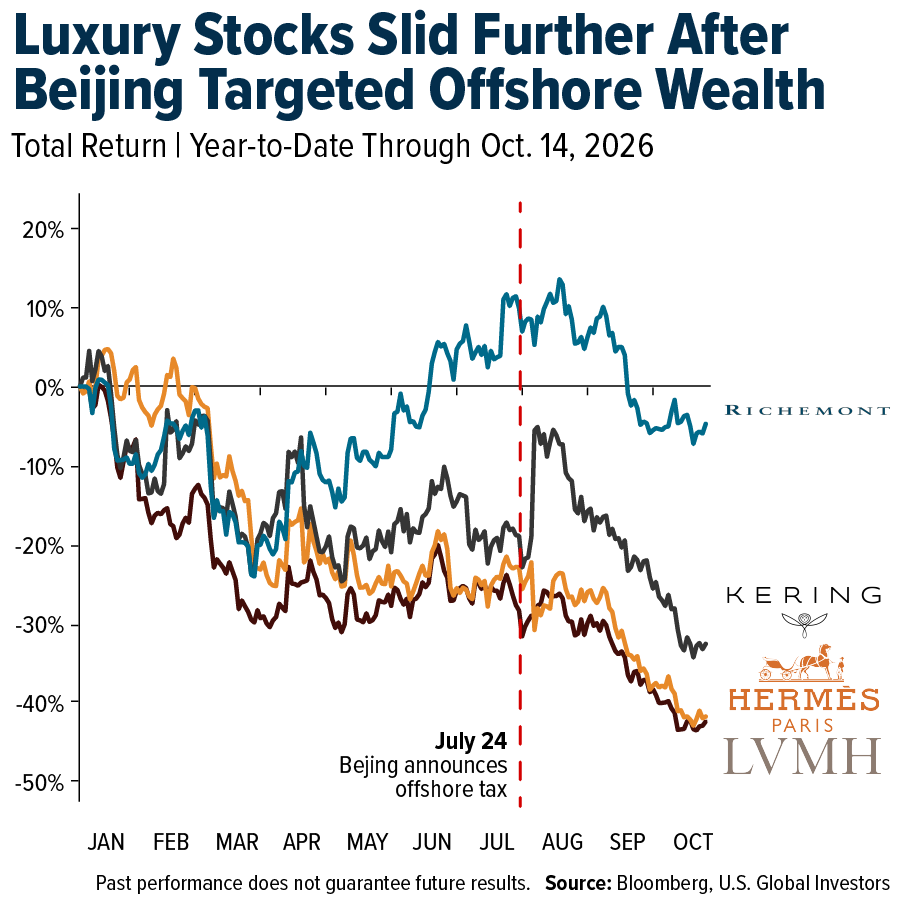
Investors have taken notice. Europe’s luxury groups have lost about €330 billion in market value this year. In dollar terms, LVMH is down nearly 43%, Hermès 42% and Kering 33%. Since Beijing’s July 24 announcement alone, LVMH has fallen 17% and Hermès 23%.
Wealth Gets Portable
Not every corner of luxury is hurting. Richemont, the owner of Cartier, grew sales in Asia outside Japan by 21% in its most recent quarter, adjusting for currency. Swiss watch exports to China rose 16% in August from a year earlier, according to Bloomberg data.
My read on this is that when the taxman comes knocking, wealth looks for things it can carry. A fine watch or a gold necklace holds its value and fits in a pocket.
The money itself is also on the move. Singapore has spent years courting Chinese family offices, but now lawyers, consultants and even lawmakers there are questioning whether the financial hub can continue to attract assets.
The American Version
If you think this is only a China story, look at California.
On November 3, Californians will vote on Proposition 40, a one-time 5% tax on the net worth of roughly 200 individuals and trusts with more than $1 billion in assets. Five percent sounds modest… until you do the math. If a stock portfolio gains 4% in a year, a 5% wealth tax works out to a 125% tax on that gain, as the National Taxpayers Union Foundation has calculated.
Residency is pegged to January 1, 2026, so anyone hoping to avoid the tax had to leave the Golden State last year. Many did!
Backers say the proposition would raise $100 billion, but researchers estimate it would collect closer to $40 billion. And once you count the income taxes lost when billionaires move away, the state comes out about $25 billion behind.
Google (GOOGL) co-founder Sergey Brin has committed more than $100 million to defeating the measure. He told the New York Times that he “fled socialism with [his] family in 1979.” He knows the “devastating, oppressive society it created in the Soviet Union.”
Art Laffer, President Reagan’s economic adviser, was even blunter. He told Fox Business he believes the wealth tax will “destroy California.”
The race is close. One survey found 52% support for Prop 40, while two competing measures designed to cancel it polled at 51% and 54%. A separate measure making the state’s 2012 income tax hike on top earners permanent polled at 58%.
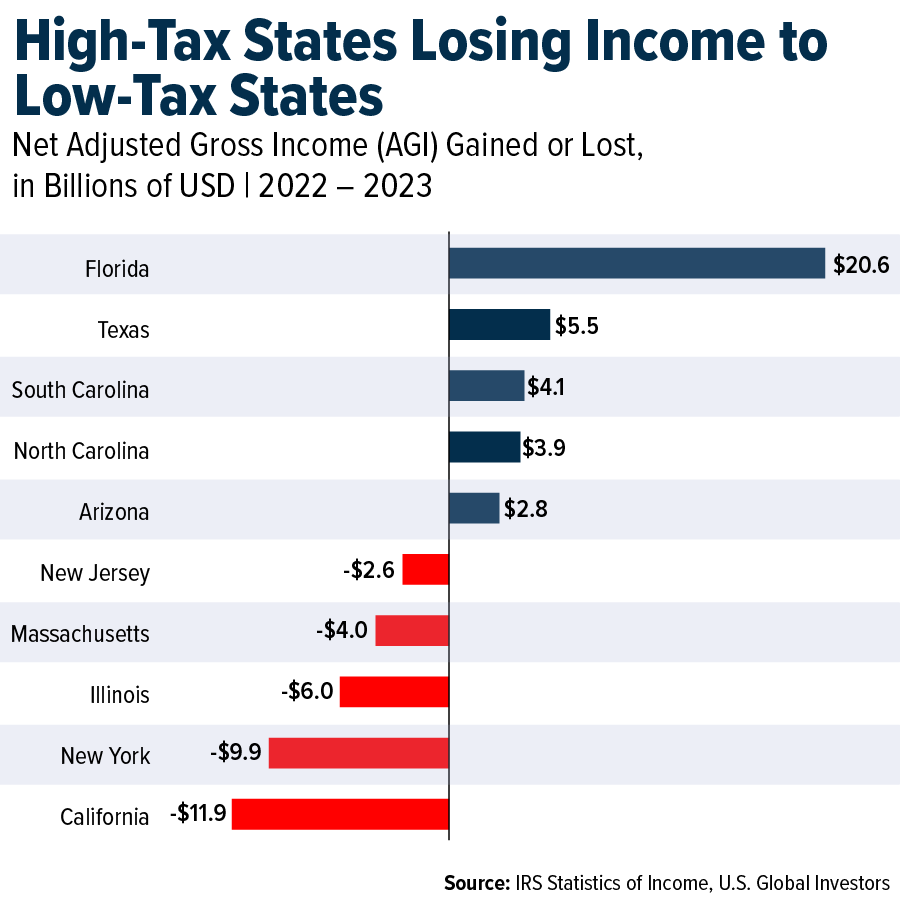
People don’t wait for a vote to make up their minds. IRS migration data show California lost nearly $12 billion in net income to other states between the 2022 and 2023 tax years, and New York lost about $10 billion. Florida, meanwhile, gained over $20 billion.
History’s Verdict
Other countries have tried this and failed. In the 1990s, 12 OECD nations had a wealth tax like the one California is proposing, but today, just four do: Colombia, Norway, Spain and Switzerland. France, Germany, Sweden and others repealed theirs, citing people leaving, high costs and disappointing revenue. Ten years ago, I wrote about Romania, which cut taxes and went on to become one of Europe’s fastest-growing economies.
Capital goes where it’s treated well, and it leaves where it isn’t.
The lesson is that when Beijing or Sacramento goes after wealth, wealth doesn’t sit still. It stops spending or it packs up and leaves. And it pays to follow where it goes.


Comments
Log in or sign up to join the conversation.