

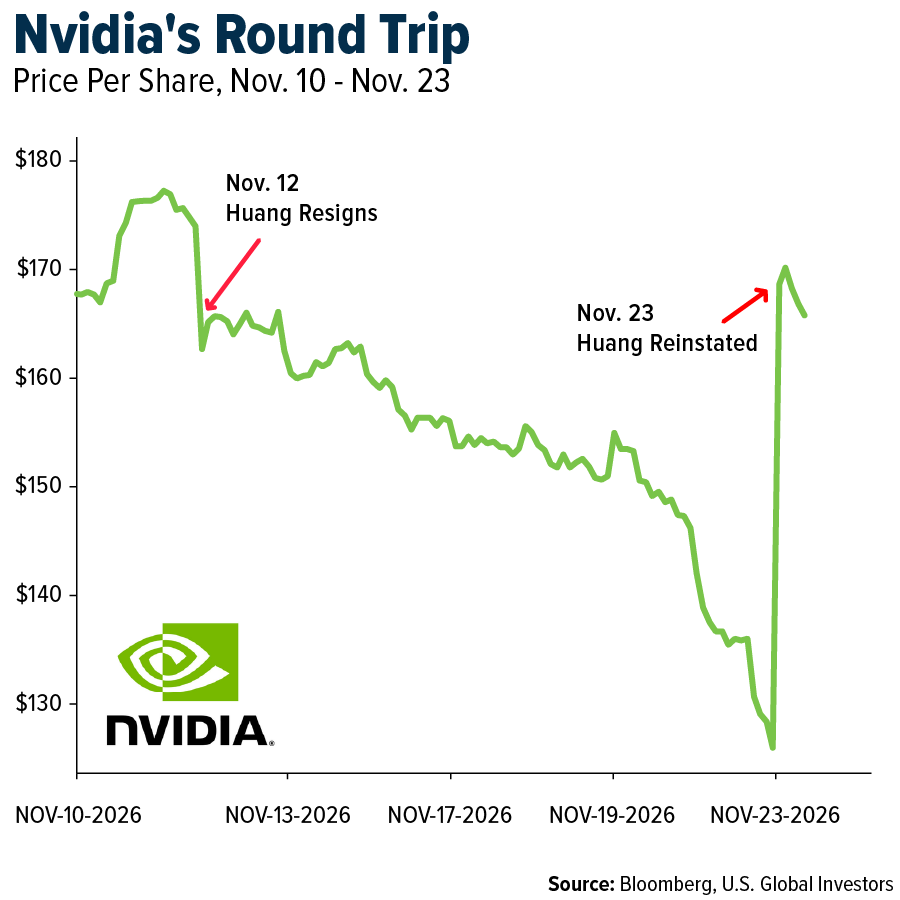
Just 11 days after he resigned, Jensen Huang and his black leather jacket are back running Nvidia (NVDA).
In between, Anthropic (ANT) pulled off the biggest listing on record, the Nasdaq lost more than $4 trillion in market value in a single week and the S&P 500 fell into correction territory.
That’s a lot of history for less than two weeks. Taken together, it reinforces my view that the AI trade has become a national security story.
Nvidia’s Round Trip
Huang stepped down on November 12 after reports linked him to a Chinese businesswoman whom U.S. authorities suspect of spying for Beijing. (Beijing denies it.) On Monday, Nvidia’s board unanimously reinstated him, saying it was satisfied with his candor and his ability to lead and confident that his return poses no national security risk.
The board also created a committee of independent directors to oversee trade compliance and national security risks, and it’s searching for a new chief compliance officer. An independent investigation into whether Huang was the target of a foreign intelligence effort will continue.
Investors were ecstatic, to say the least. Nvidia shares jumped more than 30% Monday morning, recovering most of what they’d lost since the scandal broke. Even so, the stock was still about 4% below its November 11 close, the day before Huang resigned. The Nvidia founder has agreed to testify before the Senate Banking Committee.
Through it all, Nvidia’s business never missed a beat. Revenue reported November 17 more than doubled from a year earlier to a jaw-dropping $115.8 billion.
Anthropic’s Rocky Debut
The maker of the Claude chatbot priced its IPO at $83 a share, above its marketed range of $70 to $78, after drawing orders close to seven times the shares available. Counting a $26 billion private placement, it raised more than $100 billion. Shares opened Thursday at $111.50, 34% above the IPO price, and closed the day at $97.17.
Then the selloff caught up with the stock. Anthropic fell 8.5% on Friday to $88.91, still above its IPO price but well off its highs.
At around $1.18 trillion, Anthropic is still worth more than Walmart or JPMorgan, according to the Wall Street Journal.
The growth is hard to argue with. According to its prospectus, Anthropic took in $33.2 billion in revenue in the first nine months of this year, up from $2.5 billion a year earlier. Its adjusted operating margin swung from negative 221% in early 2025 to positive 15% last quarter. The headline net loss of $104 billion is mostly a noncash accounting charge on convertible notes.
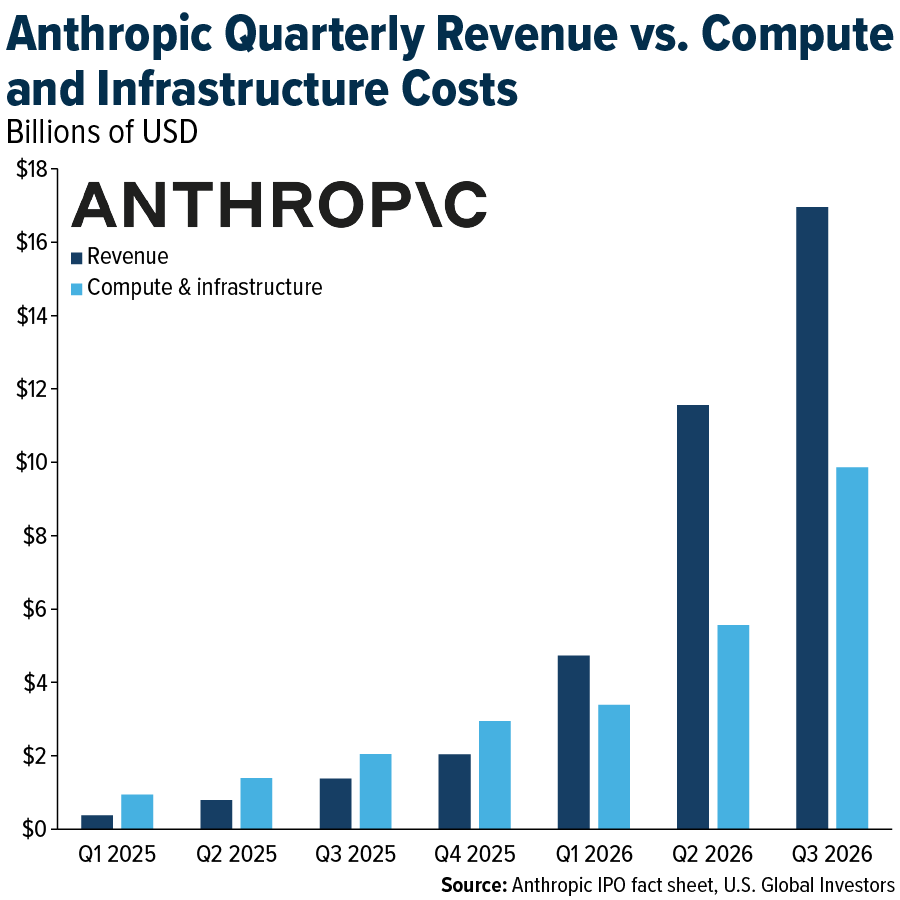
The skeptics have a case too. Research firm New Constructs compares Anthropic to WeWork. Steve Eisman of The Big Short fame pointed out of CNBC that Anthropic’s quarterly revenue growth slowed from roughly 145% to under 50%.
Follow the Money
Whether Anthropic becomes the next Nvidia or the next WeWork, its money is already spoken for. The company has committed roughly $900 billion to computing power and infrastructure. Look at who bought its private placement. Nvidia and Google (GOOGL) put in $10 billion each, followed by AMD, Broadcom (AVGO), Micron (MU), Microsoft (MSFT) and Taiwan Semiconductor. The suppliers, in other words, are investing in their own customer.
Now Anthropic has to borrow, and that may be harder than selling stock. According to the Wall Street Journal, the debt market expects credit-rating firms to rate Anthropic’s bonds as junk. That matters well beyond one company. Nvidia and Broadcom have guaranteed tens of billions of dollars of loans to buyers of their chips, the kind of “circular” financing that has analysts increasingly worried. The chipmakers would like the AI labs to start borrowing on their own.
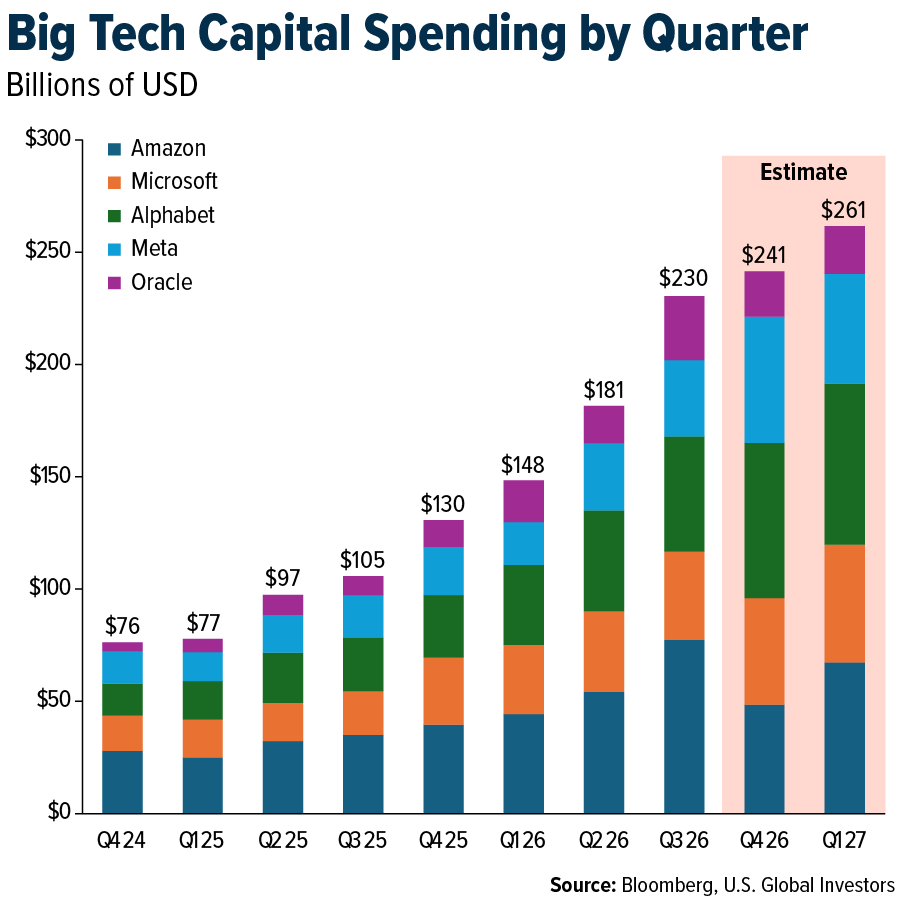
Anthropic is just one buyer of compute. Amazon (AMZN), Microsoft, Alphabet, Meta and Oracle (ORCL) spent $691 billion on capital expenditures over the past four quarters, including $230 billion in the third quarter alone, more than double a year earlier.
Anthropic’s risk factors read like a national security briefing. The prospectus names a military conflict or blockade around Taiwan as a risk, notes that the high-bandwidth memory its AI chips rely on comes from just three suppliers and flags long backlogs for transformers and turbines. It even mentions that Texas can now curtail large data centers during grid emergencies, which hits close to home for us in San Antonio.
Chips Are National Security Now
While Huang has been the industry’s leading voice for keeping access to China, Washington is moving the other way.
Last week, the Commerce Department closed a loophole that let Chinese companies rent American AI chips through overseas data centers. According to Axios, President Trump authorized a crackdown on companies suspected of diverting Nvidia chips to China three times this year while Commerce Secretary Howard Lutnick resisted. Lutnick is now under fire from lawmakers in both parties.
A New York University scholar told the Associated Press that China hawks now have a “story with a name and a face.” Democrats, who take control of Congress in January, have already opened an investigation into Commerce’s approval of Nvidia chip sales to China. Keeping America’s best technology away from Beijing is one of the few things both political parties seem to agree on.
Bet on the Bottlenecks
So what should investors take from all this? I don’t know which AI lab will win, and neither does anyone else. But every lab needs the same things, including advanced chips, memory, electricity and protection from hackers. Those are the bottlenecks, and both parties now treat them as matters of national security.
Last week was a painful reminder that even the best story can get ahead of itself. The S&P 500 fell 8.6%, its worst week since April 2025, and closed in correction territory. The Nasdaq plunged 10%. Monday’s rebound, led by Nvidia, shows how quickly sentiment can swing the other way.
Warren Buffett said it best in 1979: “You pay a very high price in the stock market for a cheery consensus.” The consensus on AI got a lot less cheery last week. For investors focused on the bottlenecks rather than the headlines, that’s worth keeping in mind.


Comments
Log in or sign up to join the conversation.