

The decline in oil prices continues to take its toll on the Canadian economy. In its most recent Economic Statement [1], the Federal government presented estimates of just how damaging the loss of oil revenues has been since 2014. The oil impact has forced the Government to lower its revenue projections, increase the budget deficit and institute a number of fiscal measures to boost growth over the next decade.
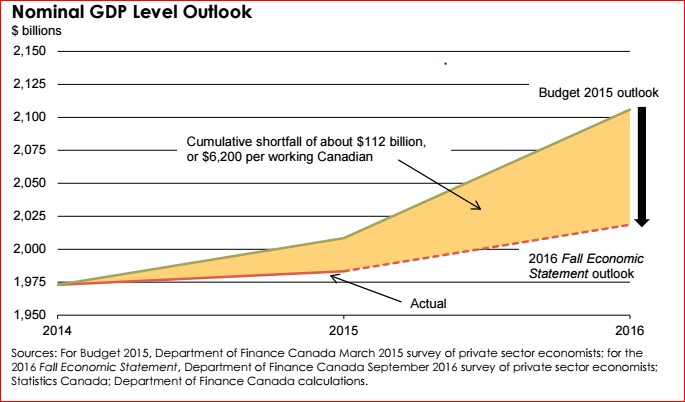
Let’s start by examining the loss of income from the oil price collapse (Chart1). Cumulatively, the loss of output amounts to over C$ 112 billion [2] ( nominal) since 2014 or about C$ 6,200 for every employed person. The projected nominal GDP in the Federal budget outlook is now C$ 75 billion lower than the budget estimates of 2015. Moreover, the projected growth in incomes will be on a much lower path beyond 2016.
Chart 1
In many ways, Canada has a bifurcated economy--- energy vs. non energy—as apparent in Chart 2 which compares the growth in income and employment in Alberta, Saskatchewan and Newfoundland with the rest of Canada.
Chart 2
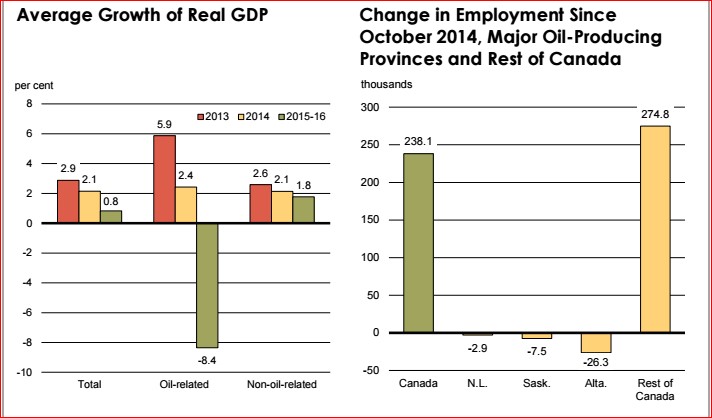
So far, the brunt of income and employment losses have been borne by the energy-producing provinces, while the rest of the country continues to register positive, albeit modest, gains. Nonetheless, it is an economy that continues to be held in check by a weak energy sector.
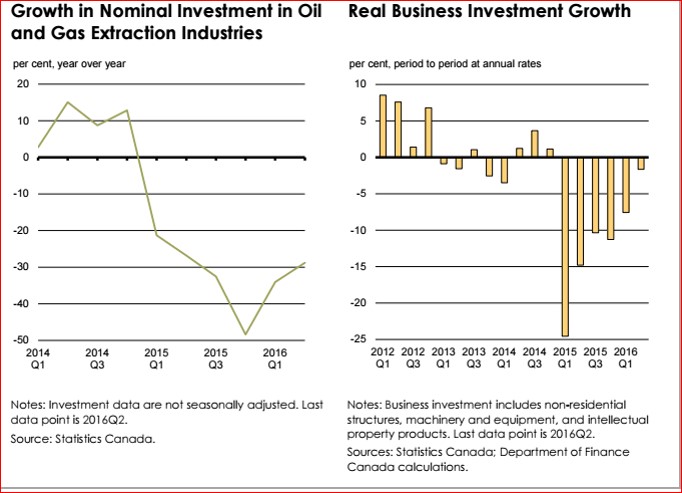
The crux of the matter is that business investment has been on a steady decline even prior to the oil price collapse. No amount of monetary stimulus since has contributed to any resurgence of capital expenditures much to the disappointment of the Bank of Canada and its accommodating monetary policy.
Chart 3
Canada’s current account deficit has widen significantly due to the slump in oil export revenues .Non-energy exports have not been able to make up the slack in energy exports, despite the 30 percent devaluation of the Canadian dollar since 2014. In its most recent policy report, the Bank of Canada [3] continues to place its bets on non-energy exports leading the way to reducing the current account deficit. However, it is widely recognized that high level of manufacturing integration between the Canadian and U.S. economies reduces the effectiveness of a currency devaluation in driving exports. It will take more than the recent devaluation to boost exports.
These altered economic conditions are now affecting the Federal government`s financial outlook.The revised outlook anticipates that nominal GDP will be lower by C$10 billion in 2016 and, subsequently, will widen to C$ 40 billion by 2020.Thus the lower tax base will result in widening Federal government deficits. The budgetary deficits will expand by a total of an additional C$ 12 billion over the next three year. Returning to a balance budget remains far in the future.
[1] Fall Economic Statement,Dept of Finance Canada
[2] USD= 1.33 CDN
[3] Monetary Policy Report, October ,2106



Comments
Log in or sign up to join the conversation.