


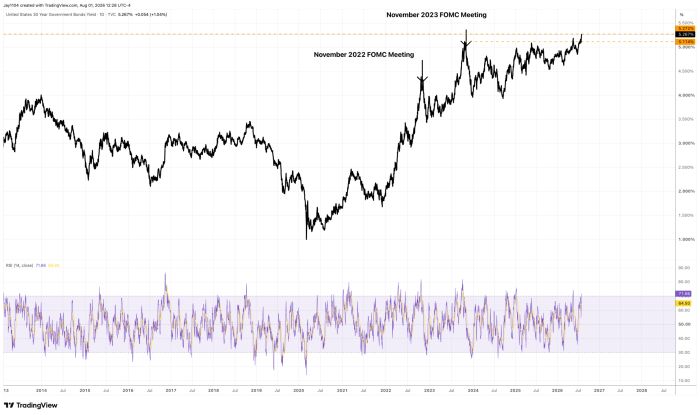
The biggest piece of news this week was the FOMC meeting and the press conference, which didn’t reveal a lot, but revealed enough. The market got a hint of what was being implied, and it resulted in long-end rates rising rather dramatically. The 30-year yield broke out this week, surpassing the 2023 highs, and we’re now looking at levels we haven’t seen since 2008. This region has been an important area of support and resistance historically, and if we were to break out from here, the 30-year could start heading toward the 6% area. We’re already at 5.25%, so 6% doesn’t seem as far-fetched as it did a couple of weeks ago.
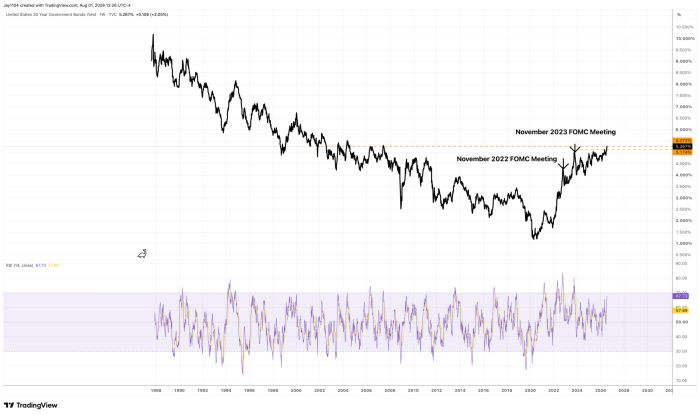
What was really different about this meeting was the absence of pushback. Typically, when long-end rates have risen too much, the Fed has leaned against it. In late 2022, the cumulative effects of tightening financial conditions worked their way into the Fed’s language, giving the bond market the heads-up, and rates came down. The same thing happened in November 2023. This time, Chair Warsh almost applauded the rise, noting that they didn’t have to raise rates because the market raised rates for them. I’ve often thought the reason the Fed hasn’t been able to get back to its 2% mandate is that long-end rates haven’t risen enough, because the long end has far more impact on borrowing costs for consumers and businesses than the overnight rate does.
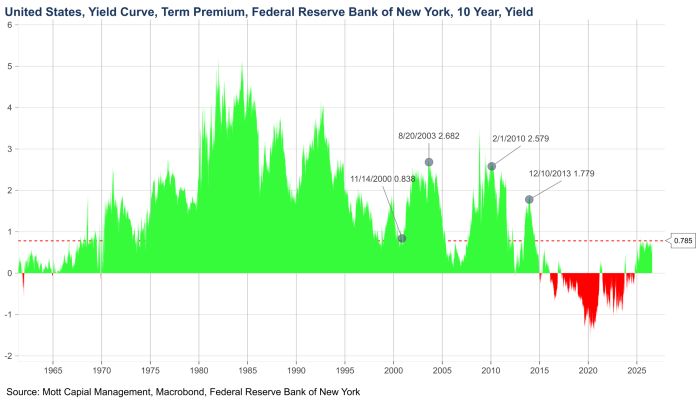
The term premium (the extra compensation investors demand to own longer-dated Treasuries) has also begun to move higher after being stuck around 75 basis points since May 2025. Historically, that is still fairly low, so it’s quite possible investors will continue to demand more compensation for owning Treasuries, which would push rates higher as well. This week also brings the quarterly refunding announcement, which has probably gone a little under the radar. It doesn’t necessarily have a big market impact, but if the Treasury starts shifting issuance away from bills and toward the long end of the curve, that could add another source of upward pressure on rates. There are also still a lot of Treasury bills settling, with roughly another $100 billion this week alone.
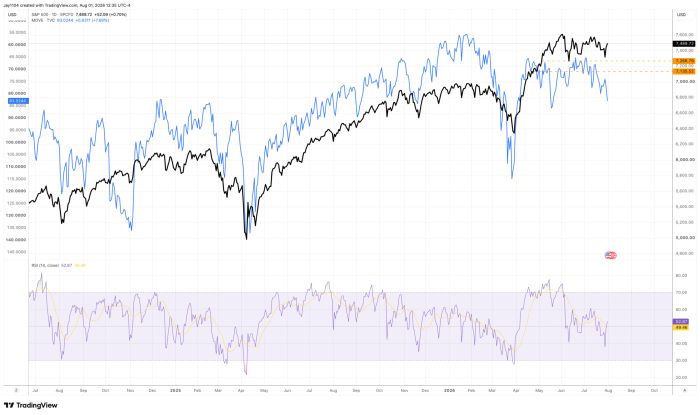
Bond market volatility has started to rise too. The VXTLT, which I find a really useful intraday proxy for the long end since the MOVE index isn’t visible until the end of the day, moved up notably. That matters because implied volatility on bonds and implied volatility on stocks pretty much go hand in hand, and the big move down in equity implied volatility on Thursday and Friday certainly does not match the big move up in the VXTLT. When the MOVE index is rising, stock prices tend to fall, because rising bond volatility can contract multiples and lead to credit spreads widening. If you invert the HYG, it trades right along with bond market volatility, though the VXHYG actually came down a little on Thursday and Friday.
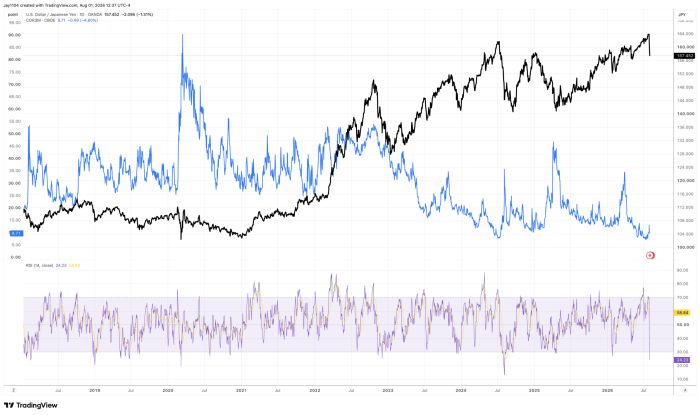
Meanwhile, dispersion has started coming down now that we’re past the heart of earnings season, and as dispersion falls, correlations should rise. When you take dispersion minus the 3-month implied correlation index, you get what I think is a useful proxy for where markets are likely to go, and it could be telling us the move we saw Thursday and Friday may not be for keeps. The recent yen strength matters here too: the USD/JPY and the implied correlation index have been basically mirror images since March 2023, so if the yen keeps strengthening, that could push correlations higher, which we know tends to weigh on equities. The Korean won is worth watching as well, since USD/KRW has traded closely with the semiconductor stocks and the KOSPI, and South Korean money in US markets has grown from around $200 billion to around $800 billion over the last year and a half. If the won continues to strengthen, unhedged holders start losing on the currency side, and that could be another potential headwind over the next couple of weeks.


Comments
Log in or sign up to join the conversation.