

As the Federal Reserve paves the way for future rate hikes, investors in long-dated bonds are moving entirely in the opposite direction. Conventional thinking expects the whole spectrum of the yield curve to march in step with changes in the benchmark interest rate set by central banks. After all, the basic mathematics of the yield curve suggests that the long- term rate is just a succession of short -term rates; the 10 yr rate is an average of 10 consecutive one- year forward rates. This is the theory, but in the real world, it is not that simple.
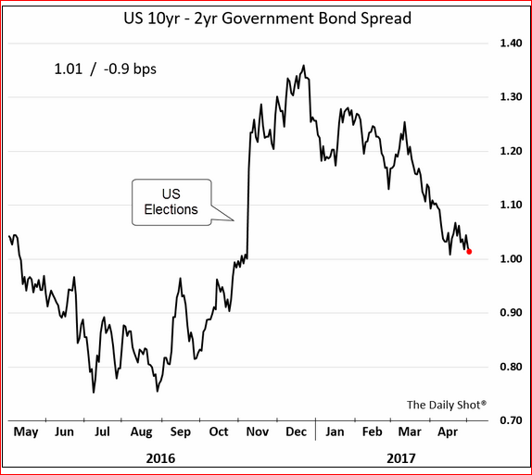
There has been a steady decline in the 10-2yr bond spread since reaching its high point just after the U.S. elections (Chart 1)Just as the Fed is signaling that more rate hikes are in the cards, the 10 yr rates drop further and the curve flattens considerably.
Chart 1 Government Bond Spread
A similar situation occurred under Alan Greenspan’s tenure as Fed Chairman. In 2005 when the Fed raised short-term rates, the long rates actually fell much to the Greenspan’s amazement. As he pointed out `` this development contrasts with most experience, which suggests that, other things being equal, increasing short-term interest rates are normally accompanied by a rise in longer-term yields``[1]. Hence, his famous reference to a `conundrum`. Greenspan did not accept the view that the economy was slowing and inflation abating, citing that “this interpretation does not mesh seamlessly with the rise in stock prices and the narrowing of credit spreads”. Sounds familiar to us today?
The Fed speakers are all sounding upbeat about the prospects for sustained growth and reaching inflation their targets very soon. The stock market continues to remain strong and credit spreads on corporate bonds continue to narrow ; both developments suggest that growth is solid. Yet, the Treasury market does not share this enthusiasm regarding the longer term prospects for growth. That long rates continue to remain very low is not confined just to the United States. Ten-year rates in Germany are 0.3 per cent and in Japan are zero per cent. Investors in these countries have a strong conviction that both low inflation and low real interest rates will continue for many years.
In searching for possible explanations for the drop in long-term rates, Greenspan cites conditions that have been in effect for several years: namely, excess savings, especially from emerging markets, funding the U.S. Treasury market.He points out that “none of this is new ....for the moment the broadly unanticipated behavior of world bond markets remains a conundrum.” It is 12 years since Greenspan made these pronouncements and here we are, again, experiencing the same bond market conditions. How long does something have to be in place before it is no longer an aberration?



Comments
Log in or sign up to join the conversation.