


Economist Lacy Hunt has been a bond bull longer than most money managers have been in the business. Recently, he made a surprising U-turn on his bullish stance. The following paragraph opens his Second Quarter Review and Outlook.
The structural backdrop for U.S. inflation increasingly suggests that the long-run equilibrium range is migrating from roughly1.5–3.5% toward 3.5–4.5%, with a significant risk of episodes of inflation above 5%. An important core reason is the steady erosion of the disinflationary architecture that dominated the 1990–2020 period, even as various cyclical pressures also play a role.
For nearly four decades, Lacy Hunt has been pounding the table for lower yields. As chief economist of Hoisington Investment Management, Hunt bought long-term bonds, betting that globalization and excessive debt impede economic growth, keeping a lid on inflation and interest rates. Despite the extraordinary monetary efforts to stem the 2008 financial crisis, the decade of extremely loose monetary policy following the crisis and even through the pandemic-related surge in the money supply and high inflation, Hunt held his deflationist line.
So, when Lacy Hunt and his partner Van Hoisington posted their Second Quarter Review and Outlook titled “Capital Scarcity and the End of Globalization’s Disinflationary Era,” heads turned. Backing their words with action, Hoisington Investment Management, managed by Hunt and Hoisington, sharply reduced their clients’ bond duration and put the proceeds in Treasury bills.
That reversal of such long-held opinions deserves serious attention. We provide a summary of their new views and some counterpoints to help you assess their new stance.
Our objective in this article is not to support Lacy Hunt or rebut his work, but to present his case and accompanying data to help you better assess his warning.
A Broken Production Function
Lacy Hunt’s basic bond bullish thesis for the last thirty-plus years rested on the core economic framework that economic output is a function of labor, capital, technology, and resources. Thus, anticipating changes to those four factors is paramount to forecasting output and inflation.
Hunt argues that the collapse of the Iron Curtain and China’s entry into global trade, along with economic globalization involving many other countries, introduced “One of the largest positive supply shocks in modern economic history.”
Hundreds of millions of low-cost workers entered the global economy, with manufacturing concentrating in the regions that could do so most cost efficiently. Simply, those countries that could produce at the cheapest costs did so to the benefit of the global economy. From the US perspective, outsourcing production resulted in cheaper goods.
Moreover, with enhanced global trade, global capital flows increased, and resources became more abundant. Further, because of the dollar’s reserve status, steadily increasing global trade boosted demand for US dollars and dollar investments like US Treasury debt.
Deflationary Debt
Hunt claims that the macroeconomic environment of the last 30 to 40 years helped explain why increasing debt levels were disinflationary. Per Hunt:
Diverted income away from consumption, restraining aggregate demand growth, while expanding global productive capacity absorbed liquidity and credit expansion without generating broad pricing pressure.
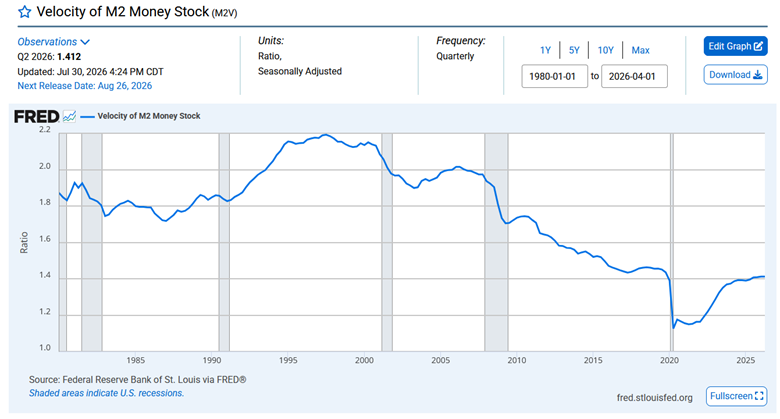
Further to his case, monetary velocity fell. Velocity calculates how often a dollar circulates through the economy. Inflation is a function of the supply of money and, often overlooked, the velocity of money. For the better part of the last 40 years, velocity declined as money was increasingly parked in financial assets rather than investments in plant and equipment or consumption. Corporate executives increasingly favored financial engineering, like stock buybacks, over capital investments. This inflated financial asset prices while doing little for the economy’s underlying productive capacity.
Hunt’s Shift
Hunt’s new stance appears to be predominantly based on three factors.
First, in his opinion, globalization is reversing. Tariffs, reshoring and friendshoring, alongside security-related trade protectionism, replace the “lowest-cost producer” model with a more expensive “secure and resilient producer” model.
Second, labor supply growth is slowing. The combination of lower birth rates, an aging population, and reduced immigration is decreasing the supply of labor, thus raising wage costs. Furthermore, with deglobalization, less outsourcing forces corporations to use more expensive labor domestically.
Third is capital scarcity. AI data centers, electrical grid modernization, and semiconductor fabs are all vying for the same scarce pool of capital, commodities, and skilled labor. At the same time, government deficits require significant capital, and it comes at a time when the national savings rate is near historic lows.
Hunt’s Argument Versus Data
While Hunt makes a very convincing argument, we must analyze recent and historical data to see if the trends he envisions are starting to play out.
Inflation Expectations
The market isn’t buying into Hunt’s inflation forecast. As we share below, the 5-, 10-, and 30-year breakeven inflation rates, as determined by TIPS and nominal Treasury securities, are at the same level they have been for the last four years and not that different from the post-financial crisis era. For context, Hunt is forecasting a 3.5-4.5% equilibrium range, and “episodes above 5%” which he flags as a real risk.
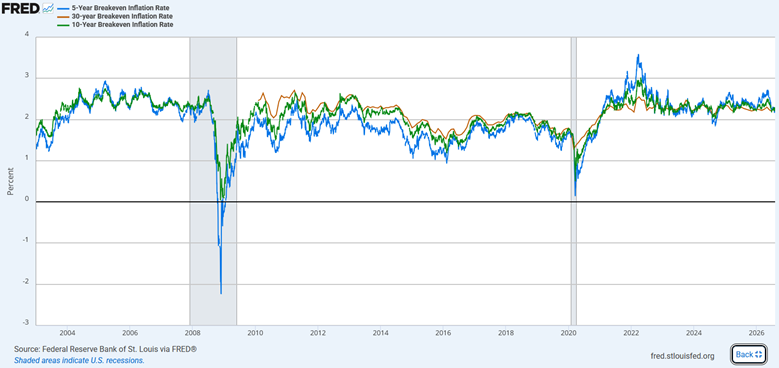
While expected long-term inflation hasn’t budged, long-term real yields have risen appreciably as shown below.
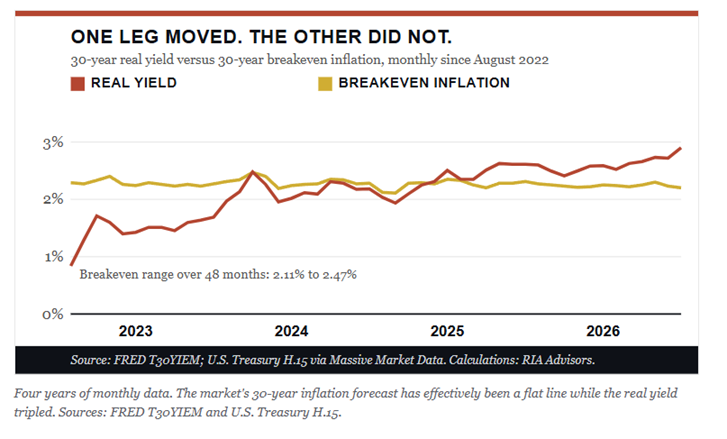
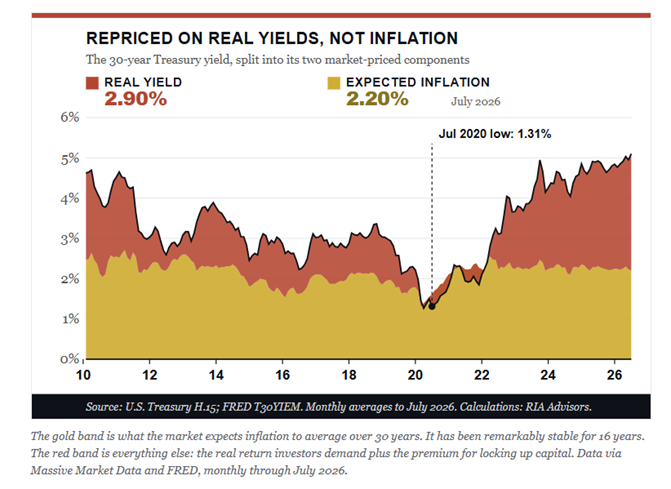
Given that Treasury yields are a function of expected inflation, current inflation, and the term premium, the graphs suggest that the term premium is largely to blame for higher interest rates. Investors are demanding higher yields as they are likely worried about the government’s growing borrowing needs alongside the massive capital being allocated to AI. This feeds into Hunt’s scarcity-of-capital argument, which we discuss next.
Capital Scarcity- Savings Rate
The United States appears to be entering a period in which the demand for capital is rising far faster than the domestic supply of saving.
Debt must be financed by domestic saving, foreign capital, or government intervention like quantitative easing (QE). A low domestic savings rate, shown below, means a greater reliance on the other funding sources. Hunt warns that expanding the money supply via increasing the Fed balance sheet (QE) can help the scarcity problem, but it can also drive inflation higher.
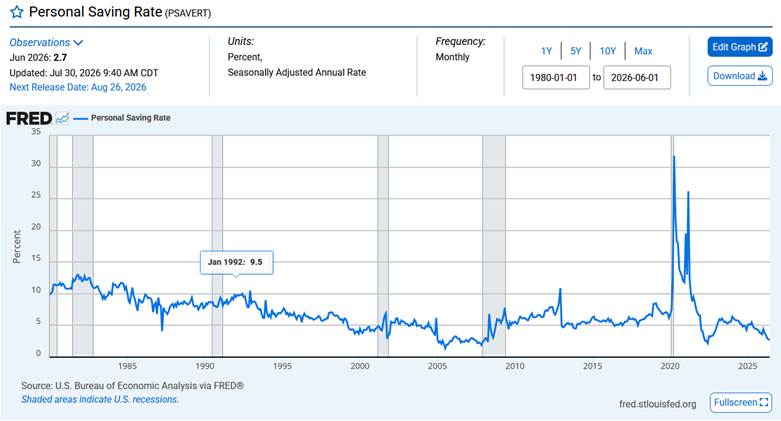
The U.S. has operated with a low net national saving rate for most of the last twenty-five years. This shortfall of an important funding source for US Treasury debt has in part been financed by foreign capital requiring dollar assets and QE at times. Despite the recent bout of higher inflation, poor bond returns, large fiscal deficits, and recent policy actions like tariffs, the international inflow of capital to the US Treasury has continued to grow, offsetting the low saving rate.
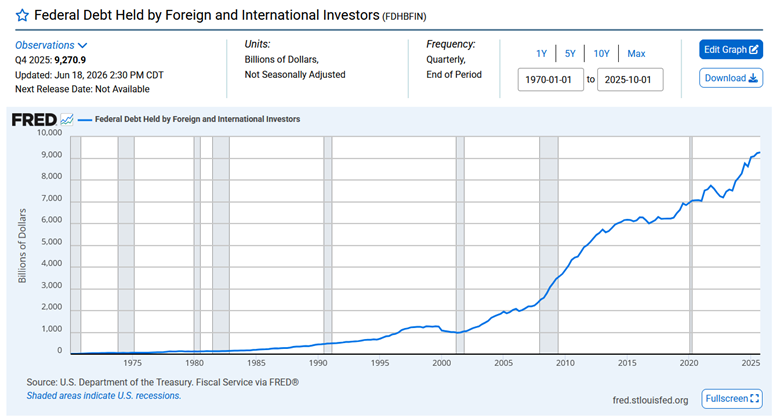
Whether we can continue to depend on foreign investors depends heavily on the dollar’s reserve-currency status, a variable Hunt’s letter doesn’t directly address.
We view the military actions in Venezuela and Iran, as well as some recent trade deals, as viable attempts to strengthen the dollar’s reserve currency status, thus bolstering foreign demand for US debt.
Furthermore, forcing crypto stablecoins to hold US Treasury securities as collateral should provide a multi-trillion-dollar source of new funding for the Treasury.
QE
Hunt mentions QE as another possible source of future deficit funding. He views this as inflationary. To wit, he provides recent evidence:
Substantial liquidity injections occurred from mid-December 2025 through June 2026. In this period, the Federal Reserve purchased approximately $290 billion of Treasury securities, igniting a surge in bank deposits and loans. ODL rose at a torrid 8.9% annualized rate in this year’s first six months—more than 1.6 times faster than its ten-year compounded growth rate… This Fed-driven liquidity event, along with the recovery in velocity, may explain a sharp February reacceleration in inflation prior to the latest geopolitical energy shock.
Hunt assumes that a recent seven-month bout of QE was inflationary. It may have been, but the graph below shows a weak but negative historical correlation between QE and inflation.
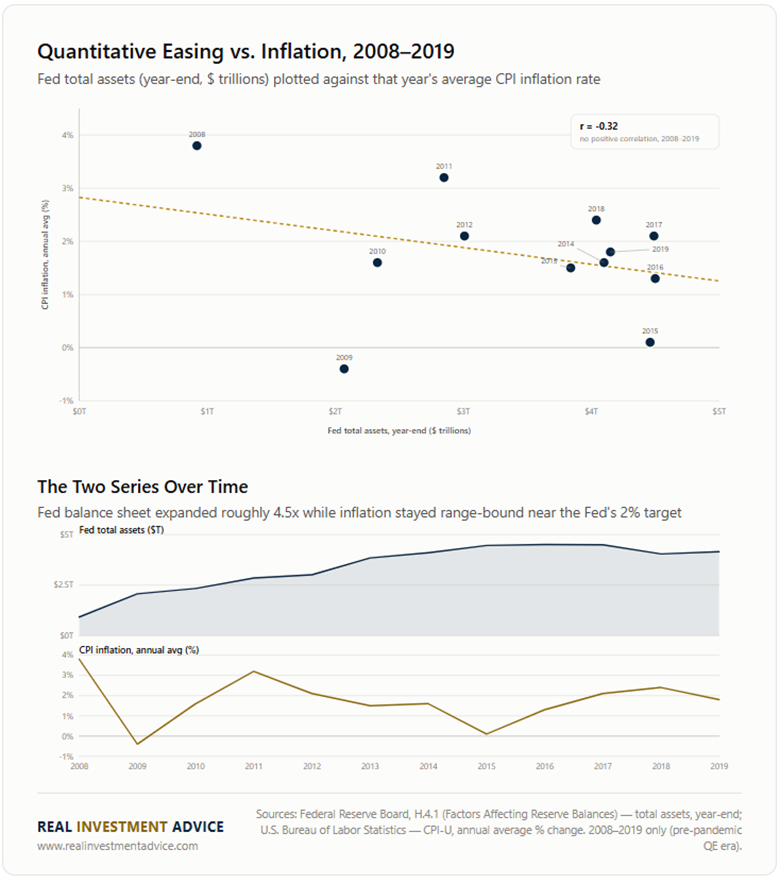
Hunt does concede that QE may not be an inflationary concern. He credits Fed Chair Kevin Warsh’s balance-sheet restraint as “an important monetary offset to fiscal expansion.”
Warsh, a Fed governor from 2006 to 2011, was arguably the Fed’s most consistent skeptic of asset purchases, and after his term ended, he became one of the most vocal outside critics. Warsh as the Fed chair, on its face, is a bet against the QE playbook Hunt says just reignited inflation. Hunt’s 3.5 – 4.5% inflation range may hold water if fiscal and market pressures overwhelm Warsh’s instincts.
Global Trade
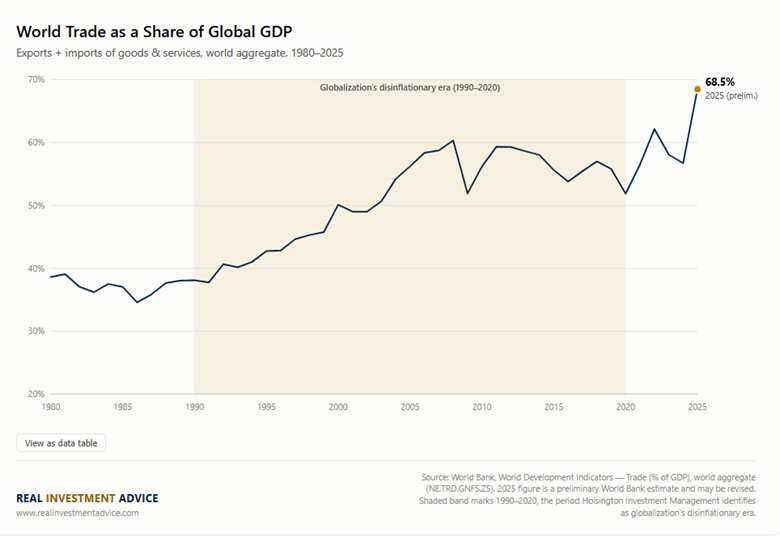
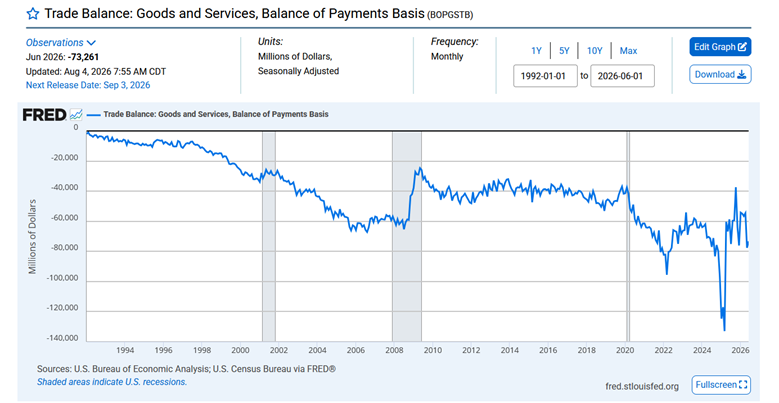
President Trump has imposed tariffs and other protectionist measures on many imported products. He has also incentivized domestic companies to shift production back home. While the actions may appear to have an anti-globalization impact, the data so far tell a different story.
Global trade, exports plus imports relative to world GDP, climbed to an estimated 68.5% in 2025, the highest level in 46 years, per the World Bank. Moreover, despite Trump’s trade policies, 2025’s 68.5% was a big jump from 56.7% in 2024. If tariffs and reshoring were meaningfully unwinding globalization, that ratio would be flat or falling. Similarly, the US trade deficit is bouncing around the same levels as it was under President Biden and worse than any reading before 2020.
AI And Productivity
Moving on to AI and productivity, Hunt rightly blames the capital intensity of building data centers and the resulting upgrades to the electrical grid for making capital scarcer and pushing interest rates higher. However, he gives little weight to the possibility that AI-driven productivity gains show up sooner rather than later and act as a disinflationary force, much as prior technology waves eventually did.
In our opinion, it is unknown when the productivity benefits of AI, including lower inflation, will ease the capital scarcity argument. History shows that the benefits could accrue rapidly or they could take time.
Summary
None of the recent evidence we share indicates Lacy Hunt will be wrong. He is forecasting a regime change to the macroeconomic environment that recent data trends haven’t picked up on.
Hunt also acknowledges his forecast is not necessarily that of higher interest rates. He writes:
The result is not a simple forecast of continuously rising interest rates, but rather a more volatile interest-rate regime.
He notes that a recession, a favorable supply shock, or successful balance-sheet restraint under Chairman Warsh could still deliver lower inflation and falling rates. His Treasury Bill purchases appear to be not just a bet on higher inflation and a sustained high term premium, but equally a desire to avoid volatility in the long end of the curve.
While we have the utmost respect for Lacy Hunt, we must remember that he is making a forecast, an educated guess. His warnings may prove correct. But he is forecasting a big change in the way the global economy operates and its impact on capital flows. Further, he is making assumptions about one of the greatest technological innovations that is just in its infancy.
Might the Covid echo be coming to an end and the historical disinflationary trends of the last forty years be reasserting themselves, or are we in the early innings of the macroeconomic regime change Hunt is calling for?



Comments
Log in or sign up to join the conversation.