

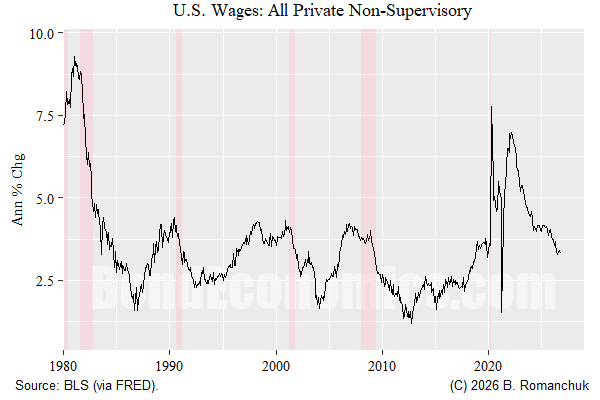
I have not been tracking the data flow too closely recently, as “events” were overshadowing the cycle. However, the oil price shock has subsided, and so we are in a better place to look at the current situation. The economy in the United States has been a two speed affair — broadly growing at a pace that is decelerating, while there has been a mania in AI and data centres (directly affecting a small portion of the population, even though it has a large equity market capitalisation effect).
The chart above shows the growth of average hourly earnings in the United States for non-supervisory employees. It has been in a downtrend since the end of the pandemic wage spike. However, the level of wage growth is still at the high end of the experience of the 1990s and 2000s (when inflation was near “desired” levels). A hawkish central banker would certainly want to see the level of wage inflation to drop further. That said, given that we are already in a downtrend, excessive policy action might not be the best choice.
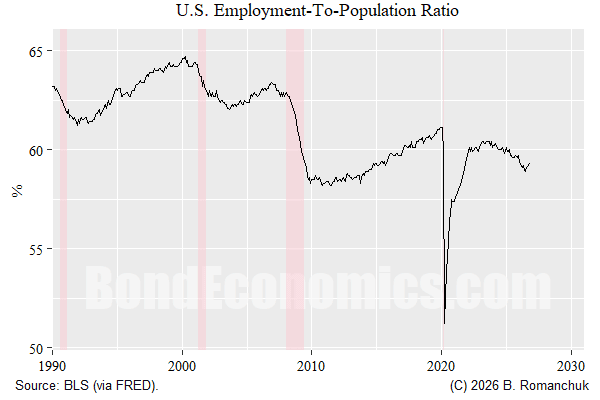
Going back to my favourite labour market indicator — the employment-to-population ratio, we see it is also in a downtrend. One thing to keep in mind with this series is that it is affected by demographic trends. Oldsters drop out of the labour market in higher numbers, so as the weight of the 60+-year old cohort increases, it drags down the ratio. This means that we should not compare the levels across the decades. Nevertheless, the downward trend over the past years is not that encouraging — the usual experience is that the ratio rises during an expansion. The demographic shifts 7-to-8 years ago were not that radically different than now, and the ratio increased. This sluggishness helps explain the deceleration in wage growth.
North of the Border
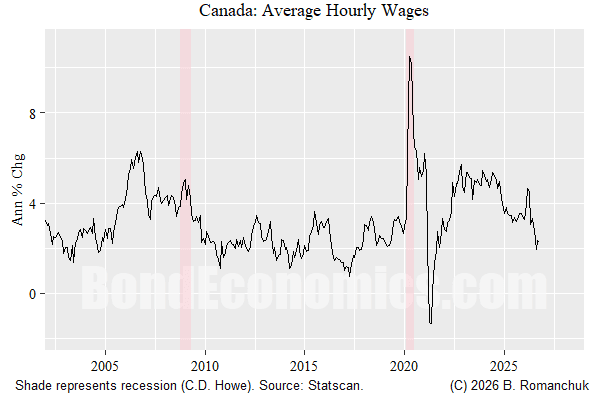
In Canada, the hourly wage series that I found on Statscan (I am not entirely sure whether there are better series, this one has a relatively short history) fits the story that the Canadian economy was wacked by a nasty trade shock. Wage growth has dropped near the middle of the range of the past decades. Barring supply chain issues, it is hard to get excited about Canadian inflation risks.
AI Headlines
There has been a lot of wacky headlines coming out of the graphic chip business in recent days. I stay clear of equity market commentary, so I have nothing to say on corporate governance concerns. The only macro story I see are the risks associated with the financing deals between the chip maker and the chip buyers. The tech industry blew itself apart in the 1990s with vendor financing, and it is very much unclear whether anybody learned anything from that experience.
My argument in the past was that a lot of big AI spenders had clean balance sheets. However, exponential growth in spending will eventually catch up to you, and so we now have some larger issuers with debt that are trading at wider spreads. Since I avoid offering unsolicited investment advice, I cannot comment on whether those debts are “sustainable.”



Comments
Log in or sign up to join the conversation.