


This is an analysis of Korea’s derivatives market around the 3 November 2026 session. The index closes and the VKOSPI reading below are as of that day’s close; the options open-interest and investor-flow figures are as of the 2 November close, the last full book available before the drop.
South Korea’s KOSPI fell 3.59% to 5,648.79 on Tuesday, 3 November, as chip stocks followed the Philadelphia Semiconductor Index lower, Yonhap reported. The large-cap KOSPI 200 dropped about 3.8% to 885.67. Samsung Electronics (005930) lost 4.15% and SK Hynix (000660) 5.03%, while foreign investors sold a net ₩1.5 trillion ($1.12 billion) of KOSPI shares, according to Yonhap’s Korean-language market report.
For US holders of the iShares MSCI South Korea ETF (EWY), Samsung or SK Hynix, or semiconductor exposure tied to the Philadelphia Semiconductor Index (SOX), the index move was the easy part to see. Seoul’s session ran from 7 p.m. on Monday to 1:30 a.m. on Tuesday, New York time. The headline explanation was straightforward: concerns about AI spending weighed on Korean chip stocks.
Korea’s derivatives market provided additional context. Going into the drop, KOSPI 200 call open interest substantially exceeded put open interest, while the implied-volatility gauge, VKOSPI, was already above 53.
What the Options Book Adds
KOSPI 200 options data offers a view beyond the movement in share prices. Open interest (OI) measures outstanding contracts, showing where positions are concentrated across strikes and expirations.
At the 2 November close, outstanding calls substantially outnumbered puts. That does not, by itself, establish bullish positioning: every contract has a buyer and a seller, and calls may form part of covered-call strategies, spreads or hedges.
The Numbers
At the 2 November close, November KOSPI 200 options held 132,160 calls and 60,058 puts of open interest, a put/call OI ratio of 0.45, according to KRX data compiled by the KOSPI Monitor dashboard. Outstanding calls therefore outnumbered puts by more than two to one. SK Hynix’s own single-stock options held about 28 calls for every put on the same date.
Four levels stand out:
Largest call OI concentration at 1,000. The largest call open interest at a single strike, 7,425 contracts, sat at 1,000. That was about 8.6% above the 2 November spot level of 920.63 and about 12.9% above the 3 November close.
Calculated max pain at 940. This is the theoretical expiry level that minimizes the aggregate intrinsic payout on the outstanding options included in the calculation, excluding premiums paid. It stood about 6.1% above the 3 November close.
Previously at-the-money strike at 920. This strike was approximately at the money on 2 November and stood about 3.9% above spot after Tuesday’s decline.
Largest put OI concentration at 750. The largest put open interest across the full chain, 5,968 contracts, sat about 15.3% below the 3 November close.
These are open-interest reference points, not established support, resistance or forecasts of where the index will settle.
The flow data adds another perspective. KRX investor figures for 2 November show foreign investors as net buyers of call premium—about ₩3.5 billion ($2.61 million)—and net sellers of puts. Institutions were net sellers of call premium in roughly the same amount.
Foreign investors’ net call-premium buying on Monday contrasted with their net share selling on Tuesday. However, these aggregate figures may reflect different investors and strategies, including hedges, rather than the same traders reversing their outlook.
The front December KOSPI 200 futures contract closed at 885.15, a small discount to the underlying index, according to a KRX price table carried by Yonhap Infomax. That discount alone does not establish the degree of stress in the market.
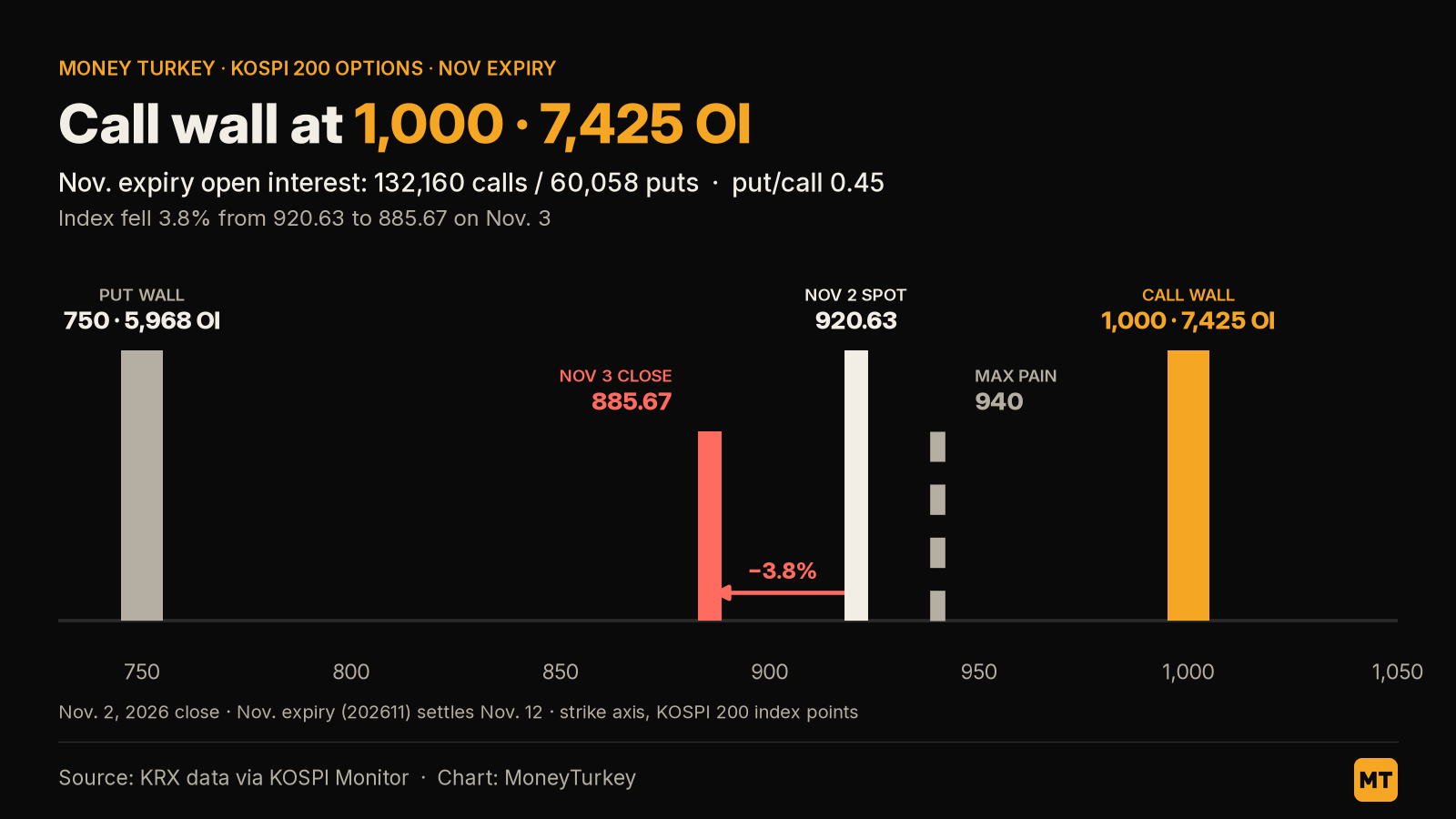
Source: KRX data via KOSPI Monitor; MoneyTurkey chart.
“Call wall” and “put wall” identify the largest open-interest concentrations shown. These levels and calculated “max pain” do not establish support, resistance or a likely expiry price.
The Volatility Read
VKOSPI, the KRX implied-volatility index for the KOSPI 200 and Korea’s counterpart to the VIX, closed at 53.34 on 2 November, above its 50-day average of 47.52. The 3 November reading, published with a one-day lag by Korea Fear & Greed, came in at 54.08, up just 0.74 points, with the 50-day average at 47.39.
Implied volatility rose only modestly alongside the approximately 3.8% index decline, from an already elevated level. This indicates that options were pricing substantial volatility before the sell-off, although the small daily increase does not establish how surprised individual traders were.
For US investors accustomed to lower VIX readings, the distinction matters: a high implied-volatility level and a small daily change can coexist. The level describes the magnitude of volatility priced into options; the daily change describes how that pricing shifted.
Why It Matters for EWY, Samsung, SK Hynix and SOX
Samsung and SK Hynix carry substantial weights in both the KOSPI 200 and EWY, making Korea’s index derivatives relevant to investors following the memory-chip trade. However, index options also reflect exposure to other sectors and broader market risks; they are not a pure measure of semiconductor sentiment.
Tuesday’s decline followed a sharp sell-off in US chips. The SOX fell 3.4% on Monday after a 7.2% drop on Friday, and the Korean names followed overnight.
The call-heavy options book and foreign net call-premium buying provide context for the sell-off, but do not establish that bullish bets on Korean chips were crowded. For investors assessing EWY or US semiconductor shares, the Korean data offers an additional perspective on market conditions rather than a standalone directional signal.
Takeaway
Before the KOSPI 200 fell about 3.8% on 3 November, call open interest exceeded put open interest and VKOSPI was already above 53. Implied volatility rose only modestly during the decline.
Together, these figures describe an options market already pricing large swings, without establishing the direction of investors’ overall exposure.
The 3 November Snapshot
This analysis stops at the 3 November 2026 close. Subsequent open-interest changes—including whether November calls were cut after the drop or puts accumulated at the 850–900 strikes—are outside the scope of this snapshot.
Under KRX rules, the monthly November KOSPI 200 options expire on the second Thursday of the contract month, 12 November 2026. They are European-style and cash-settled.
At Tuesday’s close, the index sat below the calculated 940 max-pain level and the largest call OI concentration at 1,000. Those were options reference levels visible in the data available for this snapshot, not predictions of an expiry recovery.
FX note: Dollar figures use ₩1,341 per US dollar, the Seoul close on 3 November reported by Yonhap.
Comments
Log in or sign up to join the conversation.