


Market prices are as of the 20 November 2026 close unless stated otherwise.
On Friday, Nvidia (NVDA) closed at $125.53. That's below the $142.62 it closed at on 24 January 2025, the session before DeepSeek's cheap model knocked 17% off the stock in a single day. Nearly two years of AI enthusiasm later, the market's favorite AI supplier trades below where it stood before the first scare.
Part of that is Nvidia's own trouble. Jensen Huang resigned on 12 November, and on Friday Reuters reported that SEC enforcement staff are examining potential accounting issues at the company. The slide started before either story, though, and it isn't only Nvidia. The PHLX Semiconductor Index (SOX) closed at 8,408.59, about 43% below its 22 June record close of 14,634.72, and the Nasdaq Composite fell 5.3% on the day.
One number keeps popping up. US investment in information-processing equipment and software reached 5.35% of GDP in the third quarter of 2026. The dot-com peak was 4.46%, in the fourth quarter of 2000.
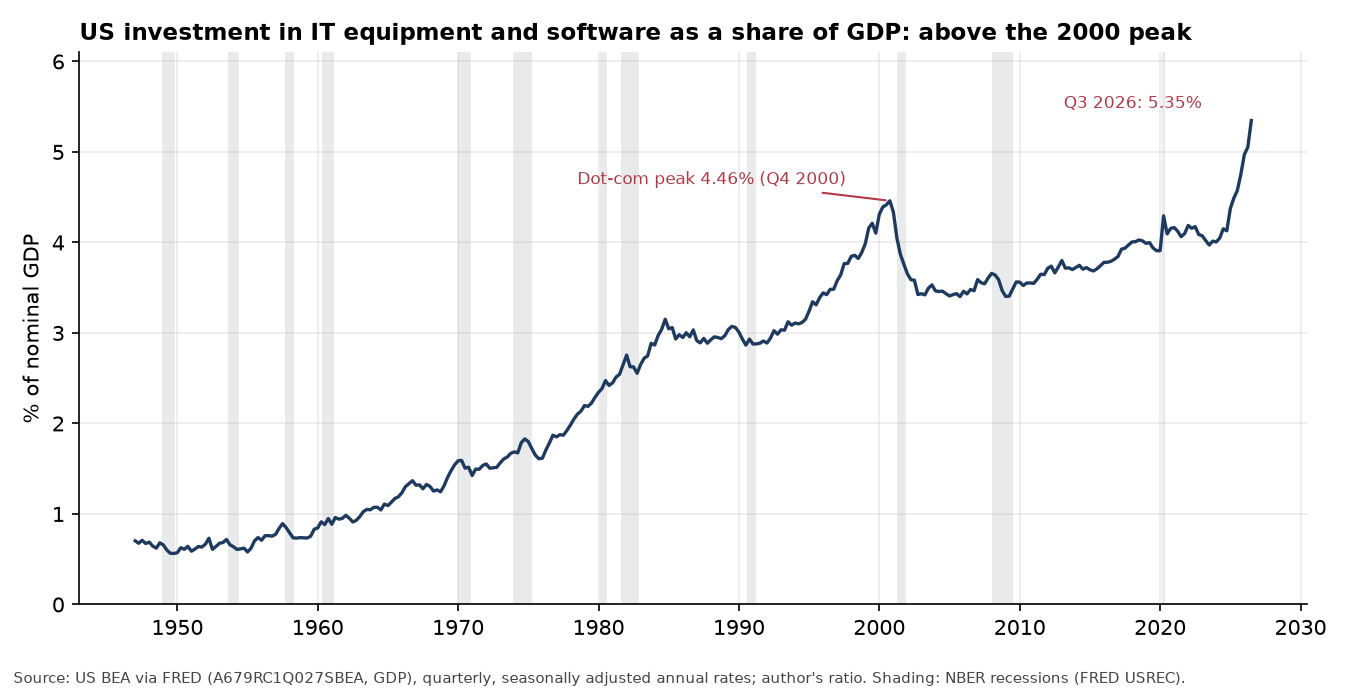
US private investment in information-processing equipment and software as a share of nominal GDP, 1947 to Q3 2026. Shading marks NBER recessions. The BEA category covers all IT spending, not only AI.
Source: US BEA via FRED; author's ratio; MoneyTurkey chart.
MoneyTurkey's longer study goes back through seven earlier technology booms to see what followed spending peaks like this one. Here are the parts that matter most for AI.
The Railways Won. Many Backers Didn't.
In 1847 Britain put roughly 7% of its GDP into railways, and the men building the lines numbered about twice the British Army. The railways became the backbone of the economy. The boom still ended in a bust.
America repeated it on a bigger scale. In 1893 alone, more than 27,000 miles of US railroad went into receivership. Yet in 1900 railroads still made up 63% of US stock-market value.
A technology can change the world and still be a poor investment for the people who paid for the build-out. Easy to say. Much harder to act on mid-boom.
Fiber Is The Closer Match
The late-1990s telecom build-out is the most uncomfortable parallel. In the five years after the Telecommunications Act of 1996, carriers put more than $500 billion into fiber, switches and wireless networks. No more than 2% of North American long-distance capacity was in use. Shareholders lost roughly $2 trillion, and about half a million telecom workers lost their jobs.
The product didn't fail. It got cheap. IP transit fell from $1,200 per Mbps a month in 1998 to $0.63 in 2015. Users won outright. The Nasdaq Telecommunications Index fell 92% from February 2000 to September 2002 and is still less than half its 2000 peak. US operating-company IPOs went from 476 in 1999 to 66 in 2002.
The Same Shape, Again And Again
The other cycles rhyme. America had 272 car makers in 1909 and nine by 1941. US airlines filed for bankruptcy 198 times between 1979 and 2016, by their industry body's unofficial count, while real domestic fares fell by nearly half. McKinsey concluded that memory-chip makers "were not able to create economic value between 1996 and 2012." Nokia (NOK) had 49.4% of world smartphone sales in 2007, and six years later Microsoft bought its phone business.
The likelier reading, and it is a judgment rather than a law: the damage for investors tended to come after the peak in capital spending, not the peak in the technology. In MoneyTurkey's study of these cycles, the sector indexes and fallen leaders dropped between 70% and 98% from peak to trough, and several never regained their highs.
Where AI Sits Now
Prices are already collapsing. OpenAI launched GPT-4 in March 2023 at $30 per million input tokens. GPT-5, a far more capable model, launched in August 2025 at $1.25. Epoch AI estimates that the cost of reaching a fixed level of model performance has been falling between 9 and 900 times a year, depending on the benchmark.
For now the supplier still keeps the margin. On 17 November Nvidia reported record quarterly revenue of $115.8 billion, $107.6 billion of it from data centers, at a 74.8% GAAP gross margin. The stock fell anyway.
The buyers are stretching to pay for it. Amazon (AMZN), Alphabet (GOOGL), Microsoft (MSFT) and Meta Platforms (META) guided to roughly $720 billion to $740 billion of combined 2026 capital spending after their October results, and Fortune reports that four of the five biggest AI spenders had negative free cash flow in the third quarter. Alphabet alone reported negative free cash flow of $9.1 billion for the quarter. Some of the money is now borrowed or raised. Microsoft priced $25 billion of senior notes on 29 October, and Meta launched $37.5 billion of underwritten stock offerings on 26 October.
The shakeout has started quietly. Big platforms have absorbed start-ups through license-and-hire deals rather than letting them fail: Microsoft with Inflection, Google with Character.AI and Windsurf, Meta with its 49% stake in Scale AI. Seed rounds fell 27% year on year in the third quarter.
The Index Problem
Each era's new technology ended up dominating its home market. Railroads were 63% of US stock-market value in 1900. Information technology was about 33% of the S&P 500 in March 2000. The Magnificent Seven made up 34.9% of the S&P 500 at the end of 2025, and CME Group puts information technology at roughly 39% in mid-2026.
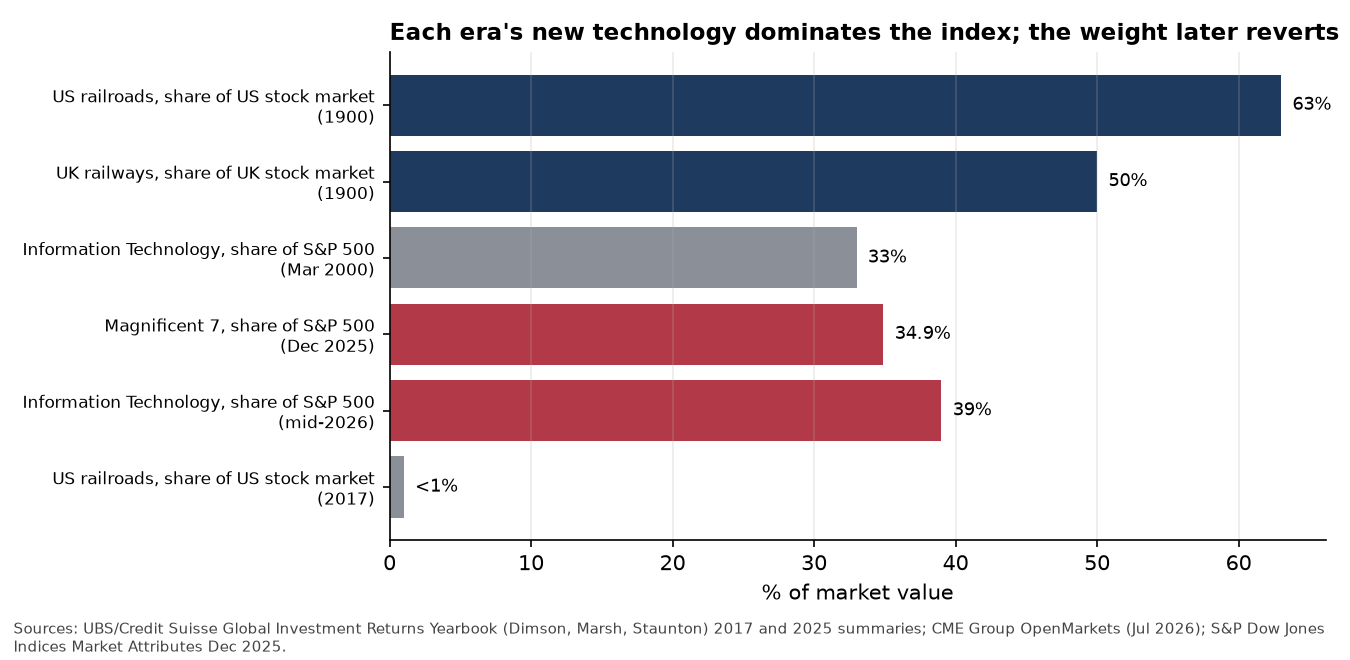
Peak weights of each era's leading technology in its home market index, compared with US railroads in 2017.
Source: UBS/Credit Suisse Global Investment Returns Yearbooks; CME Group; S&P Dow Jones Indices; MoneyTurkey chart.
Each earlier time, that weight later came down. A cap-weighted index fund holds that concentration by design.
What Could Be Different
AI doesn't have to follow the script exactly. Railways and telecom were built largely by leveraged newcomers. Today's biggest spenders are some of the most profitable companies in history and still fund most of their capex from operating cash flow, though that cushion is thinning. That could make any shakeout slower and shallower at the top of the index, and harsher among debt-funded neoclouds and single-product start-ups. Gartner (IT), for one, forecasts that 80% of neocloud companies will have been absorbed or will have shut down by 2030. That's a forecast, not an outcome.
What’s to Watch
A 43% fall in the chip index is a deep correction. It isn't 2000 to 2002 yet, when the SOX fell 80% and took 17.6 years to regain its peak.
The indicator most worth watching is the dull one: IT investment as a share of GDP in the BEA's quarterly figures. In 2000 that line turned before most people called it a bust. If it rolls over while hyperscalers keep borrowing to fund capex, the history above starts to look a lot less academic.
Railways and fiber both got built, and both became cheap for the people who used them. AI is clearly working. What nobody knows yet is who gets to keep the money.
A longer version of this analysis, with all seven cycles and the full data, first appeared on MoneyTurkey.com.
Sources
Nvidia closes of $125.53 (20 Nov 2026) and $142.62 (24 Jan 2025), and its 17% one-day fall on 27 Jan 2025: Yahoo Finance, NVDA price history ; Reuters, "China's DeepSeek sets off AI market rout," 27 Jan 2025.
Jensen Huang's resignation on 12 Nov 2026: CNBC, 20 Nov 2026.
SEC enforcement staff examining potential accounting issues at Nvidia: Reuters, 20 Nov 2026.
SOX close of 8,408.59, the 22 June record close of 14,634.72 and the 43% drop from it; the Nasdaq Composite's 5.3% daily fall: Yahoo Finance index history, and author's calculations.
IT investment at 5.35% of GDP in Q3 2026 and 4.46% in Q4 2000: US BEA via FRED, series A679RC1Q027SBEA, and GDP (author's ratio)
British railway investment of roughly 7% of GDP in 1847: Andrew Odlyzko, University of Minnesota, 2010, https://www-users.cse.umn.edu/~odlyzko/doc/hallucinations.pdf
Railway construction workforce about twice the size of the British Army: Andrew Odlyzko.
More than 27,000 miles of US railroad in receivership in 1893: Stuart Daggett, Railroad Reorganization (1908).
Railroads at 63% of US stock-market value in 1900: UBS Global Investment Returns Yearbook 2025 (summary).
Telecom capex of more than $500 billion, under 2% of long-distance capacity in use, roughly $2 trillion of shareholder losses and about half a million jobs lost: Robert E. Litan, "The Telecommunications Crash: What To Do Now," Brookings, Dec 2002.
IP transit price of $1,200 per Mbps a month (1998) and $0.63 (2015): DrPeering.
Nasdaq Telecommunications Index fall of 92% (Feb 2000 to Sep 2002), and still under half its 2000 peak: Yahoo Finance, ^IXTC history (author's calculations).
US operating-company IPOs: 476 in 1999 and 66 in 2002: Jay R. Ritter, University of Florida, IPO Statistics.
272 US car makers in 1909 and nine by 1941: Steven Klepper, NBER, 2009.
198 US airline bankruptcy filings, 1979 to 2016: Airlines for America, unofficial compilation (archived 28 May 2016).
Real domestic airfares down nearly 50% since deregulation: Airlines for America, June 2024.
Memory makers "were not able to create economic value between 1996 and 2012": McKinsey, "Memory: Are challenges ahead?", 2016.
Nokia's 49.4% of world smartphone sales in 2007: Gartner, 11 March 2009.
Microsoft's purchase of Nokia's phone business in 2013: The New York Times, 3 Sep 2013.
Peak-to-trough falls of 70% to 98% for the sector indexes and fallen leaders, several never recovering: MoneyTurkey data page, (author's calculations from Yahoo Finance and Kenneth R. French Data Library data)
GPT-4 at $30 per million input tokens (March 2023): OpenAI.
GPT-5 at $1.25 per million input tokens (August 2025): OpenAI.
Fixed-capability model costs falling 9 to 900 times a year: Epoch AI.
Nvidia Q3 fiscal 2027 revenue of $115.8 billion, data-center revenue of $107.6 billion and a 74.8% GAAP gross margin: Nvidia, 17 Nov 2026.
2026 capex guidance of roughly $720 billion to $740 billion for the four hyperscalers, and four of the five top spenders with negative Q3 free cash flow: Fortune, 31 Oct 2026.
Alphabet's negative Q3 2026 free cash flow of $9.1 billion: Alphabet Q3 2026 earnings release, SEC EDGAR.
Microsoft's $25 billion of senior notes priced on 29 Oct 2026: Microsoft prospectus supplement, SEC EDGAR.
Meta's $37.5 billion of underwritten stock offerings, launched 26 Oct 2026: Meta free-writing prospectus, SEC EDGAR.
License-and-hire deals (Inflection, Character.AI, Windsurf, the 49% stake in Scale AI): CNBC, 19 Aug 2025.
Seed rounds down 27% year on year in Q3 2026: Carta, State of Private Markets Q3 2026.
Information technology at roughly 39% of the S&P 500 in mid-2026, and about 33% in March 2000: CME Group OpenMarkets, 2026.
Magnificent Seven at 34.9% of the S&P 500 at the end of 2025: S&P Dow Jones Indices, Market Attributes, Dec 2025.
Gartner forecast that 80% of neoclouds will be absorbed or shut down by 2030: CNBC, 29 Oct 2026.
SOX fall of 80% (March 2000 to September 2002, month-end closes) and 17.6 years to regain its 2000 peak: Yahoo Finance, ^SOX history (author's calculations)

Comments
Log in or sign up to join the conversation.