


Subscriber Robert G. sent me an eye-opening article, Americans say they need $1.2 million to retire comfortably, survey finds — but many expect to fall short. My grandfather would grin and say, “Things that don’t change, remain the same.”
Whenever I chided my elders, “Why didn’t you warn me?” their response was, “We did, and you didn’t listen.” As an elder, I understand timing is important, however, if warnings are in order, speak up and hope they are listening!
16 years ago I began reporting about the Allianz Life Survey, “Americans Are More Worried About Running Out of Money Than Death.”
Their annual survey results don’t change much. Over the last 15 years the number has risen from 61% to 64%. Their key findings:
|
|
|
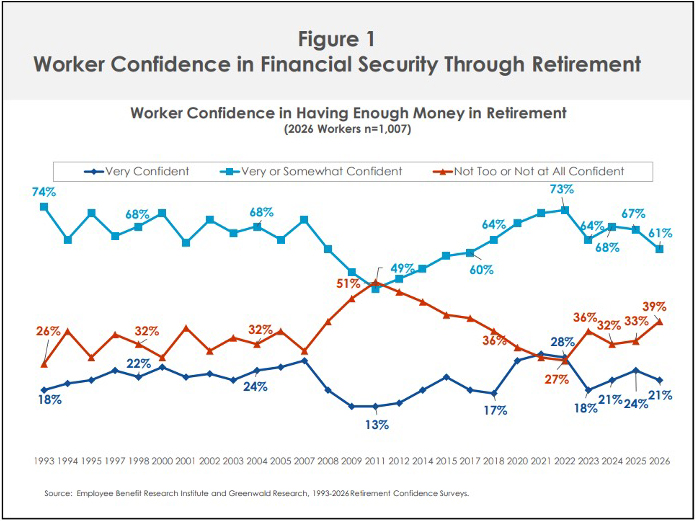
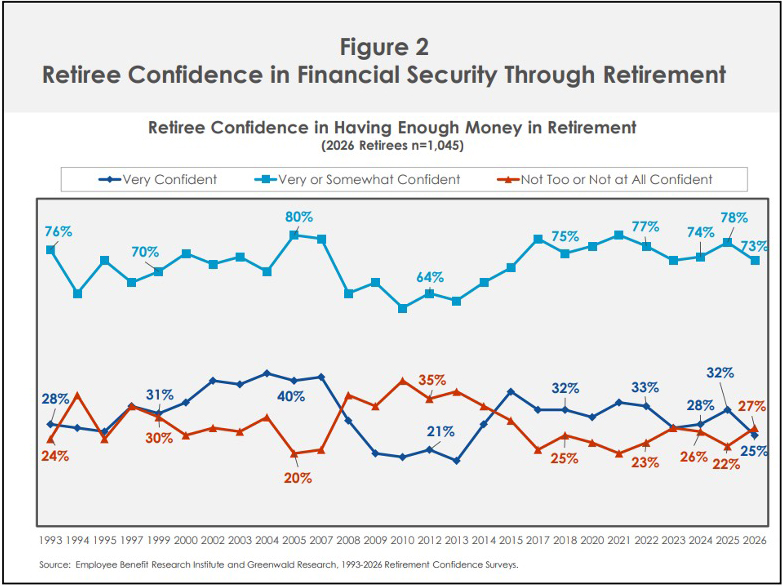
The EBRI, conducts an annual Retirement Confidence Survey. They measure worker and retiree confidence:
“The 2026 Retirement Confidence Survey (RCS) finds that six in 10 American workers (61 percent) feel confident in their ability to have enough money to live comfortably throughout their retirement, with 21 percent feeling very confident (Figure 1). This percentage confident is …. at its lowest level since 2017.”
Respondents point to debt levels presenting a major challenge to their ability to save and accumulate wealth.
Most workers should be very concerned about their ability to retire comfortably. A computer program calculating a “magic number” is not enough. While they know current debt levels, fear of the unknown (like the 2008 bank bailout), future inflation and personal longevity are guesses about the future.
Most retirees generally tailor their lifestyle to fit their income, downsize, and adjust financially as best they can. Medicare helps reduce some health expense worries as opposed to when you were still working; however, government promises can be changed at the will of politicos.
In 2010, more Baby Boomers were concerned about running out of money than death than they are today. They have now experienced retirement, adjusted, and their remaining time line is much shorter.
Falling Short? – Knock! Knock!
The poll concluding that workers feel they need $1.2 million saved highlights the fact the majority falls woefully short:
“Just 30% of the 615 workplace retirement plan participants polled …. think they’ll reach a $1 million savings mark before retiring.
…. More than half of the workplace retirement plan participants — 51% — said they expect to have less than $500,000 saved when they reach retirement, including 24% who expect to have less than $250,000 saved, according to the survey.
…. 55% said they are unable to save 10% of their paycheck toward retirement due to competing expenses.
…. 69% said rising costs have put retirement out of reach for their generation.
…. 33% of the workplace retirement plan participants said they have more credit card debt than retirement savings.”
Rather than being proactive, they keep plodding along:
“…. 24% of the workplace retirement plan participants don’t know how their retirement savings are invested. Of those who do know, in allocations across all types of retirement savings accounts, a significant portion, 26%, is allocated to cash, almost equal to equities, with 27%.
Those cash holdings are largely driven by the pursuit of safety, which 53% of workplace retirement plan participants cited; the desire to diversify investments, 44%; and waiting for the right time to invest, 33%.”
Concluding:
“To gauge whether you’re on track toward retirement, consult a reputable financial advisor or the educational resources provided through your workplace retirement plan.”
The first step is to assess your situation. If you don’t know how to do this, a financial advisor can help you set up the necessary scorecard for building a financial plan to get you on track.
Building Genuine Retirement Confidence
A good financial advisor will run the number – and knock-knock! – hopefully get your attention. If the numbers come up short, the retiree (and spouse) must change habits, set savings goals, and get serious.
The time period from becoming an empty-nester to retirement is a race to the finish line. Your priorities change from raising a family to debt reduction and wealth accumulation.
The dirty little secret….
Hitting your “magic number” doesn’t guarantee a comfortable retirement. The real confidence comes from making a plan, and following it so the updated scorecard shows you are winning – you are doing the right things….
What about inflation?
Retirement studies always raise big red flags, warning about inflation. Gold and precious metals provide the best inflation hedge.
Friend Frank Trotter at Battle Bank shared an eye-popping statistic in their recent Battle Bulletin:
“Despite gold’s spectacular run, including a roughly 65% gain in 2025, its best year since 1979, U.S. investor allocations remain remarkably thin.
Bank of America’s Global Fund Manager Survey found average professional allocations of just 2.4%, with nearly 40% of managers reporting no gold exposure at all. Estimates of gold’s share of U.S. household financial assets run well under 1%.
Morgan Stanley’s headline-making late-2025 recommendation that investors adopt a 60/20/20 portfolio, with gold receiving the same 20% weighting as bonds, was newsworthy precisely because actual positioning is nowhere close to that.”
Houston, we have a problem!
Financial planners, brokers, and “retirement specialists” may have a fancy office, impressive titles, flowery certificates, awards and plaques – all designed to create the illusion of security and confidence with their clients. Some are held to high ethical standards, taking pride in the fact they must put their client’s interest ahead of their own.Don’t be fooled, they are not Mighty Mouse, coming in to save the day!
They use sophisticated computer programs and run fancy projections based on historical models, but the projections into the future are still guesses based on past models. None predicted Covid, the 2008 bank bailout, periods of high inflation, you name it.
We are bombarded with financial advisors hawking their wares – “let us help you build a solid retirement plan.” The statistics show the vast majority are NOT properly protecting their clients from the inevitable inflation. If they are so damned concerned about inflation, why are they not guiding their clients into the best inflation protecting assets known to man – gold and precious metals?
My Quest For Truth
I’ve questioned hundreds of well credentialed financial advisors about why they are not using precious metal to adequately protect their clients against inflation. Here’s some typical responses and my thoughts:
|
|
|
It’s a waste of time trying to determine their motivation. It’s our life savings; we must be doggone sure we allocate enough to precious metals to offset the inevitable inflation that is not going away.
If you have an IRA, 401k or a company sponsored program, I recommend taking full advantage; max out your contributions. “Pay yourself first, and learn to live on the rest” is alive and well.
Most company sponsored plans limit their choices to things like conservative, growth, etc. The company generally turns over the contributions to a firm that funnels money into their fee-based products. The overriding concern is avoiding the probability of being sued for mismanagement.
What Can We Do?
Advisors tout clients “not wanting to lose money.” Duh! The definition should be redefined.
It’s easy to make money and lose wealth at the same time. Since the 2008 bank bailouts, treasuries, CDs and top-quality bond interest rates have generally not beaten inflation. On paper your “safe interest income” might look nice, you made a profit, however, the buying power of your life savings decreased.
In 2022 inflation hit 8%, and most CDs still paid 2%. The confident investor with $1.2 million in CDs would lose a net 6% ($72,000) in buying power of their life savings.
Try This….
Ask your financial advisor this simple question:
“How do we set up a system that generates income, while protecting against market downturns and inflation? I want help building a plan to grow our real wealth after taxes and inflation.”
If there’s no allocation toward gold, why not? You may do everything right to hit your “magic number”; however, an advisor who does not adequately protect your nest egg from inflation, could easily destroy much of what you worked for over your entire life.
You may have to adjust your saving, accumulating precious metals on your own, outside of what the financial planner is helping with. The reason gold jumped 65% in 2025 has not gone away.
Knock! Knock!
Once accumulated wealth is lost to inflation, it’s almost impossible to play catch up and earn it back. The consequences of not listening and poor advice could spell disaster.
Don’t settle for anything less. Insist on a financial advisor that will help you make money and protect your wealth!
On The Lighter Side…
It’s hard to believe it is mid-August already. Grandson Braidyn is heading off for his senior year in college, and Brock is starting his junior year in high school. Last week, Brock and a couple friends drove to Nashville for a concert. It feels like yesterday it was a big deal for me to ride shotgun while he drove the golf cart around the neighborhood.
Yeah, we all were relieved when they got home safely — but — he is spreading his wings and growing up quickly. I keep reminding myself that the job of parents and elders is to help them along the way. With six grandchildren and two great-grandchildren, I know the process, but the emotions, and pride, are part of the deal.
When we were young it seemed like time was slow, you had to wait forever for something you are looking forward to. Senior citizens complain years and decades fly by much too quickly. Time waits for no one, all the messages about enjoying the moment are very real….
Quote of the Week…
“In the absence of the gold standard, there is no way to protect savings from confiscation through inflation. There is no safe store of value. Deficit spending is simply a scheme for the hidden confiscation of wealth.
Gold stands in the way of this insidious process. It stands as a protector of property rights. If one grasps this, one has no difficulty in understanding the statists’ antagonism toward the gold standard.” — Alan Greenspan
And Finally…
My wife Jo shares some Facebook wisdom for our enjoyment:
|
|
|
|
|
|
|
|
|
|
|
And my favorite:
Never lose sight of your core values, it’s who you are.



Comments
Log in or sign up to join the conversation.