


While this week will be all about Nvidia (NVDA), that will only last through Wednesday. Then attention shifts to the annual Jackson Hole Symposium, where Fed Chair Kevin Warsh will give his first speech as chair. Markets will be listening closely for any sign that Warsh has changed his tune on ending the Fed’s habit of hand-holding markets. My hunch is he hasn’t. I firmly believe that a market free of Fed forward guidance is a good thing, and more importantly, that allowing the yield curve to steepen is too.
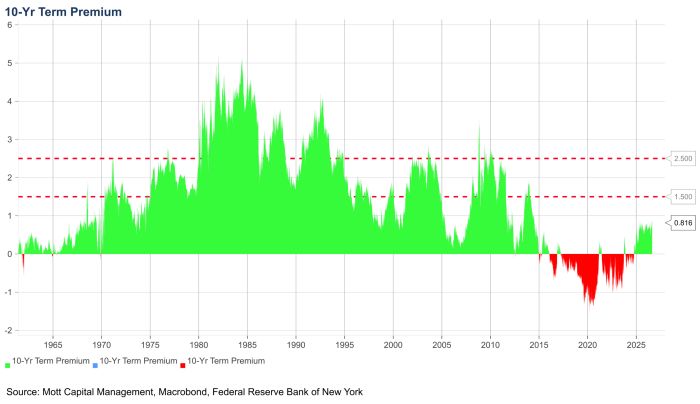
We are already seeing the term premium rise, which is the bond market’s way of asking for greater compensation to hold US debt. At just 82 bps, the 10-year term premium (ACM) remains very low by historical standards; it averaged around 150 bps in the decades before QE. A return to that level alone, on top of a neutral rate in the low 4s, would push the 10-year above 5%.
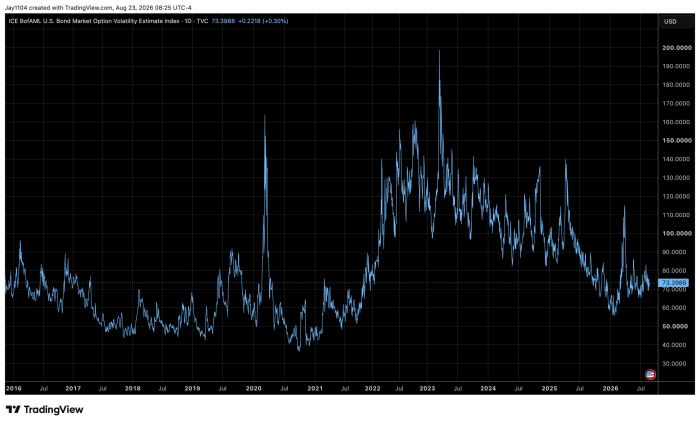
A Fed that provides less forward guidance should also mean higher implied volatility in the bond market. The MOVE index remains very low despite the recent rise in long-end rates, because the market is still confident it knows the Fed’s next few moves. Take that certainty away, and every meeting becomes a live event. That is how rate volatility reprices structurally higher without a single hike.
This matters because the funds rate by itself does very little to tighten financial conditions. What tightens them is the long end: higher 10-year yields feed through to mortgage rates, corporate borrowing costs, and equity multiples, and higher rate volatility feeds through to credit spreads. That is the channel Powell never used.
So, I think the plan is to let the long end do what it never did under Powell: rise. Let the curve steepen, let bond-market volatility expand, and let higher long-end rates do the tightening until inflation meaningfully turns lower. Once that happens, the Fed has the room it needs to cut at the front of the curve.
Given that backdrop, I find it highly unlikely we hear anything different from Kevin Warsh on Friday. The message in my view will remain unchanged.
Global Rates Are Rising
The other factor is that rates are rising globally, with Japan leading the way. It is going to be very hard to see rates fall anywhere in the world, given that rates in Japan are rising quickly, with inflation expectations returning to 2% on the 10-year breakeven.
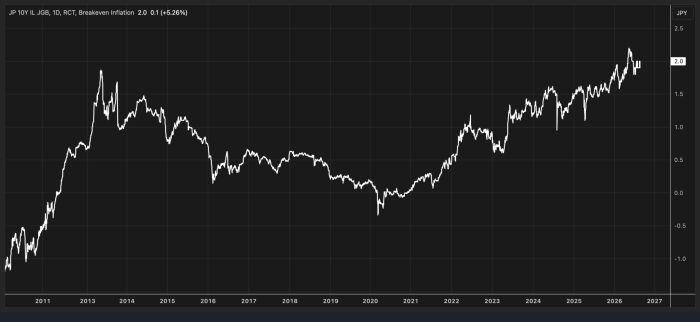
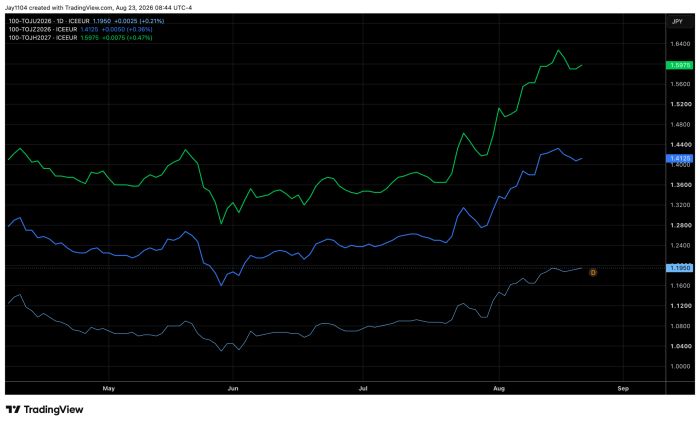
It would seem to me to be the clearest signal yet from the market that it is ready for the BOJ to normalize policy and proceed with its next round of rate hikes. Odds of rate hikes in Japan have been rising, with September TONAR futures pricing in a rate of 1.19% for September, 1.41% for December, and 1.6% for March.
With Nvidia and the Jackson Hole this week, it could turn out to be rather interesting, to say the least.

Comments
Log in or sign up to join the conversation.