


The USD/JPY pair loses traction to around 159.20 during the early European trading hours on Friday. The Japanese Yen (JPY) edges higher against the US Dollar (USD) as Japan’s National Consumer Price Index (CPI) inflation data boost expectations for Bank of Japan (BoJ) policy tightening.
Data released by the Japan Statistics Bureau on Friday showed that National Consumer Price Index (CPI) inflation climbed to 2.3% YoY in October from 2.1% in September. Meanwhile, the core CPI, which strips out prices of food, rose 2.2% YoY in October, compared to 2.1% in the previous reading, below the market consensus of 2.3%. This figure exceeded the central bank's 2% target for the second straight month.
The index that strips away the effects of both volatile fresh food and fuel, which is closely watched by the BoJ as a better gauge of demand-driven price pressures, increased 2.2% YoY in October, versus 2.4% prior.
Japan’s October inflation report is likely to push the BoJ toward another rate hike in December, despite an unexpected contraction in economic growth in the third quarter. Data from LSEG indicates that there is a 72% likelihood of a 25 basis points (bps) hike from the Japanese central bank.
On Thursday, BoJ Governor Kazuo Ueda said that underlying inflation roughly aligns with the price target. He added that the central bank plans to continue raising interest rates as monetary conditions remain accommodative.
USD/JPY tests 160 as BoJ signals December hike but flags yen risks
Strategists at Brown Brothers Harriman note that USD/JPY is “up and testing key resistance at 160.00,” with “higher US yields” keeping the pair “biased upward.” However, they caution that “intervention risk makes chasing gains beyond 160.00 a less attractive risk-reward trade.”
On the policy front, BBH highlights that BoJ Governor Kazuo Ueda “reinforced expectations for a 25bps rate hike to 1.50% on December 18 (85% priced in).” Ueda “played down weak Q3 consumption spending, arguing the decline was in line with expectations and spending should recover.” He also “reiterated that financial conditions remain loose and warned that yen weakness could add to inflation pressures,” underscoring the central bank’s growing sensitivity to currency-driven price risks.
Ueda flags inflation overshoot risk as BoJ leans toward further tightening
Ueda’s 8/10 FXS Speechtracker score sits modestly above the historic 7.5/10 baseline, signalling a slightly more hawkish tilt as the Bank of Japan highlights both steady growth and “fragility” alongside a clear willingness to keep raising rates while financial conditions remain loose. Emphasis on underlying inflation aligning with the 2% target, the explicit risk of an inflation overshoot, and simulations showing accelerated ETF sales would not severely damage BoJ finances all reinforce a narrative that policy normalization can proceed without destabilizing markets.
The repeated focus on a weak Yen amplifying inflation via broader price pass-through, and the admission that FX swings now matter more for long-term inflation expectations, underscore a growing sensitivity to currency-driven upside inflation risks that supports a hawkish bias. Still, acknowledgement that rising crude prices and a weak Yen could squeeze real incomes and damp consumption, plus data showing only steady consumption as wages rise, gives Ueda cover to keep rate hikes gradual and data-dependent, with the pace and timing explicitly tied to the probability of the baseline outlook and associated risks.
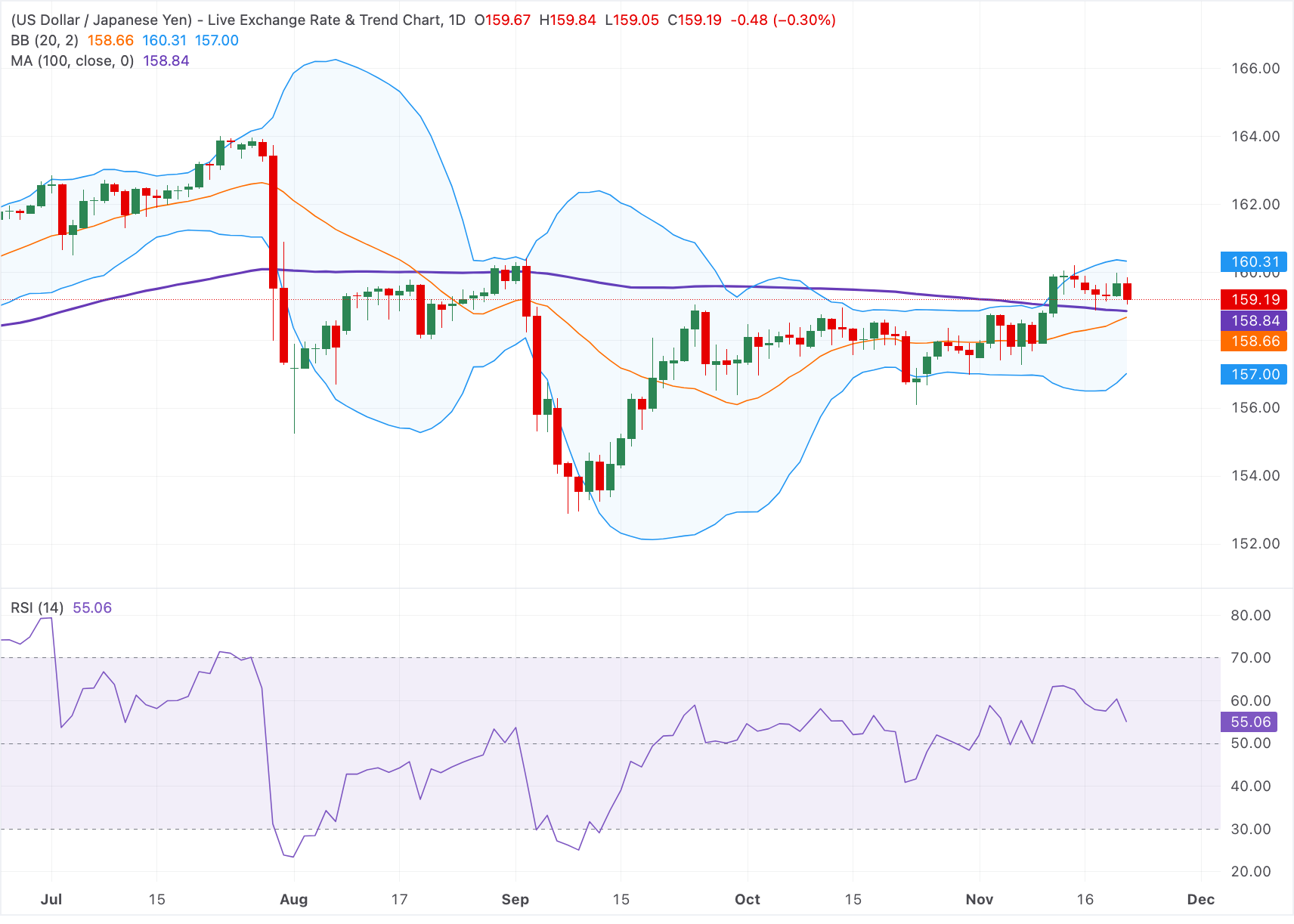
Technical Analysis: USD/JPY maintains a constructive outlook above the 100-day SMA
In the daily chart, USD/JPY keeps a mild bullish bias as it holds above the 100-day simple moving average (SMA) and the Bollinger middle band, suggesting underlying demand on shallow pullbacks. The Relative Strength Index (14) at 55 stays in positive but not overbought territory, hinting that upside momentum is constructive yet not stretched.
On the topside, immediate resistance is aligned with the upper Bollinger band near 160.30, where buyers could face profit-taking and volatility expansion. On the downside, initial support is seen at the 100-day SMA at 158.85, followed by the Bollinger mid-line at 158.65; a deeper retracement toward the lower Bollinger band around 157.00 would be needed to undermine the prevailing constructive tone.



Comments
Log in or sign up to join the conversation.