

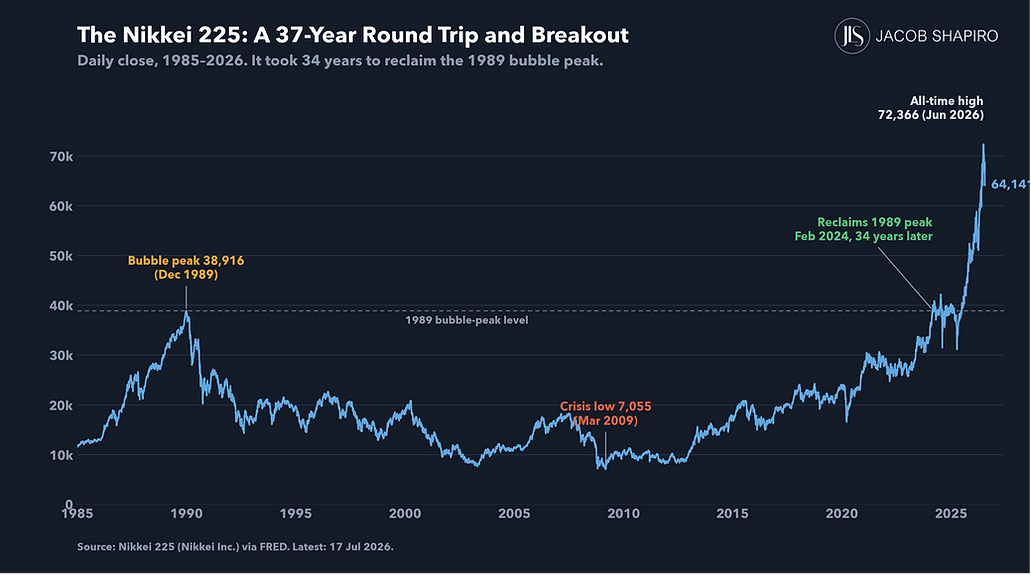
In February 1999, the Bank of Japan (BOJ) did something unthinkable: In response to stagnating growth and persistent deflation, it cut interest rates to zero. It was quite a fall from grace for a country that in the 1980s seemed to be on the cusp of global economic domination. But by 1989, what had been seen as inevitable was recognized as a bubble, and the Nikkei plunged by over 50%.
It took 34 years for it to recover to its previous level. In hindsight, the ’90s were a lost decade, but at the time, Bank of Japan Governor Masaru Hayami declared that the Zero Interest Rate Policy was a temporary measure and would continue “until deflationary concerns [were] dispelled.”
In this case, “temporary” meant 25 years, as rates remained near zero—even negative at times until March 2024. Buoyed at last by rising wages and higher prices, the BOJ increased short-term rates to 0.0–0.1%. (Hot diggity, as my grandmother would have said.) They now stand at 1%, the highest since 1995.
There were a few strange consequences of Japan’s at-the-time unorthodox policy. For one, Japan became the world’s largest creditor nation for 34 years. Another consequence was the rise of the so-called yen carry trade, whereby investors would borrow yen at zero (or even negative) rates to invest in other currencies offering higher yields. It is unclear how large the carry trade is—estimates range from $350 billion to $14 trillion.
On the other side of that trade are investors who have long speculated that Japan would have to raise rates, a trade that is often given the moniker of “widowmaker.”
The Situation:
Japan has always been a geopolitical conundrum. It’s a country that imports ~60% of its food and ~90% of its energy. It’s also one of the oldest countries in the world; almost 30% of its population is over the age of 65. Yet Japan has the fourth-largest GDP in the world. Investors who expected that Japan’s 200%+ debt-to-GDP ratio would force the BOJ’s hand to raise rates prematurely joined a fine club of analysts, investors, and economists who have gotten Japan wrong time and time again.
Japan’s history is rife with domestic infighting and overall instability, punctuated by brief but overwhelming moments of power, unity, and fierce national pride that enable it to punch far above its weight. There are nascent signs that Japan may be entering such a paradigm-shifting moment again. On February 8, Japan held a general election. Prime Minister Takaichi Sanae and her Liberal Democratic Party became the first party to secure a two-thirds majority in the House of Representatives, a supermajority that allows it to bypass the upper House of Councillors. The result shocked even the LDP, which literally ran out of candidates for the number of seats it won, forcing it to give 14 seats to rival parties.
Takaichi wants to rebuild the Japanese state for a dangerous century, not tinker at its margins. She aims to be a transformative figure who restores national strength in a world where she believes no one will save Japan but Japan itself. She sees the country, accurately, as strategically vulnerable, and her answer is unapologetically statist: Use public spending to pull private money off the sidelines, rebuild key industries, expand defense, and put economic security ahead of fiscal orthodoxy.
Takaichi’s government revealed its Basic Policy on Economic and Fiscal Management and Reform (i.e., the honebuto) in June and articulated a pivot away from conventional austerity, leaning toward a “responsible proactive fiscal policy.” Two weeks ago, Japanese Finance Minister Satsuki Katayama said she would push the Government Pension Investment Fund—the world’s largest pension fund—to invest more in domestic financial assets.
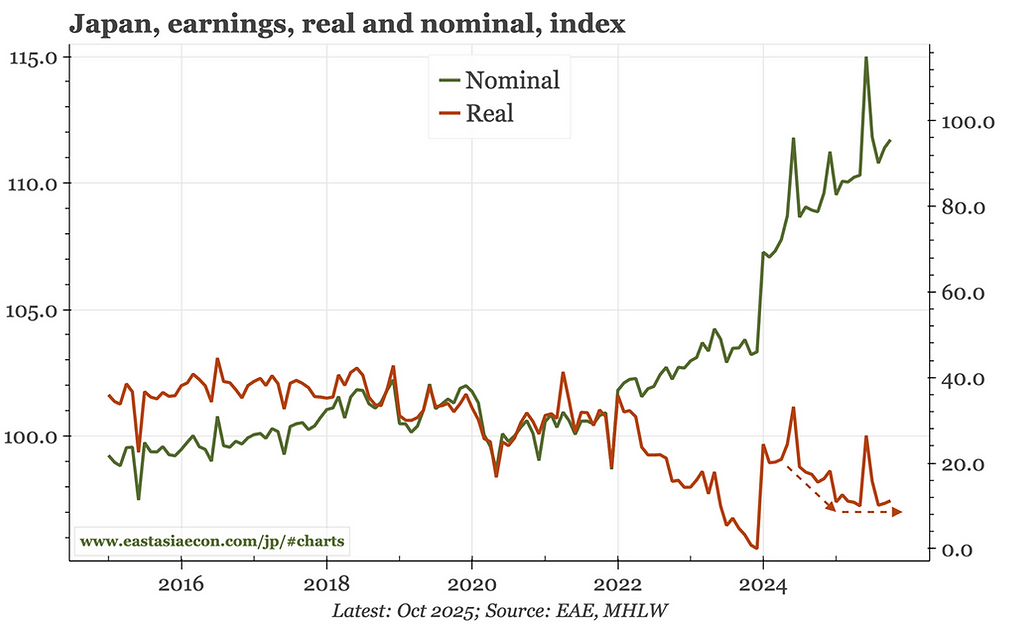
Inflation giveth, inflation taketh away. In a cruel twist of fate, the very inflation successive Japanese governments and the Japanese Central Bank have pursued for decades is now complicating Takaichi’s moves. Even though nominal wages have been rising in Japan, real wages in Japan declined 1.3% in 2025, marking a fourth consecutive year of decline. In fact, they were down every month last year.
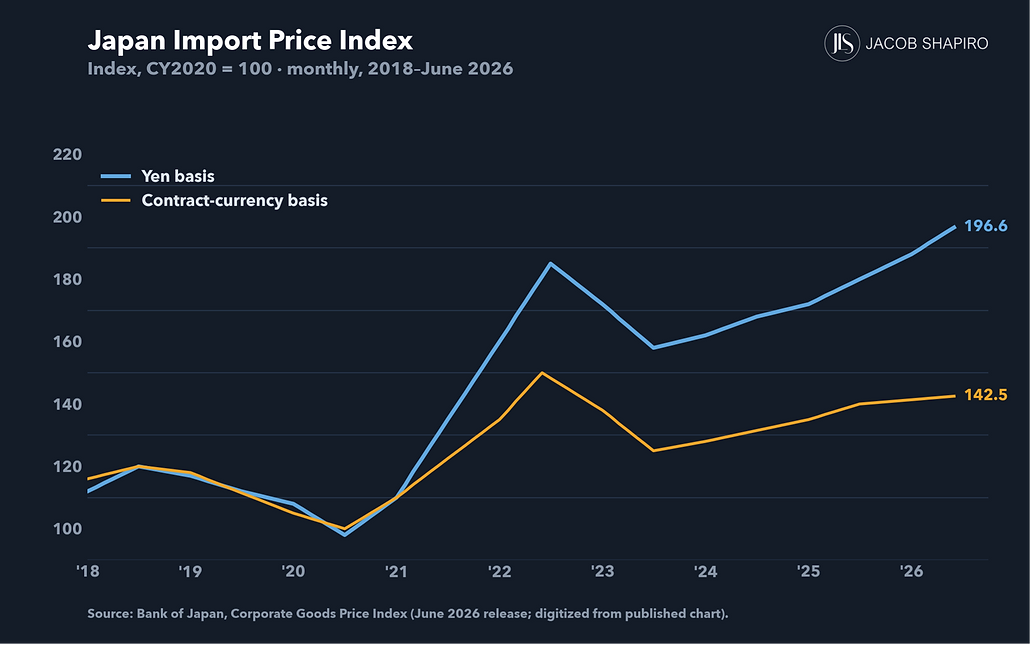
For a moment it looked like the corner had finally been turned. By May, total cash earnings were up 3.2% year-on-year, and real wages had risen for a fifth straight month. But that turn is largely engineered, because it leans on headline inflation cooling to around 1.4%, a number the government is holding down with energy subsidies even as producer prices run at 7.1%.
Strip out the subsidy, and net out rising social-insurance premiums and a new childcare levy, and Japanese households are still going backward. The positive real-wage print is real on paper, but it papers over a cost shock that gets worse every day the status of the Strait of Hormuz is in doubt.
Source: East Asia Econ
The Trilemma Comes Due
Back in February, I wrote that Takaichi faced a policy trilemma. She wants cheap government borrowing, a stable yen, and higher growth-and-defense spending, but from a policy perspective she can only get two of the three. My base case was that she would accept a weaker yen to preserve cheap borrowing, with success hinging on whether wages could outrun imported inflation, but I noted that “Japan is one geopolitical shock—a US–Iran conflict, for example—away from inflation looking ugly again…”
Unfortunately for Takaichi, that take was prescient. The yen has sunk to a 40-year low on the dollar. Long-term yields on Japanese bonds have risen to as high as 2.81%, a “Honebuto shock” and reaction to that “responsible proactivity” Takaichi is on about.
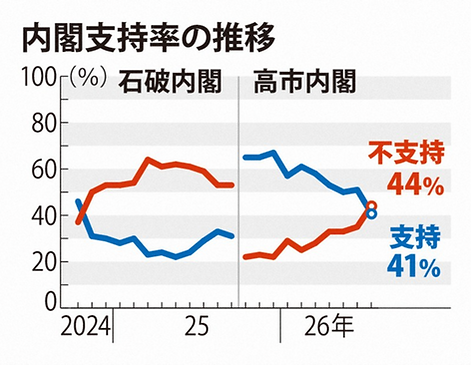
Takaichi has enjoyed relatively high approval ratings above 60%, but the latest polling shows support for her government nosediving to below 50%. An inability to solve the inflation issue was ultimately what doomed her predecessor, Shigeru Ishiba, and seems to be arresting her progress now as well.
Source: Arin Yumi
This says nothing of the diplomatic spat with China over Takaichi’s November remark that a Chinese attack or blockade of Taiwan would be a “survival-threatening situation” for Japan. China retaliated against Japan with comprehensive export controls on dual-use goods, rare earth minerals, and critical materials. China is Japan’s largest trading partner, and China is using its economic leverage at the worst possible time for Takaichi’s plans.
What Happens in Hormuz
And so here we are: there and back again. Japan spent 34 years climbing back to a stock market number it first hit in 1989 and 25 years trying to escape a zero-rate policy it swore was temporary, only to reach the exit in the worst possible shape to take it: a currency at a 40-year low, real wages that only look positive if you refuse to do the arithmetic, and a prime minister whose approval is sliding.
The easy call is that Takaichi is overmatched and the widowmaker is finally paying, and I would be careful making it. The bigger story is that the shock now complicating her reinvention has almost nothing to do with Japan: It is a war in the Persian Gulf. And what happens in Hormuz does not stay in Hormuz. What is happening in Japan is a second-order Hormuz disruption, and it raises the question I cannot shake: What do the third- and fourth-order disruptions look like, and will we recognize them before they arrive?
Map/Chart of the Week:
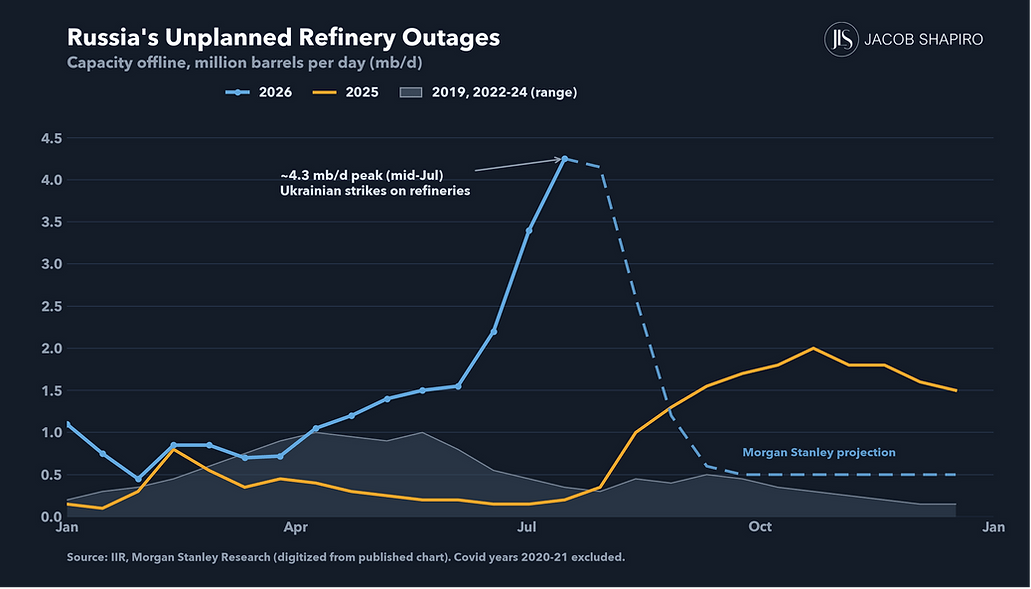
This is an astounding chart. According to Morgan Stanley, half of Russia’s oil refining capacity is offline due to Ukrainian attacks.
Blind Spot:
For decades, Commerzbank was untouchable. Germany bailed it out in 2008, took a stake, and defended it like a crown jewel. This week, Berlin stopped saying no. Chancellor Friedrich Merz, who still calls UniCredit's pursuit “hostile,” conceded the only point that matters: “We are not preventing this merger.” Italy's UniCredit will likely take Germany's second-largest bank, and the German government has moved from blocking the deal to negotiating the terms of its own retreat.
What I’d watch is simpler than a theory of Europe: whether anyone else follows UniCredit across a border or this stays a one-off, and whether UniCredit ends up growing Commerzbank or quietly shrinking it.
Bonus:
An update on the China vs. US AI story from a few weeks back, because the constraint I wrote about then just introduced itself. On July 16, the Chinese lab Moonshot released Kimi K3, a 2.8-trillion-parameter open-weight model (the largest yet) that lands at Claude Opus 4.8’s level on coding and reasoning, beats Anthropic’s Fable 5, and does it for roughly 40% less per token.
Recall the argument: Washington can switch off an American model, but it cannot switch off the open-weight frontier, as capability no longer lives inside any single system. Six weeks after Commerce reached for the off switch on Mythos and Fable, Beijing’s ecosystem answered by matching the American frontier and simply giving it away, which tells you how durable that off switch really was.


Comments
Log in or sign up to join the conversation.