


Here’s a special research report on a timely topic. The recent rise in interest rates and US government debt surpassing $40T has sparked worries about sovereign default. The logical response to these fears is that today’s interest rates aren’t actually that high in historical terms (they’re actually lower than the 50-year average of 5.8%) and that you can’t focus on debt without also considering the unparalleled size of assets in the USA. But debt sustainability isn’t purely a balance sheet item. It’s also sensible to consider the debt-to-income analysis, and by that metric you could argue the USA is worse off than it has ever been, with debt-to-GDP fast approaching 130%. But is that metric even useful? Let’s dig in and actually apply some historical analysis instead of relying on big, scary-sounding numbers. If you’re short on time, here’s the TLDR version:
• I can’t find any debt-to-GDP level that reliably predicts default or high inflation for a country that borrows in its own currency. The UK ran debt near 250% of GDP after WWII. Japan sits around 230% today. Neither defaulted. The UK had modest inflation, and Japan had well-known deflation. More recent cases (like Italy, Singapore and Greece) all coincided with low to modest inflation. Meanwhile, Lebanon, Venezuela and Sudan had the opposite. But there is no consistent causality here, and in larger developed economies the causality often runs backwards while hyperinflations often appear in nations with lower debt to GDP.
• The US government isn’t a household. It issues the currency it borrows in, and its debt is the private sector’s asset. The real constraint is inflation, not running out of money.
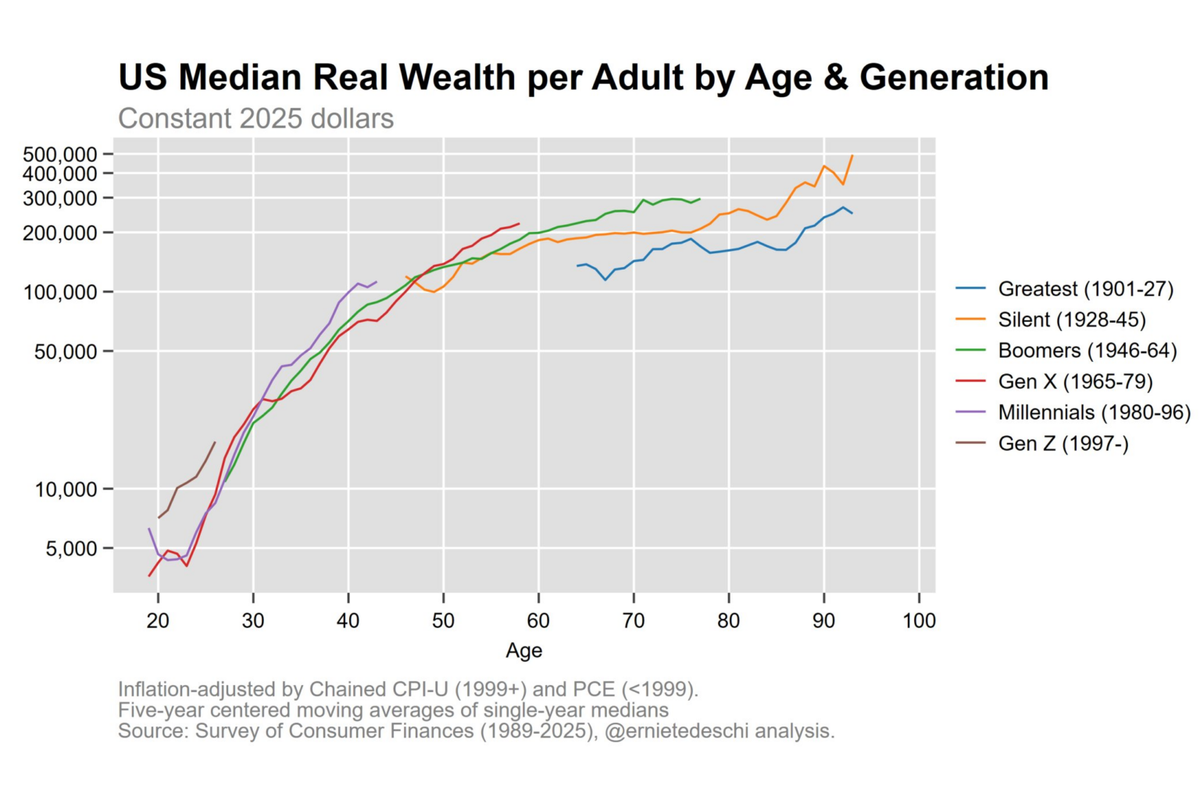
• The US is also enormously wealthy. Household net worth is roughly six times GDP and about five times the federal debt. Out of all the countries in the world that could have a debt crisis, the wealthiest country in human history surely isn’t the most obvious (or logical) choice.
• I actually think the risk is that 130% goes higher, not that it’s a cliff. Demographics, inequality, and technology are going to push the government to spend more in the decades ahead. And whether that causes high inflation is much more complex than simply looking at the size of the debt. It’s a complex interplay of disinflationary long-term headwinds versus a government that tries to offset them.
• The current burst of inflation and rise in rates isn’t the start of a sovereign debt default. It’s primarily an adjustment to higher inflation expectations as the war in Iran continues to push commodity prices up.
• The real historical cost is quieter. Slower growth and years of negative real returns for people holding long bonds. That argues for ALM strategies that should be short duration in bonds, avoid long bonds entirely, add a little portfolio insurance where appropriate, and keep your long duration assets matched to real assets and, at a minimum, multi-asset instruments that capture diversification and equity risk premia in the long run.


Comments
Log in or sign up to join the conversation.