

The pressure is building within the financial markets for central bankers to react to the current bout of inflation, yet the bond market is signaling that this would likely result in a policy error. Investors are laying bets that the Federal Reserve will begin a tightening cycle as early as next summer, almost a full year earlier than anticipated last year at this time. Expectations are rising in Europe that the ECB will tighten next year, despite protestations to the contrary by President Lagarde. Speculation is rife that the Bank of England would be the first out of the gate and would likely raise its policy rate by the new year.
Like its counterparts worldwide, the Bank of Canada is concerned that it does not lose control over inflation expectations. Accordingly, it just announced that it is ending its QE program and signaled that it would likely raise its benchmark interest rate by next summer. The reaction was rather swift, as the CIBC economists moved up their forecasts for the start of a rate hike cycle. The bank economists expect the overnight rate, currently at 0.25%, to reach 0.50% in September 2022 and 1.50 % by the end of 2023. ( CIBC forecast). In the US, where there is a similar yield flattening underway, Goldman economists pulled forward its forecast for rate hikes by one full year faster than its previous forecast (Goldman capitulates).
But long-term bond investors are not buying this narrative. One indication of this skepticism is apparent in the yield spreads between long- and short-term rates. Long-dated bondholders are the most sensitive to inflationary expectations, so their reactions are more telling regarding the wisdom of accelerating rate hikes. The Canadian 10 year/2year interest spread has narrowed by more than 50bps since spring 2021. This indicates that long-term investors anticipate a significant drop-off in growth rates resulting from rate hikes that come too soon. More to the point, long-term investors do not want to have the Bank of Canada validate the knee-jerk reaction in the short end of the bond market. The higher short rates move, the more likely the slow down in economic growth.
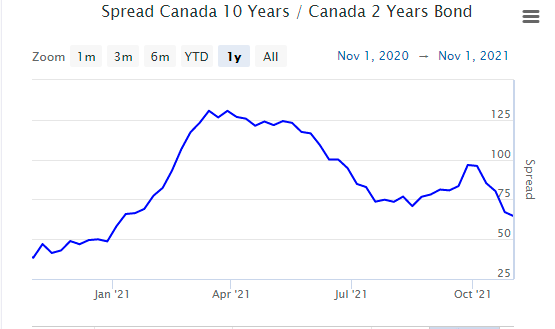
Source: World Government Bonds
Central banks are essentially powerless to deal with inflation generated by supply-chain issues emanating from the disruptions to international trade. How can an interest rate hike alleviate these shortages? The most likely outcome of sudden increases in short-term rates will be a recession which, in turn, will likely force central banks to reverse policy and ease up through rate cuts. A central bank’s credibility is then on the line when it is forced to reverse gears. The narrowing of the 10-year/2-year spread is saying that rate hikes must be carried out with great care not to harm what is already a shaky recovery process.


Comments
Log in or sign up to join the conversation.