

A few weeks ago I was certain that SPCX was going to trade below $100. The valuation analysis and the sentiment did not justify the hype. But once again, when Musk touches something, it feels like it can turn into gold. From the August 3 low of $104.83, the stock gained as much as 64% by early October, and even after a pullback it is still up about 41% and trading above its $135 IPO price. More importantly, the numbers are starting to sit well. So what is happening? What do the fundamentals of SPCX say? And what just happened in Q3?
A Quick Recap: Where SPCX Stands Today
Since its IPO, SPCX has been extremely volatile. IPO excitement and a tiny float drove the stock higher, then investors worried about the valuation, the heavy AI spending and the locked-up shares waiting to hit the market. By late July it was below its IPO price and the bearish case looked like the consensus. However, since August, the sentiment has turned positive, even though the wider market has been shaky and AI stocks have been going through repeated sell-offs.
Key reasons include:
The feared selling never arrived. The first lock-up expired on August 6, releasing about 911 million shares. Reports suggest insiders largely did not sell, and traders positioned for a drop were caught off guard.
The numbers beat. Q2 revenue of $7.81 billion was up 92% and ahead of the roughly $6.93 billion expected. Argus upgraded the stock to Buy, and stakes disclosed by Nvidia, Alphabet and AMD added credibility.
Index money and Starship. A larger float raised SpaceX’s Nasdaq 100 weight at the September rebalancing, forcing index funds to buy. Yahoo Finance also ties the late-September breakout to Starship and a spectrum purchase.
The latest weeks have been mixed. The Q3 report beat on every segment and the Q1 2027 guidance of $33 billion to $37 billion compares with Wall Street estimates near $23 billion. Musk then said Tesla and SpaceX have formed committees to discuss a merger, and JPMorgan more than doubled its target to $500. The gains did not last. On October 22 the Nasdaq fell 2.6% on AI spending fears, and SPCX dropped with it as up to 1.3 billion more shares became eligible for sale. On October 25 Musk also said SpaceX closed $40 billion of debt to buy Nvidia chips, though lenders and terms are not public.
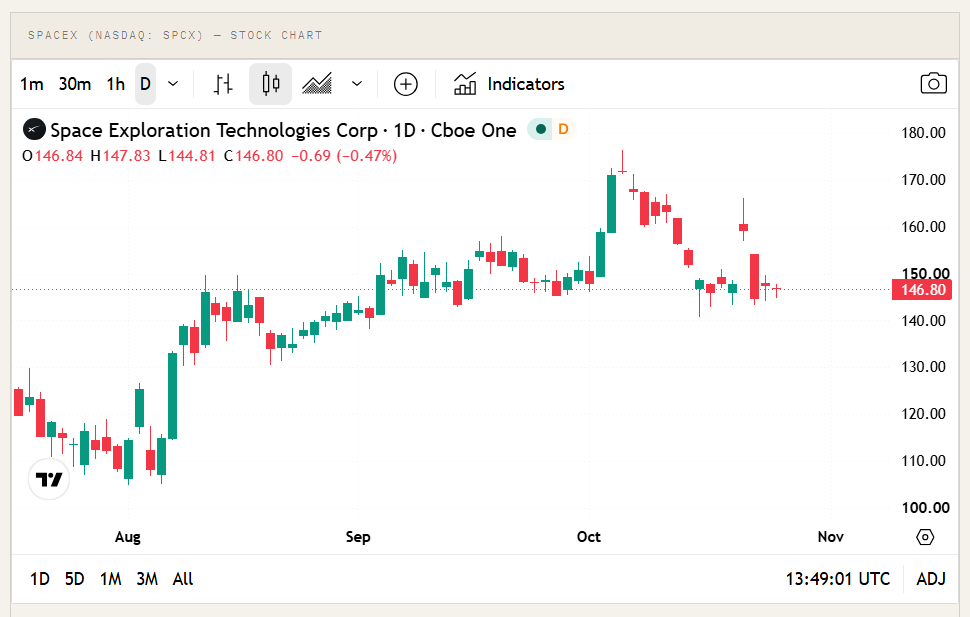
SpaceX (Nasdaq: SPCX) — Stock Chart SPCX stock chart by TradingView
Q3 Was Better Than Expected
For SpaceX, it is all about the fundamentals now. Investors want to see how the company is really doing, which is why the Q3 report was so closely watched: it was the first hard evidence on whether the valuation can be justified. In a nutshell, SpaceX crushed expectations. Revenue was $14.6 billion against the $12.86 billion expected, up 161% from a year ago, and net income of $4.4 billion made it the first profitable quarter since the IPO. Every segment beat. The miss was Starlink subscribers.
Q3 2026 Metric | Reported | Expected | Difference |
|---|---|---|---|
Revenue | $14.6B | $12.86B | +14% |
AI segment revenue | $7.56B | $6.47B | +17% |
Connectivity (Starlink) revenue | $5.25B | $4.92B | +7% |
Space revenue | $1.77B | $1.46B | +21% |
Operating income | $2.79B | $2.33B | +20% |
New Starlink consumer subscribers | 1.6M | 2.29M | -30% |
What Does It Mean?
A beat only matters if it changes how investors see the company. This one changes two things: what SpaceX is, and how it pays for what comes next.
SpaceX is now an AI infrastructure company as much as a rocket company. The AI segment, which rents computing capacity to customers such as Anthropic and Google and now includes the Cursor acquisition, was about 17% of revenue in 2025 and was 52% of Q3. It is real revenue, but rests on a few contracts.
The operations are profitable, but the $4.4 billion headline flatters them. Operating income was $2.79 billion, a margin of about 19%, and CNBC reports a $561 million gain from The Boring Company stake. The rest of the gap is worth checking in the 10-Q.
The Cash QuestionCapex was $19.6 billion in Q3, more than revenue, and free cash flow was about -$9.9 billion. Q4 capex is guided to $35 billion to $40 billion, and S&P Global Ratings expects free cash flow to stay negative through 2029. The profit is not the number to watch. The cash burn is.
The good and the bad. The good: SpaceX is growing fast, every segment beat, operations are profitable, and a $63 billion backlog supports the guidance. The bad: it runs on IPO cash and new debt, free cash flow is deeply negative, a few customers drive the growth, compute prices follow the spot market, and Starlink is adding subscribers too slowly. So the thesis is simple: SPCX has been doing well, but to keep growing it must prove the spending turns into revenue on schedule, by delivering the Q1 2027 guidance, converting the backlog into sales, and cutting the cash burn before funding gets harder.
Where the Stock Can Go Based on the Numbers
SpaceX’s valuation still rests on projections, on whether it can deliver sales over the next few years. What investors really want to know is where the stock can go, and how high it can rise if revenue keeps growing. Revenue rose from $4.7 billion in Q1 to $14.6 billion in Q3, and nine-month revenue of $27.1 billion is already above all of 2025. Management is guiding Q1 2027 revenue to $33 billion to $37 billion, more than double Q3, and says it rests on signed compute contracts. The backlog is $63 billion, and about $42 billion of it should convert within a year. That is a good sign: SpaceX is growing.
Quarter | Revenue | vs. Year Earlier |
|---|---|---|
Q1 2026 | $4.69B | +15% |
Q2 2026 | $7.81B | +92% |
Q3 2026 | $14.58B | +161% |
Q4 2026 (analyst estimate) | ~$22.5B | — |
Q1 2027 (company guidance) | $33B–$37B | — |
Now the valuation. The price-to-sales ratio (P/S) is market value divided by annual revenue. At $1.98 trillion, SpaceX trades at roughly 62x the last four quarters of sales (Motley Fool puts it near 67x) and about 34x Q3 annualized. If you annualize the Q1 2027 guidance instead, sales of $132 billion to $148 billion, the ratio drops to roughly 13x to 15x. The market is pricing the guidance, not the quarter that was just reported. If that guidance is delivered, SPCX is no longer an extremely high-valuation stock, although 13x to 15x sales is still not cheap.
What would sales need to be for SPCX to reach $200 or $300? The table shows the annual sales needed for each price at three multiples, using about 13.4 billion shares (implied by the market value, so an estimate).
Share Price | Market Value | Sales at 30x | Sales at 20x | Sales at 14x |
|---|---|---|---|---|
$147 (today) | $1.98T | $66B | $99B | $141B |
$200 (+36%) | $2.68T | $89B | $134B | $192B |
$300 (+103%) | $4.03T | $134B | $201B | $288B |
$500 (+239%) | $6.71T | $224B | $336B | $479B |
The 14x column is today’s multiple. At that multiple, $200 needs annual sales of about $192 billion, and $300 needs around $288 billion. If the market pays less per dollar of sales as the company grows, the bar is higher: $300 at 20x needs about $200 billion. If it keeps paying 30x, $200 needs only about $89 billion, which the guidance already covers. This is our own arithmetic, not a forecast.
Is it possible? Yes, but it is still far from SpaceX’s revenue today, which runs at about $58 billion a year at Q3’s pace. If SpaceX delivers more sales over the next year, if Starlink keeps growing, if the chips bought with the new $40 billion arrive on time and turn into signed compute contracts, and if compute prices hold, then $200 and $300 are reachable. Right now, SpaceX can be a good long-term investment as long as it delivers that revenue on schedule.
Final Word: Is SPCX a Good Buy Right Now?
SpaceX is in a much better position than it was right after the IPO. It is delivering, it is growing, and Musk and the team are doing what it takes to push the company higher. It is not risk-free, but the setup is stronger than a few months ago.
What to watch: Q4 revenue near the $22 billion estimate, Q1 2027 inside the guided range, Q4 capex, and the Tesla talk. The key data to look at right now is quarterly revenue against the $33 billion to $37 billion Q1 2027 guidance, together with free cash flow. These will determine whether SpaceX’s valuation can grow over the next year.

Comments
Log in or sign up to join the conversation.