

Main Street Capital (NYSE: MAIN) is popular among income investors due to its 8% yield, monthly dividend, and annual dividend increases. In fact, it’s a longtime favorite of my colleague Dr. Mark Skousen, The Oxford Club’s Macroeconomic Strategist.
Can investors (and Dr. Skousen) rely on the dividend as it now stands?
The last time we looked at Main Street a little over a year ago, the answer was a resounding yes.
The business development company’s net investment income (the measure of cash flow that we use for BDCs) was climbing, the payout ratio was appropriate, and the company had boosted the dividend each year for 15 years.
As a result, the company received an “A” rating for dividend safety.
A year later, let’s see whether the company’s dividend is just as safe.
Main Street Capital provides equity and debt financing to privately held companies.
Its portfolio includes…
A $5.3 million equity position dating back to 2011 and a $2.2 million loan at 12% to N.R.P. Jones, a La Porte, Indiana-based manufacturer of hoses, fittings, and assemblies for the oil, natural gas, agriculture, mining, and other industries
A $5.4 million equity investment and $21.5 million loan at 13% to Career Team Holdings, a workforce training software company based in Shelton, Connecticut
A $22.8 million loan at 14% to Slick Innovations, which has dual headquarters in Jamestown, New York, and Nashville, Tennessee, and provides businesses with a text-based marketing platform.
When an equity position pays off or Main Street collects interest on a loan, that is counted as investment income. After expenses are deducted, we arrive at net investment income, or NII. That is the metric we use to determine the safety of a BDC’s dividend.
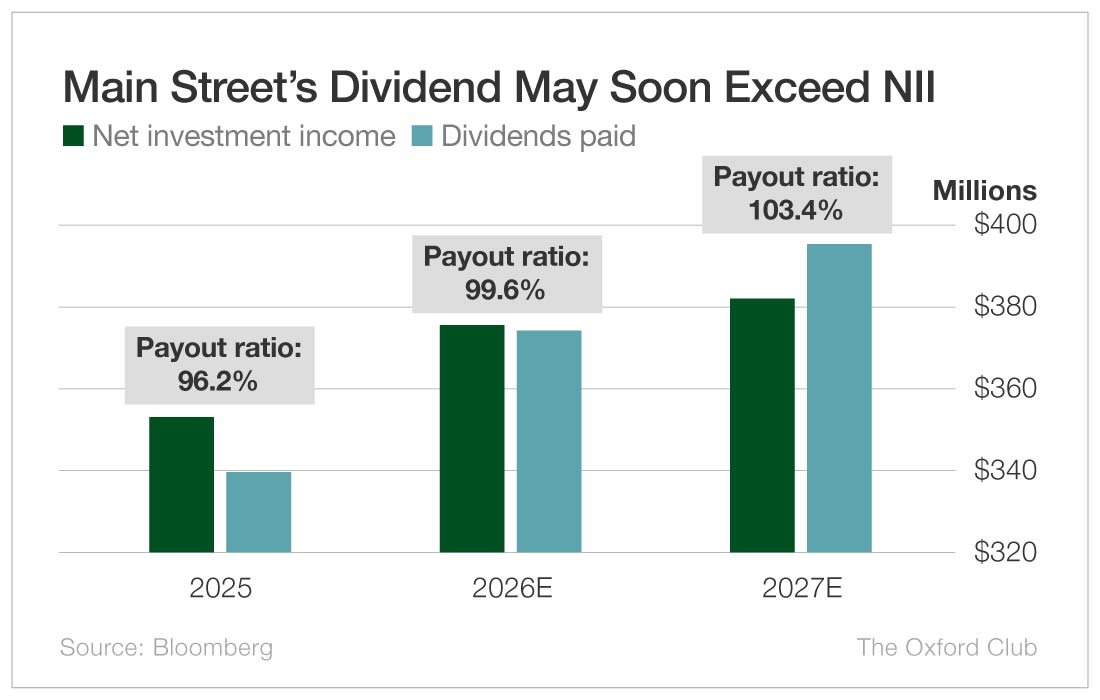
In 2025, the last full year of reported financials, Main Street Capital’s NII rose 3.3% to $352.7 million, up from $341.4 million in 2024.
NII is projected to climb to $375.4 million this year and then advance again in 2027 to $381.9 million.
NII is growing every year, and that’s positive.
Last year, Main Street Capital paid investors $339.3 million in dividends for a 96.2% payout ratio on NII.
For BDCs, I’m fine with anything at or below 100%. By law, BDCs must pay out at least 90% of their profits to shareholders. NII is not the same as profits, but because of that law, they typically pay out most if not all of their NII.
This year, the payout ratio is projected to bump up against my 100% threshold at 99.6%.
In 2027, Wall Street expects dividends paid to be $395 million, breaching that 100% level by 3.4%.
That expected payout ratio of above 100% causes a downgrade for the stock’s Safety Net rating.
The 100% threshold is not an arbitrary number. A payout ratio that exceeds 100% means the company is not generating enough cash to cover the dividend. When that occurs, a company must pay shareholders from cash on hand or raise money from either debt or equity. It’s not a good position to be in.
Main Street Capital pays a monthly regular dividend and usually pays a quarterly special dividend as well.
Not including the special dividend, the company has raised its payout for 16 straight years. A decade or more of annual dividend increases earns a company a one-point upgrade.
The current monthly $0.265 per share dividend comes out to a 6% yield. Main Street has also paid the special dividend every quarter since the end of 2021. The special dividend has been $0.30 per share since March of 2024.
When you add the special dividend to the monthly payout, the yield grows to 8.2%.
I don’t love that expected payout ratio of over 100% next year, but the company has proven itself as a reliable Perpetual Dividend Raiser.
After years of strong performance, management deserves the benefit of the doubt.
We’ll revisit it next year, but for now, the dividend is extremely safe.
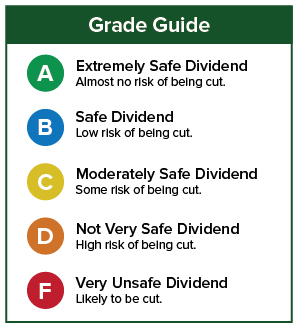
Dividend Safety Rating: A

Comments
Log in or sign up to join the conversation.