

China’s CPI inflation cooled to a 6-month low in July, marking a third straight month of negative month-on-month prices, while PPI inflation also decelerated from June's peak. Though energy is volatile in the short run, the persistent drag from food and rental costs will decide if China's reflation trend lasts.
CPI inflation cooled more than expected
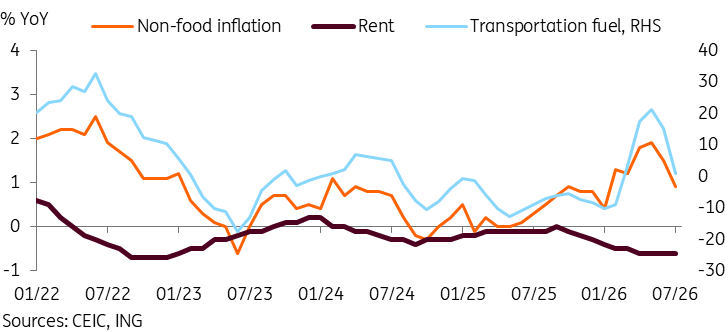
China’s CPI inflation fell to 0.5% year-on-year, down from 1.0% in June, coming in lower than expectations (market: 0.8%, ING: 0.9%) and reaching a 6-month low. In month-on-month terms, CPI edged up slightly to -0.1% from -0.3%, marking the third straight month of negative territory. Core CPI fell to 0.9% YoY in July, also a 6-month low. However, it’s been consistently positive since March 2025 and shown notably steadier behaviour than the headline measure.
The biggest mover over the past few months has been the transportation fuels subcategory, which fell to just 0.8% YoY in July, down from 15.3% in June. Gasoline prices across China generally fell quite noticeably in July despite the spike in crude oil prices. We saw gasoline prices start to move higher again in the last week of July, which could be carried forward into the August data. This category will likely remain choppy depending on geopolitical developments in the Middle East.
Other than volatility in energy prices, we continue to see the main drags on inflation coming from food and rent.
Food marked a fourth consecutive month of deflation in July, edging up 0.1pp to -1.5% YoY. Pork (-13.3%) continues to be a major drag on prices. China's typical pork cycle has largely been delayed amid ample supply. Most other food subcategories are in deflation territory as well, with the key exception of eggs (14.4%), for which prices surged. With food inflation representing nearly 30% of the CPI basket, this category remaining in deflation is clearly a notable drag on the headline CPI.
The other category is rent. This component of CPI remained unchanged at -0.6% YoY in July for a fourth straight month. Rent has been in deflation territory for 27 of the past 28 months amid the continued decline of the property market. Housing represents 22% of China's CPI basket.
In sum, it appears that roughly half of the CPI is being held back by sticky deflation in food and rent, while volatility in energy prices is driving the monthly change. Our colleagues' work on El Nino suggests a potential impact on Asia Pacific in particular that might emerge later in the year. This could impact the food part of the equation. We’re also seeing some recent signs of stabilisation in housing prices in China's largest cities, which could eventually stabilise rents as well.
As such, we'd hesitate to call an end to China's reflation story despite the slowing headline inflation. Risks to this trajectory look bigger than they were a few months ago, especially as domestic demand still looks weak without significant policy support to turn things around. But we should still end 2026 with inflation more convincingly above 0 than in the past 3 years.
Shock from energy prices faded in July while rents continue to drag inflation
PPI inflation also undershot forecasts
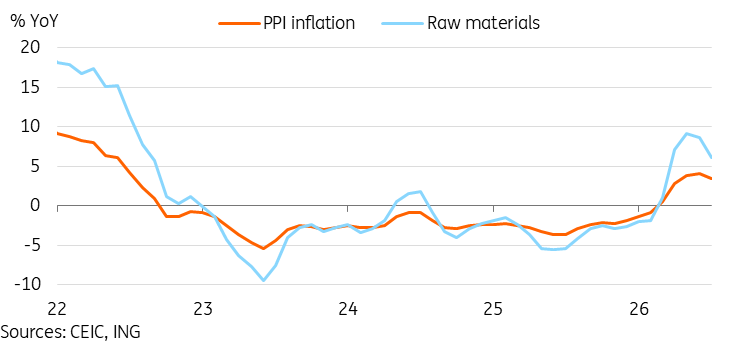
China's PPI inflation slowed to 3.5% YoY, down from 4.1% in June, short of forecasts (market: 3.9%, ING: 3.8%). In month-on-month terms, PPI inflation dropped to -0.7%, the second straight month in negative territory after an 8-month streak of positive MoM growth.
We continued to see quite an imbalanced picture in the PPI breakdown. Industries such as coal mining (27.1%), oil and gas extraction (3.2%), and non-ferrous metals mining (22.6%) led the way, while many other categories such as food manufacturing (-1.2%), wine, beverages, and tea manufacturing (-5.7%), and pharmaceutical manufacturing (-4.0%) were still in deflation.
With a less supportive base effect ahead, PPI has likely already reached its peak for the year, barring a worse-than-expected further oil price shock.
PPI looks likely to have peaked barring new shocks
PBOC rate cut remains on the table
With energy inflation cooling off a bit in recent months, and food price deflation looking stickier than expected, risks to our inflation forecast have shifted to the downside. As a result, we lower our CPI inflation forecast to 0.9% YoY, down from 1.2%.
We believe it’s important to restore positive inflation expectations in China, after several years of struggling with near-deflation and debates about potential Japanisation of the economy. The softening inflation momentum, combined with weaker domestic economic activity starting in the second quarter, provides a solid case for a 10bp rate cut in the coming months to support growth.

Comments
Log in or sign up to join the conversation.