

Okay, I’m not really with Trump’s claim that the United States has the world’s hottest economy and therefore should have the lowest rates. The first part is not true, and the second part makes no sense. Strong economies should generally have higher interest rates, since they don’t need low interest rates to boost growth. But I do think a moderate reduction in rates is appropriate.
To be clear, I recognize that inflation is both higher than the Fed’s 2.0 percent target and higher than what I would consider desirable. I just don’t think higher rates are a good remedy.
The problem is that the causes of high inflation will not be addressed by raising interest rates. The country is seeing high prices for gas, diesel, and heating oil due to the Iran War creating a worldwide shortage of oil and refined products. Raising rates will not address this situation.
Trump’s tariffs have also pushed inflation higher. If he doesn’t raise them further, this cause of inflation should dissipate over time, but this is a very big “if.” We can never know when a major trading partner will hurt Trump’s feelings and lead him to hit us with another tax increase under the delusion that he is making his enemy pay a tariff. In any case, Fed rate hikes don’t help here either.
The third source of inflation is the AI bubble. This has sent the price of computers and related equipment soaring. The price of information technology products had been falling sharply for decades, so seeing double-digit price rises is a major turnaround.
Here too it is not clear that Fed interest rate policy will have much impact. Highly leveraged AI companies, like CoreWeave (CRWV) and Oracle (ORCL), are being pressured by the interest rates they now pay on their debt, but this is almost entirely a risk-premium story. Further rises in the federal funds rate will have at most a modest effect. (If the Fed wants to burst the bubble, some high-quality research documenting the case would likely have more effect. Actors in financial markets have to pay attention to research cited by the Fed Chair and Board of Governors.)
There is also an interactive effect, where higher prices for gas and other refined products will lead to higher costs, and therefore higher prices for other goods and services. But we are not facing the sort of wage-price spiral we saw in the 1970s. Nominal wage growth is slowing. As a result, workers went from real wage growth of more than 1.0 percent annually in 2023-2024 to falling behind inflation in the last year.
If raising rates were costless, then I would join the higher rates party, but it isn’t. Interest rates are a major factor in determining housing construction. And since more construction is the best long-term remedy for high housing costs, less construction is a big deal. And we should be clear: high interest rates are undoubtedly a major factor in determining the pace of construction.
There has come to be a bit of a cult in recent years around the idea that zoning restrictions are the main factor behind high housing costs. There clearly are areas, like New York City and San Francisco, where restrictive zoning has been a major obstacle to construction, but these are the exceptions. In some places with high housing costs, like Seattle, where the population has grown by more than 50 percent since 1990, the problem is simply that it’s a very desirable place to live.
On a national level, we were building houses at a very rapid rate, more than 2 million units a year, in the not-too-distant past, when the zoning laws were not very different than they are today. The major factor slowing construction was the collapse of the housing bubble and the resulting financial crisis from 2007-2010.
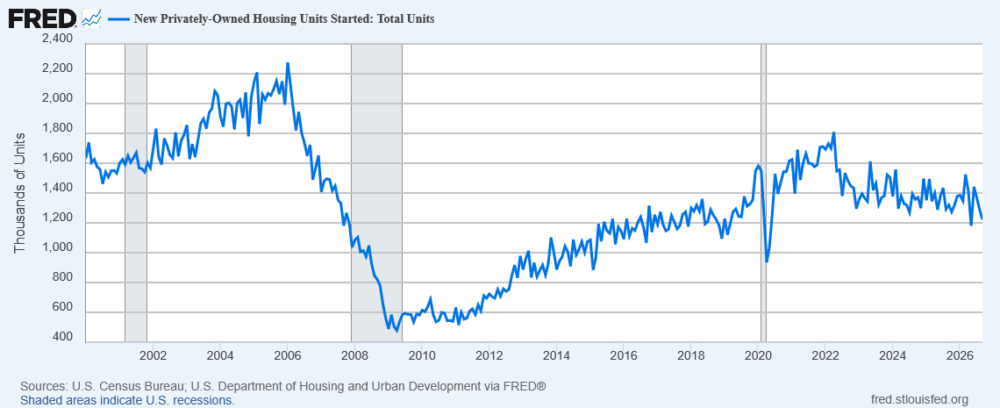
Construction did begin to gradually pick up again, and by the onset of the pandemic we were building housing units at almost a 1.6 million annual rate. After falling in the pandemic, starts rose to a peak rate of 1.8 million units in 2022, before higher rates sent construction plunging. In the most recent data, starts were at just over a 1.2 million annual rate.
Lower rates can boost construction to at least 1.5-1.6 million, which would be fast enough to put substantial downward pressure on housing costs. That would be a good thing and the main reason I would support lower rates. (Lower payments for interest on credit card debt, mortgages, and car loans would also be good.)
Anyhow, I know this is not the view of the people on the Fed at this point, all of whom seem to be looking to raise rates again in the near future. But if Donald Trump wants someone on the Fed who will argue for lower rates, I’m available.


Comments
Log in or sign up to join the conversation.