

Intel Corp. (INTC) is set to release earnings on Thursday, July 23, after the market close. But investors are nervous. As a result, INTC is way off its highs, and put option premiums are high. Short-sellers can make a one-month 4.5% yield at an INTC put strike price that is 15% lower.
INTC closed at $95.04, down 2.0% on Friday, July 17. It's down from $139.53 on June 30 (-31.9%) and $140.94 on June 22 (-32.6%) in the past two weeks.
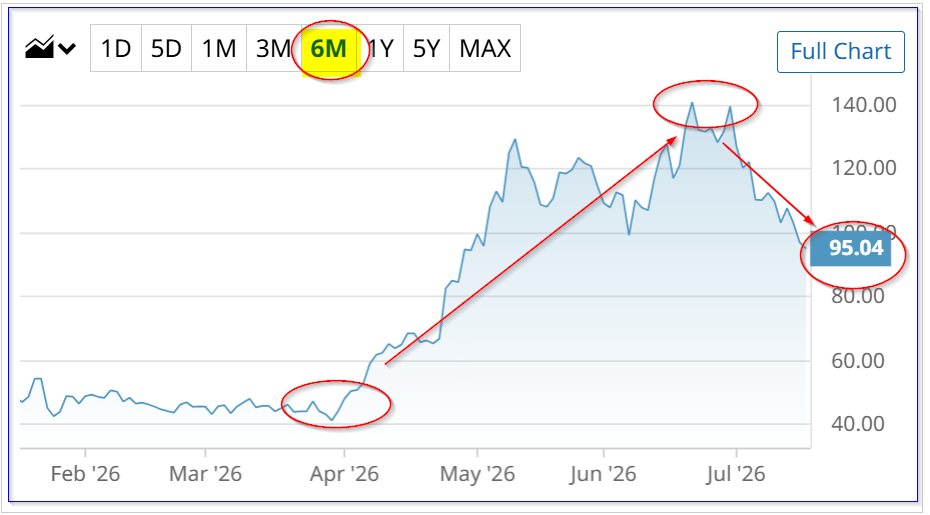
INTC stock - last 6 months - Barchart - July 17, 2026
High Expectations
This could be because some investors are wary of Intel's upcoming earnings release. Expectations are for lower earnings per share (EPS) at 22 cents (normalized), below last quarter's $0.29 EPS, according to Seeking Alpha.
Moreover, Intel continues to generate negative adjusted free cash flow (FCF). The market wants to see that become positive, preferably sooner rather than later. But that may not happen in Q2.
For example, last quarter (Q1), Intel generated just $1.096 billion in operating cash flow, but had $4.96 billion in capex. That resulted in a negative $2.2 billion adjusted FCF. That represents an outflow of cash from Intel - not what the market wants to see.
The only way this turns around is if revenue rises dramatically. That could be possible over the next year, given the huge demand for Intel chips from AI-related demand and hyperscalers' ever-increasing purchases.
In fact, management said last quarter they still expect to generate positive adj. FCF this year, exclusive of a large fab buildout (although I am not sure how they will factor that out).
Forecasting FCF and FMV
In my April 26 and June 23 Barchart articles, I showed how this could occur. I projected a price target (PT) of $147 per share by next year. This was based on analysts' revenue forecasts for 2027 ($65.45 billion) and on an 8.5% FCF margin ($5.55b FCF) and a 0.75% FCF yield, or a $740 billion fair market value, or FMV.
Moreover, since then, analysts have raised their revenue estimates. Now, the average 2027 revenue estimate is $66.17 billion. And, for 2026, they forecast $58.89 billion. (The next 12 months (NTM), the average is $62.53 billion.)
As a result, 2027 FCF could be $5.62 billion, and using a 0.75% FCF yield metric (i.e., multiplying FCF by 133.3x), the FMV is $749 billion. That is 56.8% higher than Intel's market cap of $477.67 billion today. That implies a price target of $149 per share (i.e., 1.568 x $95.02).
A more conservative estimate is $105.76 per share. That is 11.3% higher and is calculated using the $62.53 billion NTM revenue forecast, $5,315 billion in FCF (using an 8.5% margin), and a higher 1.0% FCF yield (i.e., $531.5 billion FMV, 11.3% over Friday's market cap).
Analysts agree with my lower PT estimate. For example, Yahoo! Finance reports that the average of 48 analysts is $106.70, and Barchart's mean survey PT is $108.46.
Both of these PTs are up significantly over the last month, as seen in my June 23 Barchart article (i.e., $94.75 and $94.86, respectively).
Shorting Puts Over the Next Month
However, put option premiums are very high, as investors are skeptical and worried whether Intel can deliver positive FCF. That provides a huge opportunity for short-sellers, especially in near-term expiry periods.
For example, the August 21, 2026, expiry period shows that an $80.00 strike price put (i.e., 15.8% lower than Friday's price) has a midpoint premium of $4.83. That provides a huge yield opportunity for short-sellers (i.e., $4.83/$80.00 = 0.060375 = a 6.0375% 1-month yield.
And, for more risk-averse investors, the $75.00 strike price put (21% lower than Friday's price) has a 4.533% short-put yield (i.e., $3.40/$75.00 = 0.04533). Both of these are incredibly high yields for a one-month expiry period.
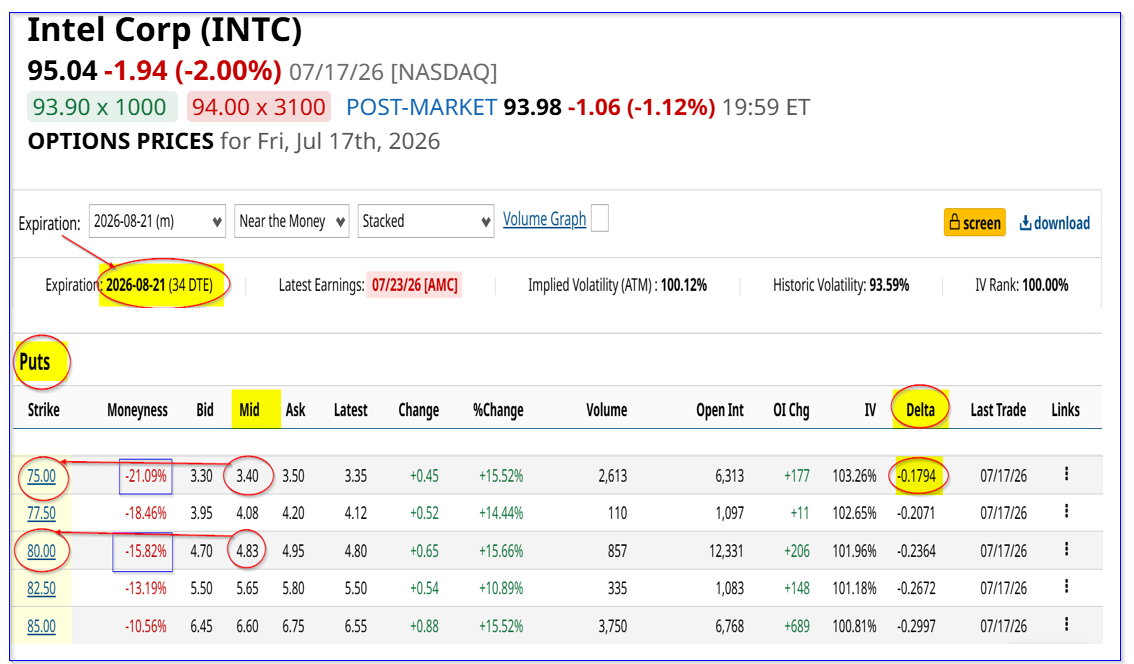
INTC puts expiring Aug. 21 - Barchart - As of July 17, 2026
Moreover, there is a huge volume of outstanding contracts at this strike price, indicating a large number of buyers and sellers. Moreover, the delta ratio is very low at -0.1794. That implies less than an 18% chance that INTC will drop 21% to $75 by Aug. 21.
However, even if it does, the investor's breakeven point (after the account is assigned to buy 100 shares at $75.00 for $7,500) is lower:
$7,500 - $340 already received = $7,160 for 100 shares, i.e., $71.60 per share breakeven
That's almost 25% lower than Friday's close (-24.7%). INTC would really have to show lousy results for that to occur. Moreover, given my $105.76 price target, the upside is high (i.e., $105.76/$71.60 = +47.7%).
The bottom line is that INTC looks too cheap here. One way to play it is to sell short deep out-of-the-money (OTM) puts.



Comments
Log in or sign up to join the conversation.