

Intel High-NA EUV machines are now printing layers of production processors, and that confirmation from Intel (INTC) and ASML (ASML) is the trigger for this INTC stock forecast. After several years of falling behind in chipmaking technology, heavy losses and large investments to rebuild its factories, Intel is winning back ground in advanced chip production. A breakout above resistance at 107 USD is the level that turns this news into a trade.
Next earnings date: Intel is scheduled to report third-quarter 2026 financial results after the market close on 29 October 2026.
Trade Idea Parameters
Below are the specific parameters for the Intel trade idea. The ticker for trading via RoboForex MobileTrader and MT5 on RoboForex is INTC.
Parameter | Value |
|---|---|
Instrument | Intel Corp (NASDAQ: INTC) |
Ticker in MobileTrader / MT5 | INTC |
Idea Date | September 15, 2026 |
Time Horizon | 3 months |
Direction | ↑ Buy (Long) |
Entry Level (trigger) | 108.00 USD, Buy Stop |
139.00 USD | |
95.00 USD | |
Risk per Trade | No more than 3% of account · Medium risk |
High-NA Becomes Intel’s New Advantage
Investors have received clear evidence that Intel's long rebuild of its manufacturing business is starting to pay off. Together with ASML, the company announced that it is using High-NA EUV in volume production of selected layers of its Panther Lake processors, built on the Intel 18A process.
The news carries extra weight because of what came before it. For several years Intel trailed TSMC (TSM) in manufacturing technology, lost processor market share to AMD (AMD) and spent tens of billions of dollars on new fabs with no quick financial return. Now Intel 18A is in production, margins are recovering, Foundry losses are shrinking, and High-NA is running in production earlier than at Intel's main competitors.
For anyone analysing Intel stock, High-NA matters first as proof that years of investment in rebuilding production are starting to deliver technological results.
What High-NA EUV Is and Why the Technology Matters
High-NA EUV is the next generation of equipment for making the most advanced semiconductors.
Today's leading processors are made with EUV lithography. ASML's machines print extremely small features of a future processor onto a silicon wafer. The smaller those features, the more transistors fit on a single chip, which raises performance and lowers power consumption.
According to ASML, the new technology prints features 40% smaller. For chipmakers that brings several advantages:
transistors can keep shrinking
chips become denser
complex layers need fewer separate lithography steps
performance and energy efficiency improve
more complex processors for artificial intelligence become possible
The technology is very expensive. A single ASML High-NA system costs about 400 million USD, so manufacturers have to show that the gains justify that level of capital spending.
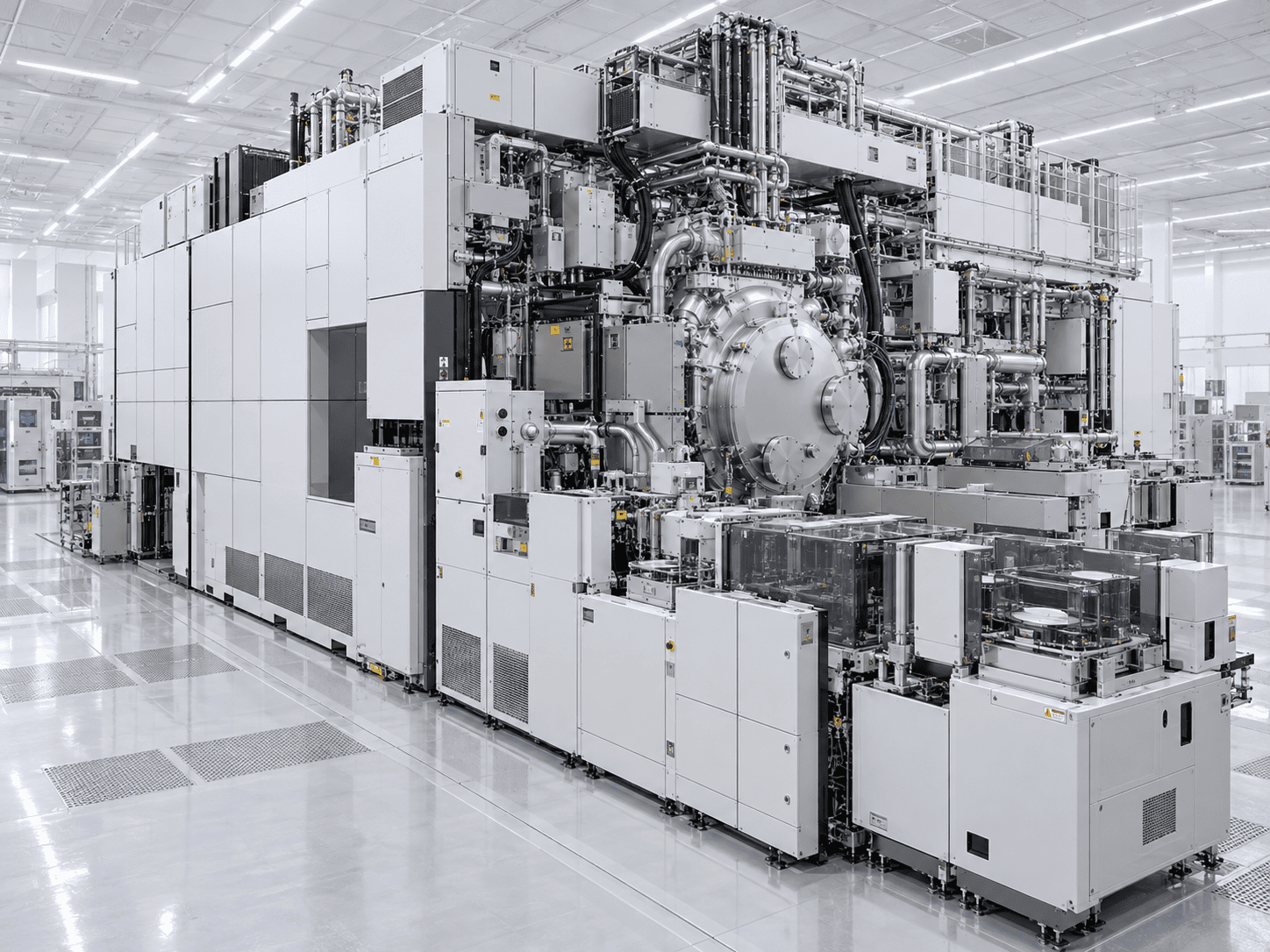
Illustration of a High-NA EUV lithography system used to make advanced semiconductor chips.
Intel took this risk before its competitors. It received the first commercial High-NA system back in 2024 and is already using the equipment in volume production. TSMC, Samsung (SSNLF), SK Hynix (HXSCL) and other large manufacturers are also moving to High-NA, and most of them expect to adopt it at scale later. Samsung plans to start using High-NA in volume DRAM production in 2028, and TSMC intends to bring it into volume production of advanced chips from around 2030. SK Hynix installed its first commercial High-NA system in 2025 and has not yet named a date for large-scale production. Overall, ASML expects wider adoption of High-NA among its customers in 2027 and 2028.
High-NA EUV in chip production: who gets there when
2024
Intelreceives the first commercial High-NA system.
2025
SK Hynixinstalls its first commercial system. No date yet for large-scale production.
2026
NowInteluses High-NA in volume production of Panther Lake layers on Intel 18A.
2027 to 2028
ASML customersadopt High-NA more widely, as ASML expects.
2028
Samsungplans to use High-NA in volume DRAM production.
Around 2030
TSMCplans to bring High-NA into volume production of advanced chips.
Dates as announced by Intel, ASML, Samsung and SK Hynix, linked in the text above. Plans can move.
It is still too early to call this a technological win over TSMC. The Taiwanese company remains far larger in contract manufacturing volume, customer base and the utilisation of its advanced fabs.
How Investment Reshaped Intel’s Manufacturing Business
Intel's large-scale manufacturing rebuild began in 2021, after Pat Gelsinger returned to the company. The IDM 2.0 strategy set out to restore technology leadership and to build a contract manufacturing business for outside chip designers.
Intel announced 20 billion USD of investment in new fabs in Arizona and more than 28 billion USD in a manufacturing site in Ohio. Its total programme of manufacturing and research investment in the United States later passed 100 billion USD. The money went into new fabs, ASML equipment, Intel 18A and the process generations that follow it.
The rebuild came at a high cost. Intel Foundry's operating loss was about 7 billion USD in 2023 and grew to 13.3 billion USD in 2024. At the same time Intel was losing ground in processors and trailing TSMC in manufacturing technology. Investors doubted the huge spending would pay back, and from the 2021 high to the 2025 low Intel shares lost more than 70% of their value.
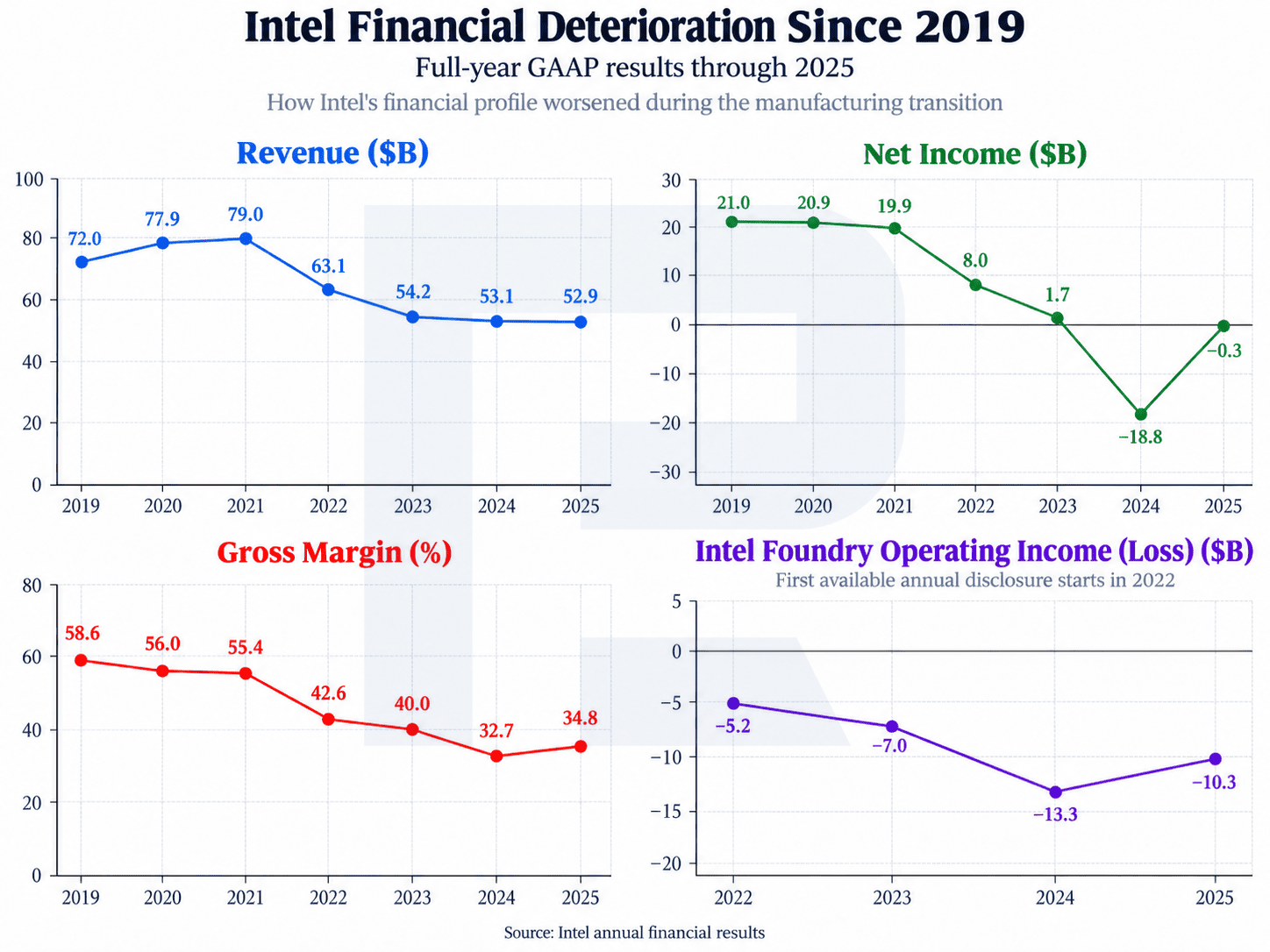
Intel key financial results, 2019 to 2025. Source: Intel annual financial results. Past results do not guarantee future performance.
The chart shows the turn as well: the Foundry loss narrowed to 10.3 billion USD in 2025 and gross margin rose from 32.7% to 34.8%.
Government support offset part of the financial burden. In 2024 Intel secured approval for up to 7.86 billion USD of funding under the CHIPS Act and up to 3 billion USD under the Secure Enclave programme. In 2025 the US government agreed to invest 8.9 billion USD in exchange for 433.3 million new Intel shares at 20.47 USD each, giving it about 9.9% of the company. Most of that 8.9 billion came from funding that had already been approved, and total government support for Intel reached 11.1 billion USD.
The support did not cover the full cost of the rebuild. It did help Intel keep capital spending high through the hardest period for the company. The manufacturing programme stayed intact, and fab upgrades and new process development kept their funding even while Foundry losses were large.
From a fundamental point of view, this points to a gradual shift for INTC: from years of heavy investment and growing losses toward the first signs of a recovery in the manufacturing business.
Intel Could Become an Alternative to TSMC
NVIDIA, AMD, Apple, Qualcomm (QCOM) and Broadcom (AVGO) design their own processors, and a large share of their most advanced products is made in TSMC's fabs.
Intel could offer these companies a second manufacturer of advanced processors on US soil. That would let customers reduce their dependence on a single supplier and on production capacity in Taiwan.
Government support alone does not win Intel new contracts. To compete with TSMC, the company has to match it on performance, power consumption, chip yield, cost and manufacturing reliability.
The first signs of interest are already here. Microsoft (MSFT) chose Intel 18A for one of its own processors, Amazon signed a multi-year agreement with Intel, and NVIDIA (NVDA) and Broadcom tested individual components on Intel 18A. AMD also assessed the new process.
None of this amounts to a mass move of customers from TSMC to Intel yet. For Intel stock analysis, what counts is that the largest chip designers are again treating Intel Foundry as a possible manufacturing partner.
The average target price is 113.90 USD, the highest forecast is 200 USD and the lowest is 75 USD. A range that wide reflects how uncertain the market is about the pace of Intel Foundry's recovery, the company's ability to win large outside customers and further improvement in its financial results.
Worth noting for this idea: the 139 USD target below comes from the chart, and it sits 22% above the analyst average.
INTC Technical Analysis and Intel Stock Forecast
At the time of writing, INTC shares trade close to 99 USD.
On the daily timeframe the stock holds above its 200-period Moving Average, which points to a prevailing uptrend. The Stochastic oscillator, meanwhile, is approaching overbought territory. After the recent rise that makes a short pullback more likely, especially ahead of the Federal Reserve rate decision on 16 September.
A rate increase usually puts pressure on technology companies. It raises the cost of borrowing and lowers the value investors place today on cash the company expects to earn in the future. For Intel the effect is stronger than for most, because the company is still spending heavily on modernising its fabs and scaling up production.
That makes buying at the current market price less attractive. A short pullback could trigger the stop-loss before the main uptrend resumes.
The more careful scenario opens a position only after a breakout above resistance at 107 USD. The descending trend line from the June high also crosses the price in that area. A move that holds above 107 USD would confirm that buyers are strong enough to extend the rise. The trade idea for INTC therefore places a Buy Stop order at 108 USD. The target is 139 USD, just under the all-time high near 141 USD set in June. The stop-loss goes at 95 USD.
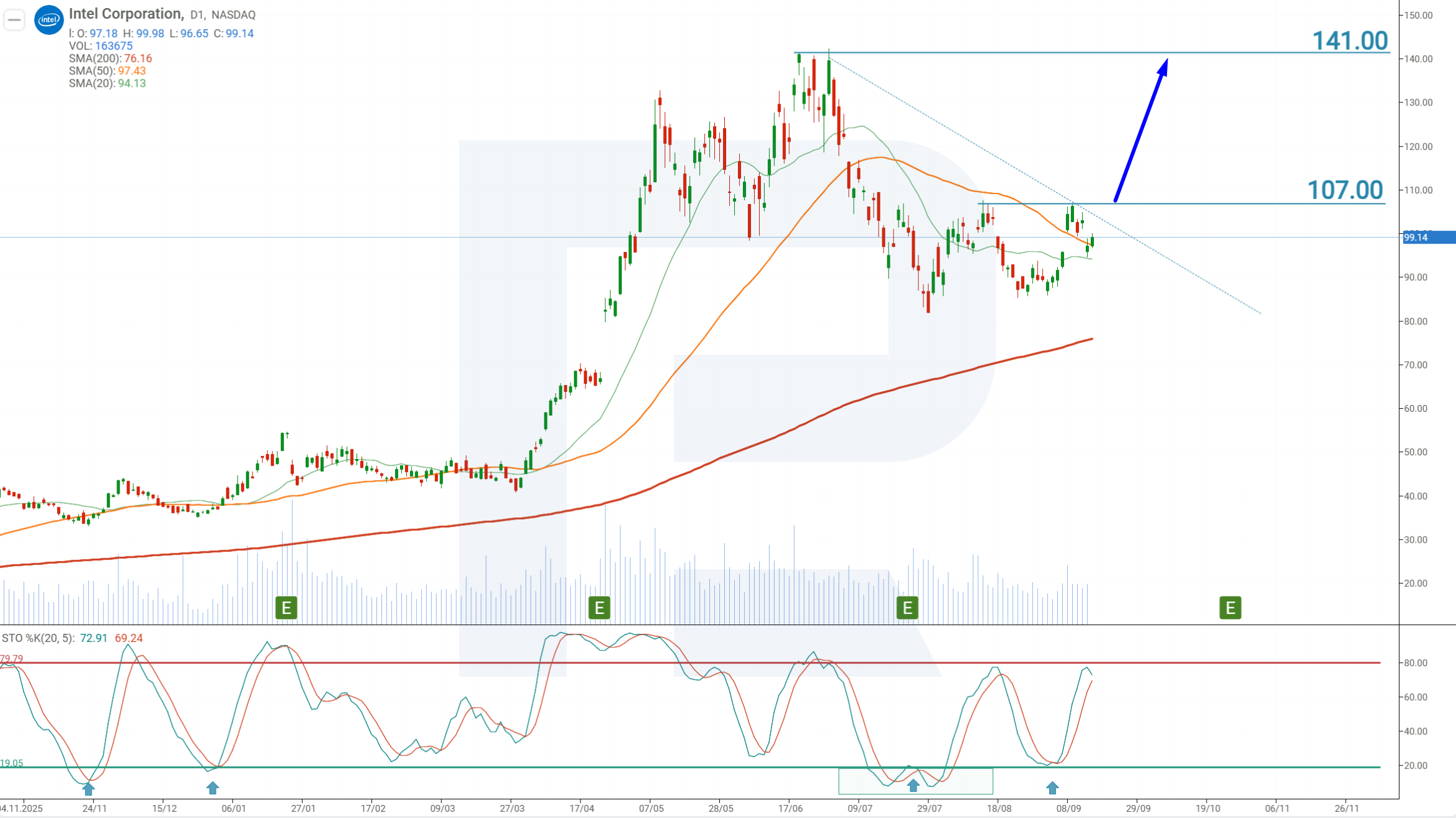
Intel Corp (INTC) stock technical analysis and forecast, daily chart. Past results do not guarantee future performance.
The 200-day Moving Average stays below the price, which confirms the strength of the long-term uptrend.
Stochastic is approaching overbought territory, which points to a possible pullback before the next leg higher.
A Buy Stop order at 108 USD fits this situation best, because the position opens only after the breakout and a short pullback from the current price cannot reach the stop-loss first.
The all-time high is the nearest upside objective for INTC shares.
Position management rule
Once the price has covered 70% of the distance to the target, at about 129.70 USD, the stop-loss moves to the entry level at 108 USD. From there it trails the price at a distance of 10% below it. Management continues until the position closes at the take-profit or the stop-loss, whichever is reached first.
Sample Trading Strategy for INTC Shares
Below is a sample trading strategy for INTC shares. This example is for educational purposes only and does not constitute investment advice. Investors should assess their own risk tolerance independently.
Parameter | Value |
|---|---|
Entry Point | Buy Stop at 108.00 USD, above resistance at 107.00 USD |
Take Profit | 139.00 USD, just under the all-time high |
Stop Loss | 95.00 USD |
Risk / Reward Ratio | 1 : 2.4 |
Risk per Trade | No more than 3% of account |
Position Size Calculator for INTC Shares
Entry at 108 USD and a stop-loss at 95 USD mean each share risks 13 USD. Set your account size and the share of it you are ready to risk. The recommended risk for this idea is no more than 3% of the account per trade.
Account size, USD
1,000100,000
Risk per trade, %
0.5%3% recommended10%
Shares
23
risk 300 USD
Position value
2,484 USD
24.8% of the account
Loss at 95 USD
−299 USD
3.0% of the account
Profit at 139 USD
+713 USD
7.1% of the account
Whole shares, rounded down so the loss stays within the risk you set. Educational example, not investment advice.
A risk/reward ratio of 1:2.4 means the potential gain is more than twice the risk taken on. Keep in mind that markets are volatile: INTC shares can move both for and against an open position.
When This Idea Stops Being Valid
Three conditions end it.
The trigger never fires. If INTC does not break above 107 USD within the three-month horizon, the Buy Stop at 108 USD is never filled and the idea expires in mid-December 2026 with no position.
The pullback runs through 95 USD before entry. A daily close below 95 USD while the order is still pending breaks the structure the stop-loss is built on. The pending order is cancelled.
The stop-loss is hit after entry. Once the position is open, a fall to 95 USD closes it with a loss of about 12% of the position value, and the case for a rise to 139 USD no longer holds.
One more condition sits outside the chart. A delay to Intel 18A, or large customers walking away after testing the process, would remove the reason the market is re-rating the stock, even while the price holds above 107 USD.
What Intel Still Has to Prove
Intel has made visible progress, and the investment case still carries real risk because the recovery of its manufacturing business is unfinished. These are the factors that could change the story:
Intel Foundry is still loss-making. Results are improving, yet the division still posts large operating losses and its revenue from outside customers remains small.
Capital spending stays high. Intel 18A, High-NA and new fabs need huge investment, so the rebuild will keep weighing on the company's cash flow.
TSMC is a strong competitor. The Taiwanese company is still far ahead of Intel in scale, customer base and the utilisation of its advanced fabs.
The High-NA lead is temporary. Samsung, TSMC and other manufacturers are preparing to adopt High-NA, so Intel's head start may narrow over time.
Large outside orders may not arrive. Testing by NVIDIA, Broadcom and others does not yet guarantee meaningful volume contracts.
Investor expectations are high. After the strong recovery in the share price, delays to Intel 18A, weak results from new fabs or a lack of large customers could trigger a sharp correction in INTC.
The chart also marks Intel's next quarterly report in late October, inside the three-month horizon of this idea. Any of the points above can move the stock sharply on that day.
Further gains in INTC depend on Intel turning its technology progress into large outside orders, raising Foundry profitability and delivering a lasting improvement in financial results.
Should You Buy Intel Stock on This News?
Using High-NA EUV in volume production lowers the technology risk around Intel 18A and confirms that years of investment are starting to deliver practical results. The news does not yet prove that Intel Foundry has become a full alternative to TSMC.
The clearest confirmation of a turnaround would be large outside orders, fast growth in Foundry revenue from outside customers, higher chip yields and a further cut in operating losses.
Intel shares look interesting as a bet on a continued recovery, especially if the company starts winning large outside orders. The choice of entry point matters. For traders the actionable level is 107 USD: a confirmed breakout fills the Buy Stop at 108 USD and activates the long scenario toward 139 USD, while a daily close below 95 USD cancels the setup.

Comments
Log in or sign up to join the conversation.