


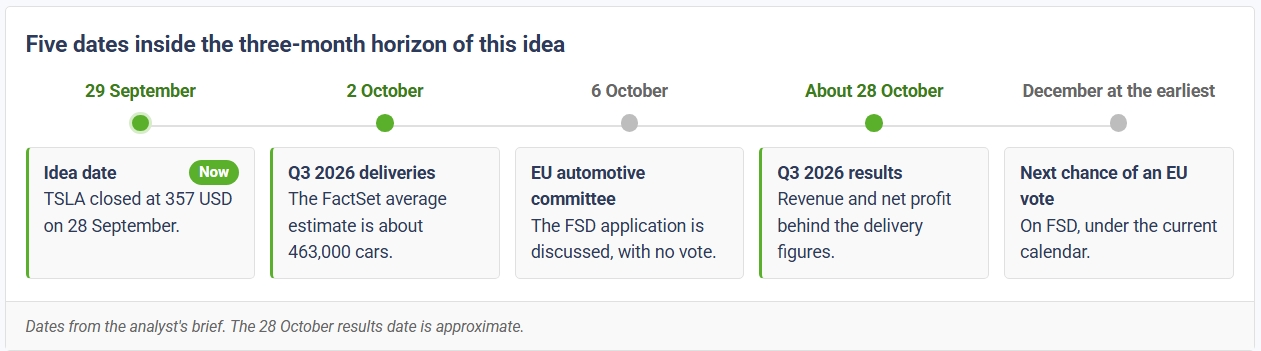
This Tesla (TSLA) stock forecast 2026 trade idea is built around 2 October, when Tesla reports its Q3 2026 deliveries. Sales in Europe are recovering while Chinese rivals grow even faster, and the EU decision on FSD has slipped to December at the earliest. On the chart TSLA stays in a downtrend, and the idea sells only after a break of support at 353 USD.
Driver Q3 deliveries on 2 October, forecast at about 463,000 cars, below last year's record
Europe EU-wide FSD vote moved to December at the earliest, Chinese rivals growing faster
Analysts 17 of 41 rate TSLA a Buy, targets from 123 to 600 USD
Caution A delivery beat can lift the stock, so the entry waits for a break of support
Trade Idea Parameters
Below are the specific parameters for the Tesla Inc trade idea.
Parameter | Value |
|---|---|
Instrument | Tesla Inc (NASDAQ: TSLA) |
Ticker in MobileTrader / MT5 | TSLA |
Idea Date | September 29, 2026 |
Time Horizon | 3 months |
Direction | ↓ Sell (Short) |
Entry Level (trigger) | 351.00 USD, Sell Stop |
325.00 USD | |
361.00 USD | |
Risk / Reward Ratio | 1 : 2.6 |
Risk per Trade | No more than 3% of account · Medium risk |
Tesla Q3 Deliveries and the EU Delay on FSD
Tesla is scheduled to publish its Q3 2026 deliveries on 2 October. After a sharp rise in the second quarter, the new figure will show whether demand held up, and the comparison with the record Q3 2025 will show whether Tesla has returned to growth year on year.
The second story is in Europe. On 25 September it emerged that the EU automotive committee will only continue discussing Tesla's Full Self-Driving (FSD) application at its 6 October meeting, and the expected vote will not take place. The application stays open, and the delay keeps Tesla from offering FSD across the whole European market at a time of growing competition.
The deliveries will show where demand for Tesla cars stands now. The FSD decision shapes how far Tesla can build on its European sales in the quarters ahead.
Tesla Q3 2026 Deliveries Forecast
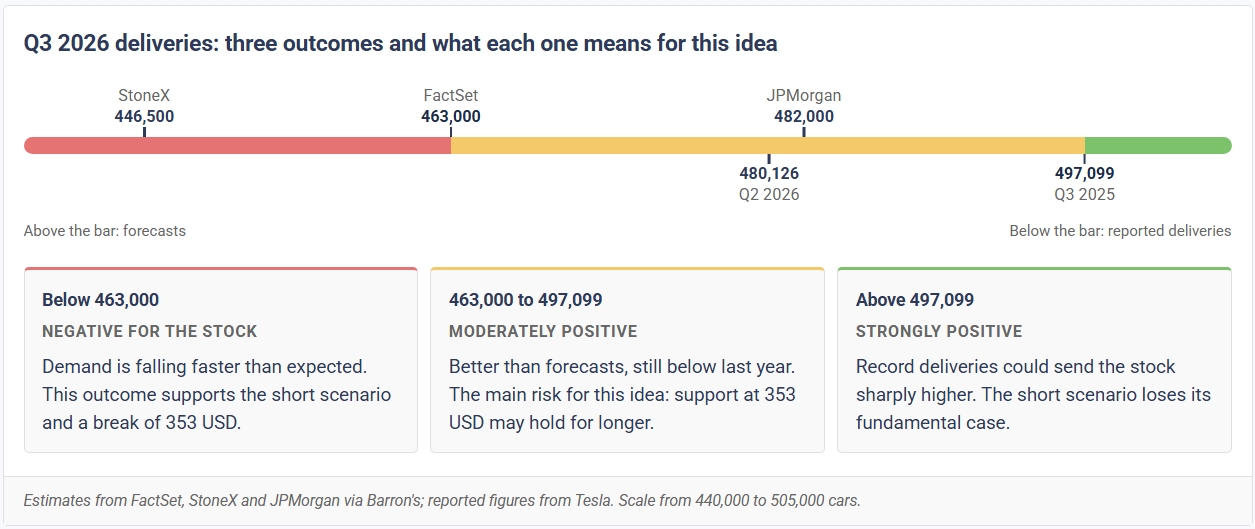
FactSet data cited by Barron's puts the average expectation for Tesla deliveries at about 463,000 cars. That would be 3.6% fewer than in Q2 2026 and 6.9% fewer than in Q3 2025. Estimates vary widely: StoneX expects about 446,500 cars and JPMorgan about 482,000. The spread shows how hard it is to judge how durable demand for Tesla cars is right now, and even the most optimistic forecast stays below the Q3 2025 result.
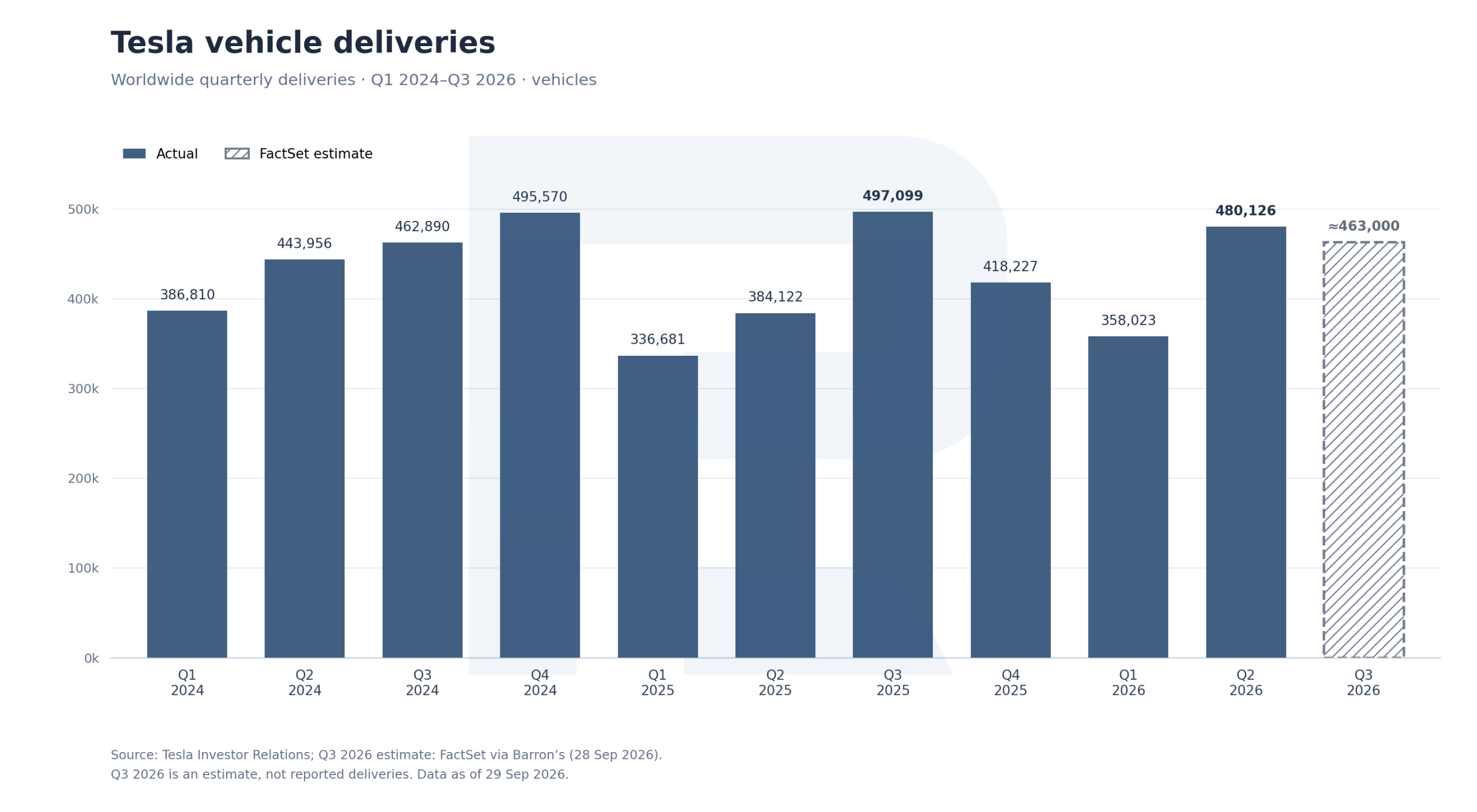
Tesla worldwide vehicle deliveries by quarter, Q1 2024 to Q2 2026, and the Q3 2026 estimate. Source: Tesla Investor Relations; Q3 2026 estimate: FactSet via Barron's. Past results do not guarantee future performance.
The report is expected on 2 October, and the market will judge it in two steps: first the actual figure against the average forecast of 463,000, then against last year's 497,099. The reaction depends on where the result lands.
The financial side of these deliveries, revenue and net profit, arrives later: Tesla's full Q3 2026 results are expected around 28 October.
Tesla Gains Ground in Europe as Competition Grows
Europe gives Tesla an important signal of strong demand for electric cars. According to ACEA data, 142,165 Tesla cars were registered in the EU in January to August 2026, 65.9% more than in the same period last year. Over the same months the EU market for battery-electric cars grew 44.9% to 1.64 million vehicles, and their share of all new cars reached 21.7%.
+65.9% Tesla registrations in the EU, to 142,165 cars
+44.9% EU battery-electric market, to 1.64 million cars
21.7% Battery-electric share of all new cars in the EU
January to August 2026 against the same period of 2025. Source: ACEA.
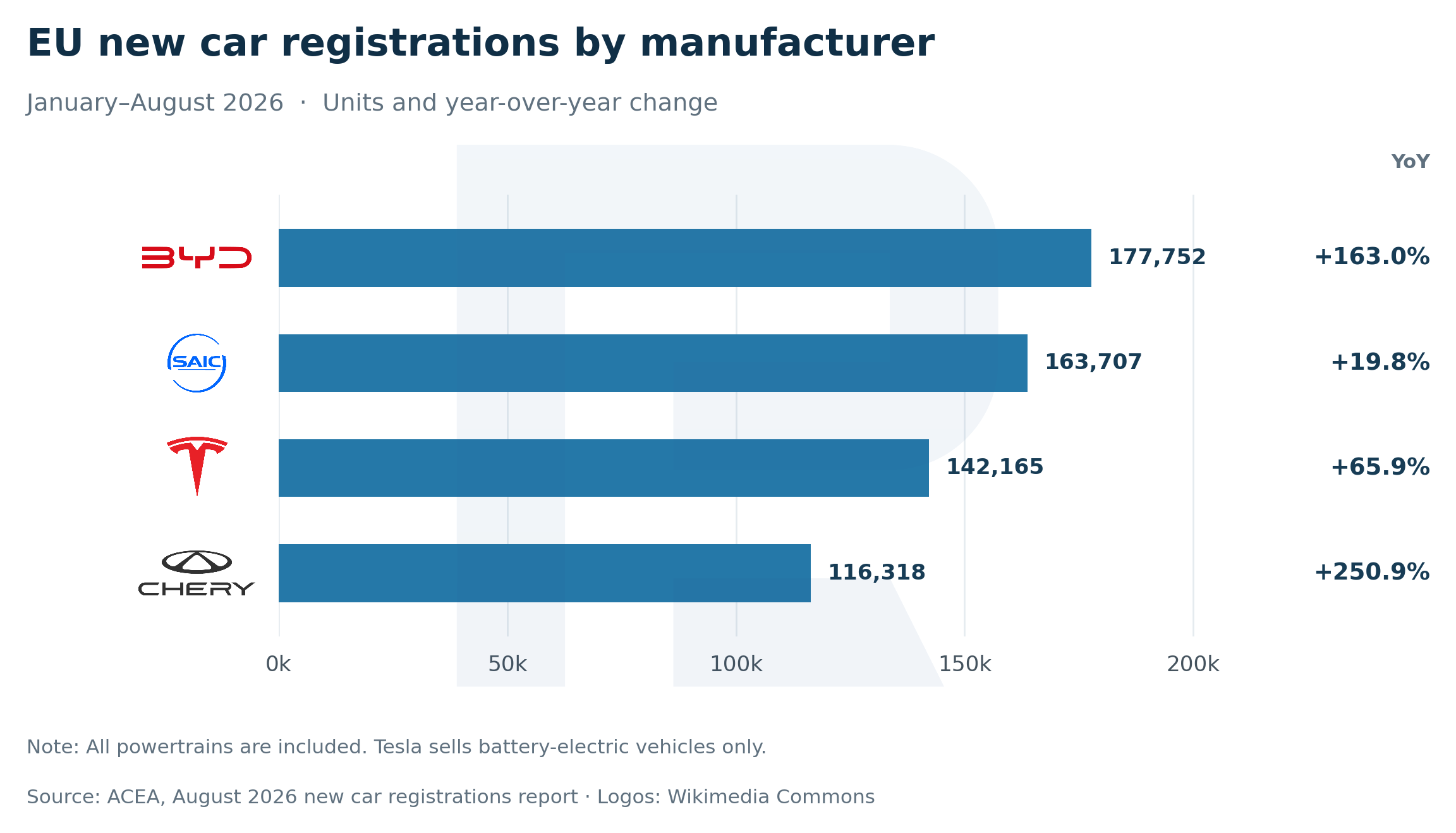
EU new car registrations by manufacturer, January to August 2026. All powertrains included; Tesla sells battery-electric cars only. Source: ACEA. Past results do not guarantee future performance.
Competition is growing just as fast as demand. Over the same eight months Chinese carmakers made a strong push in the EU. Their figures cover all powertrains, while Tesla sells only battery-electric cars:
BYD: 177,752 registrations, +163.0% year on year
SAIC Motor: 163,707 registrations, +19.8% year on year
Chery Automobile: 116,318 registrations, +250.9% year on year
Tesla's sales in Europe are growing faster than the electric car market, and holding its position is getting harder. Two things make the recovery difficult to lock in: Chinese rivals expanding faster than the market, and the slow path to EU-wide approval of FSD, which postpones an extra advantage Tesla could offer across the whole EU.
FSD Remains a Key Factor for Tesla in Europe
Tesla has a way to set its cars apart in the European market: the Full Self-Driving driver assistance system. After more than 18 months of testing, the Dutch regulator RDW approved its use in the Netherlands on 10 April 2026. FSD is supervised driver assistance: the driver has to watch the road and stays responsible for driving. Several other European countries then allowed the system, while EU-wide approval is still pending.
Tesla had allowed for a decision at the 6 October vote. The agenda of the EU automotive committee now provides only for further discussion of the application. The next chance of a vote under the current calendar comes in December at the earliest, and a positive outcome is uncertain even then. France opposes approving the system in its current form over safety questions, and Sweden has raised concerns about compliance with speed limits.
EU-wide approval would give Tesla an extra selling point and let it earn subscription revenue across Europe. Until then, the company can only scale FSD country by country.
TSLA Analyst Ratings
As of September 2026, Barchart analyst ratings for TSLA are moderately positive. Of the 41 analysts tracked, 17 rate the stock a Buy, 20 a Hold and 4 a Sell.
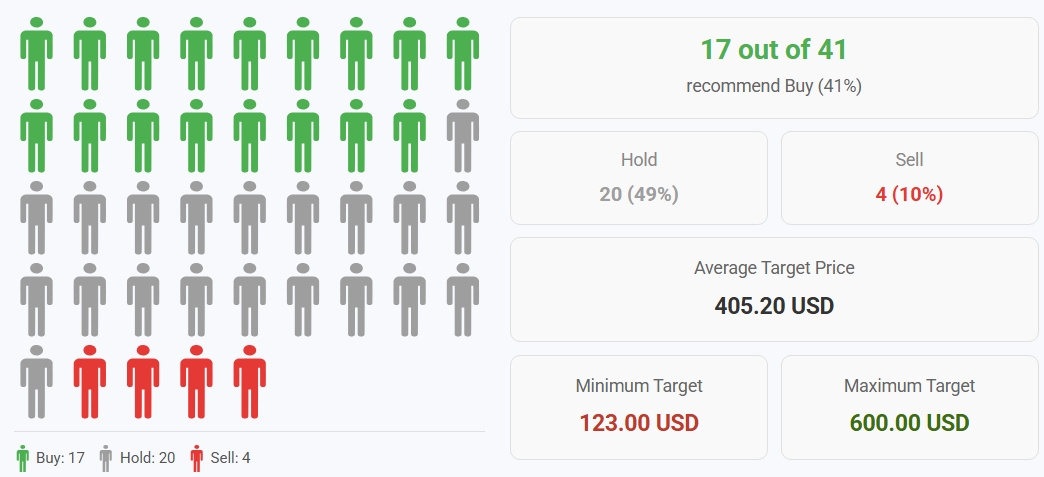
The average target price is 405.20 USD, 13.5% above the 28 September close of 357 USD. Individual targets range from 123 to 600 USD. That spread shows there is no single view on Tesla's prospects, and the Q3 2026 deliveries could become an important test of market expectations.
Worth noting for this idea: the 325 USD target below comes from the chart. It sits about 20% below the analyst average and well above the lowest forecast on the street.
TSLA Technical Analysis and Stock Forecast
TSLA closed at 357 USD on 28 September.
On the daily chart TSLA trades below its 200-period Moving Average and keeps moving inside a descending channel. The rise that began in August 2026 was a local correction: buyers could not break the medium-term trend or reach the 200-period Moving Average, which points to their weakness. The Stochastic oscillator has turned down from the overbought zone, a sign the corrective rise is fading, and that raises the risk of the decline resuming.
A double top pattern on the chart adds to the case for a decline. If support at 353 USD breaks, the pattern's technical objective is 325 USD.
Based on this technical analysis of TSLA, the trade idea places a Sell Stop order at 351 USD. The take-profit is set at 325 USD and the stop-loss at 361 USD.
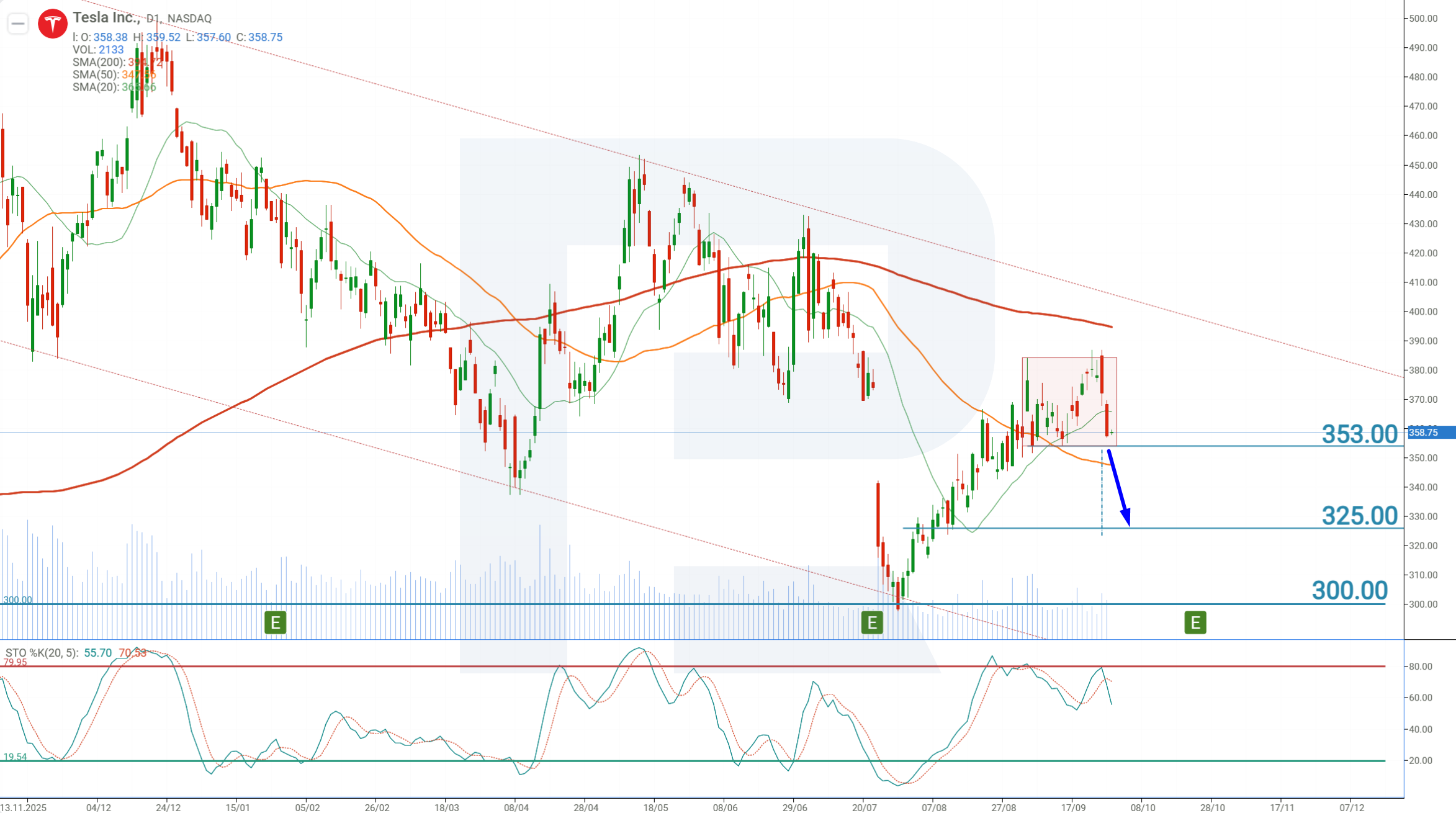
Tesla Inc (TSLA) stock technical analysis and forecast, daily chart. Past results do not guarantee future performance.
The technical analysis leads to these conclusions:
The medium-term trend stays down. TSLA trades inside a descending channel and below the 200-period SMA, which confirms the strength of sellers and the weakness of buyers.
The corrective rise is running out. Stochastic has turned down from the overbought zone, a sign that the local bounce is ending and the decline may resume.
A reversal pattern has formed. The double top is the main medium-term sell signal, with a technical objective at 325 USD.
The trigger for a decline in TSLA is a break of support at 353 USD.
Position management rule
Once the price has covered 70% of the distance to the target, at 332.80 USD, the stop-loss moves to the entry level at 351 USD. From there it trails the price at a distance of 5% above it. Management continues until the position closes at the take-profit or the stop-loss, whichever is reached first.
Sample Trading Strategy for TSLA Shares
Below is a sample trading strategy for TSLA shares, built on the parameters in the table at the top of this article. This example is for educational purposes only and does not constitute investment advice. Investors should assess their own risk tolerance independently.
Sample Calculation for 10 TSLA Shares
Scenario | Calculation | Result |
|---|---|---|
Sell 10 shares at 351 USD | 10 × 351 USD | 3,510 USD |
Target reached (325 USD) | (351 − 325) × 10 | +260 USD (+7.4%) |
Stop triggered (361 USD) | (361 − 351) × 10 | −100 USD (−2.8%) |
Risk / Reward | 100 / 260 | 1 : 2.6 |
A risk/reward ratio of 1:2.6 means the potential gain is more than twice the risk taken on. Keep in mind that markets are volatile: TSLA shares can move both for and against an open position.
Position Size Calculator for TSLA Shares
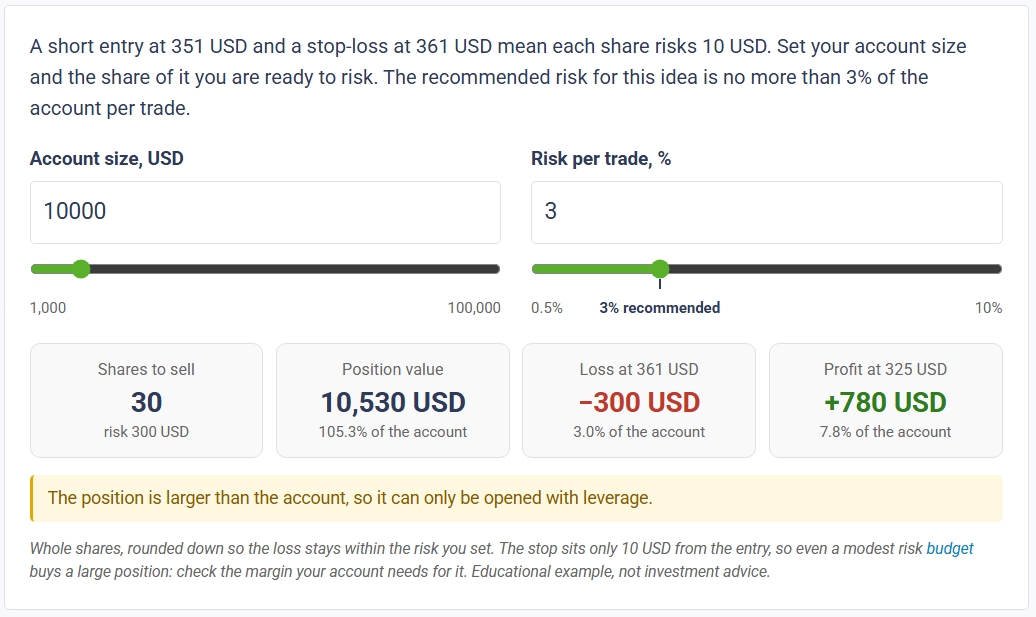
When This Idea Stops Being Valid
Three conditions end it.
Support at 353 USD holds. TSLA closed at 357 USD, so the Sell Stop at 351 USD needs a fall of about 1.7% to fill. If the price stays above support through the three-month horizon, the order expires unfilled at the end of December 2026.
Q3 deliveries beat the record. A result above the 497,099 cars of Q3 2025 removes the fundamental case for a decline, and a pending order that has not filled yet is withdrawn.
The stop-loss is hit after entry. Once the short is open, a rise to 361 USD closes it with a loss of about 2.8% of the position value, and the case for a fall to 325 USD no longer holds.
What Could Support TSLA Against This Forecast
The trend points down, and the coming delivery data and the next steps on FSD could still support Tesla shares and call the bearish forecast into question. The main risks for the TSLA downside forecast are these:
Deliveries come in stronger than expected. If the Q3 result clearly beats the market estimate of about 463,000 cars and approaches the record 497,099 deliveries a year earlier, investors may read it as proof of durable demand. That result would raise the chance of the stock rising.
The European recovery continues. Tesla's EU registrations rose 65.9% year on year in January to August. If the company keeps that pace in a growing electric car market, concerns about losing its position may ease.
FSD makes progress. The EU-wide vote is postponed, and individual countries keep approving the system. New national approvals or a constructive EU discussion of the application could lift investor expectations ahead of a final decision.
Delivery growth comes without price cuts. If Tesla raises sales without large discounts, that supports revenue and the profitability of the car business. Strong delivery data would then be a more convincing argument against the downside forecast.
Should You Sell TSLA Stock Now?
Opening a short position before support at 353 USD breaks looks premature. Tesla is expected to publish its Q3 2026 deliveries on 2 October, and the result could move the stock sharply in either direction. The average market forecast is about 463,000 cars, so a strong beat could support the price for a while and delay the downside scenario.
The technical picture stays mostly negative: the stock trades below the 200-period Moving Average, keeps moving inside a descending channel, and a double top has formed on the chart.
The more conservative option is therefore to wait for the price to hold below 353 USD. That signal would confirm the downside scenario and give a better-grounded point to open a short position.



Comments
Log in or sign up to join the conversation.