

The Indian Rupee (INR) opens on a flat note against the US Dollar (USD) on Thursday after a holiday the previous day. Still, USD/INR is close to its 10-day low of 95.40. The pair was expected to open positive due to lower oil prices; however, the recovery move in the US Dollar on Wednesday on the back of the sticky United States (US) Personal Consumption Expenditure (PCE) Price Index report for July has offset the same.
At press time, the US Dollar Index (DXY), which tracks the Greenback’s value against six major currencies, holds onto Wednesday’s gains near 99.15.
US PCE inflation accelerates at faster-than-expected pace in July
On Wednesday, the US Bureau of Economic Analysis (BEA) reported that core PCE inflation, which is closely tracked by Federal Reserve (Fed) officials, arrived in line with estimates and the prior release of 3.3% Year-on-Year (YoY). The headline PCE Price Index also grew at a steady pace of 3.7% YoY, while it was expected to cool down to 3.6%.
Signs of price pressures remaining sticky are expected to keep fears of Federal Reserve (Fed) interest rate hikes this year intact.
However, there has been no change observed in the Fed’s interest rate expectations for the September meeting after the inflation data release as of now.
According to the CME FedWatch tool, the odds of the Fed leaving interest rates unchanged in the September policy meeting are almost steady at 64%.
Jackson Hole Symposium awaited
The next major trigger for global financial markets could be remarks from Fed Chairman Kevin Warsh at the Jackson Hole Symposium.
Strategists at DBS flag Fed Chairman Kevin Warsh’s Jackson Hole keynote on Friday, August 28, as “the most important event this week,” but stress that the symposium is being “viewed more as a credibility event rather than a rate-signalling one.”
In their view, “Warsh faces a difficult balancing act: defending the Fed’s independence and price-stability mandate while providing greater clarity on the Fed’s reaction function without abandoning his preference for less forward guidance.”
Iran and Oman reach Hormuz deal
The confirmation from the Islamic Revolutionary Guard Corps (IRGC) that it has reached a revenue-sharing agreement with Oman on the Strait of Hormuz, a critical chokepoint for almost one-fifth of global energy supply, has weighed on oil prices.
However, the IRGC clarified that the reopening of the Strait of Hormuz will take more than just a deal with Oman.
In the opening session, the MCX Crude Oil contract expiring on September 21 is 0.75% lower at around Rs. 7,834.
Lower oil prices bode well for currencies from economies such as India, which rely heavily on oil imports to meet their energy needs.
USD/INR Technical Analysis
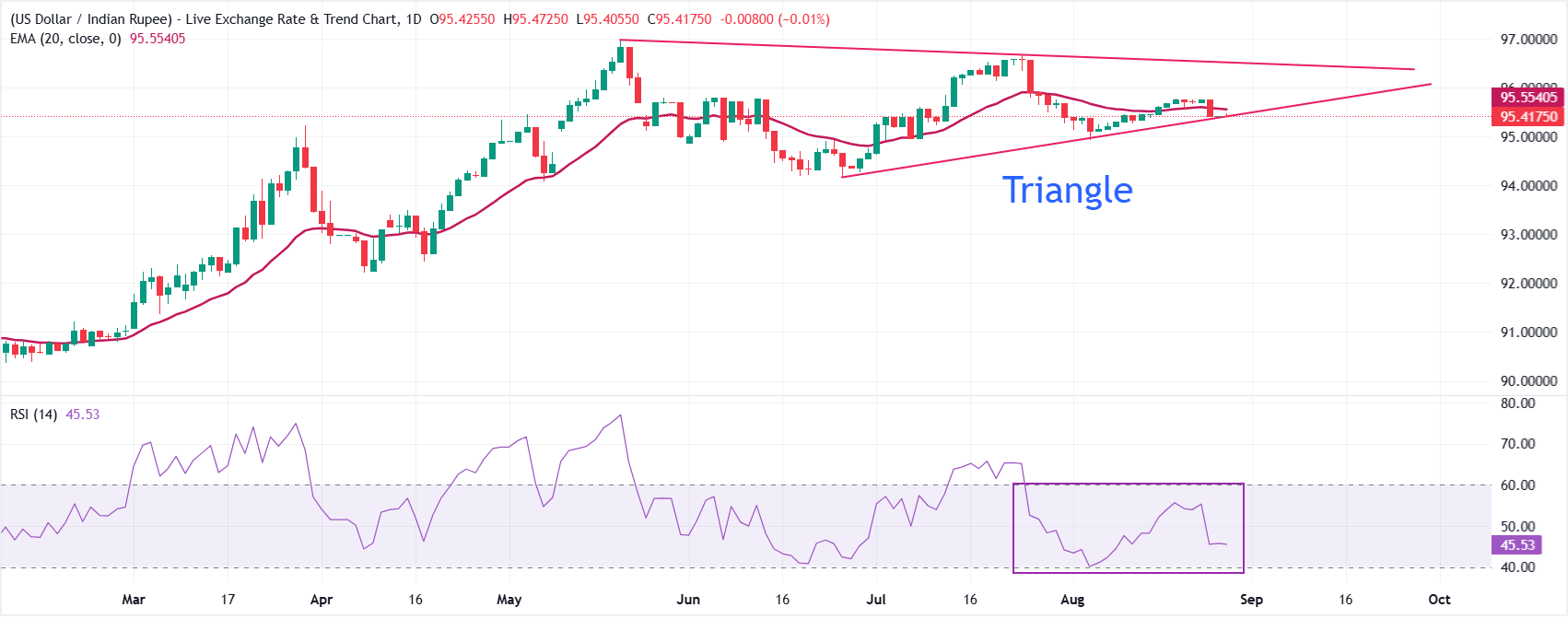
In the daily chart, USD/INR trades at 95.42, keeping a mildly bearish near-term tone as it slips just beneath the 20-period exponential moving average (EMA) at 95.5543. Broadly, the triangle formation reflects a sharp volatility contraction, which indicates a sideways trend.
The Relative Strength Index (14) inside the 40.00-60.00 zone also signifies indecisiveness among investors.
On the topside, initial resistance is seen at the 20-period EMA at 95.55, followed higher by the downward trendline break level near 96.5178. On the downside, immediate support aligns with the rising trendline break price at 95.40, with a deeper floor emerging at the trendline start point around 94.16, where buyers would be expected to defend the broader uptrend.
Comments
Log in or sign up to join the conversation.