

After opening the day on a flat note, share markets in India witnessed negative trading activity throughout the day and ended deep in the red.
All sectoral indices ended on a negative note, with stocks in the oil & gas sector and stocks in the capital goods sector, leading the losses.
At the closing bell, the BSE Sensex stood lower by 554 points (down 1.4%) and the NSE Nifty closed down by 178 points (down 1.5%). The BSE Mid Cap index ended the day down 1.8%, while the BSE Small Cap index ended the day down 1.6%.
Asian stock markets finished on a mixed note. As of the most recent closing prices, the Hang Seng was up by 0.2% and the Shanghai Composite was down by 1.2%.
The Monetary Policy Committee (MPC) of the Reserve Bank of India (RBI) today announced 25 basis points cut in repo rate in its second bimonthly policy review of this financial year.
After the cut, the repo rate now stands at 5.75% - the lowest since July 2010 (repo rate is the rate at which the central bank lends money to commercial lenders).
Apart from the rate cut, the MPC also changed its policy stance to 'accommodative' from 'neutral'.
This marks the third rate cut in a row by the central bank, and the move was largely in line with market expectations.
The RBI press statement said all the six members of the MPC voted in favour of a 25 basis points (bps) rate cut in this monetary policy meet.
The committee kept cash reserve ratio (CRR) unchanged at 4%.
In its statement, the MPC noted that the growth impulses have weakened significantly as reflected in a further widening of the output gap compared to the April policy.
It, however, stated that there is scope to accommodate growth concerns by supporting efforts to boost aggregate demand, and in particular, reinvigorate private investment activity, while remaining consistent with flexible inflation targeting mandate.
The MPC has revised its GDP growth for FY20 downward to 7% from 7.2% in the April policy. In FY19, GDP growth stood at 6.8%, which was lowest in five years.
The MPC sees growth in the range of 6.4-6.7% in the first half of the financial year and 7.2-7.5% in the second half, with risks evenly balanced.
Market participants and economists see a rate cut crucial at this point in time as the economy has been witnessing signs of slowdown.
India's retail inflation has remained benign for some time now. It stood 2.9% in April, which was well below RBI's mandated target of 4%.
Slowdown was also witnessed in the domestic economy in the sub-6% GDP growth for March quarter.
In its April review, the MPC had emphasized the need to shift focus to growth, after having achieved price stability. What measures the RBI takes ahead and how this pans out remains to be seen.
The rate cut by the RBI means a drop in the cost of funds for individual and corporate borrowers.
However, banks have not been very efficient is passing on the benefits of the recent rate cuts to their customers.
Excluding the above 25 bps rate cut, the RBI has cut policy rate by 50 basis point so far in 2019. However, banks have not adjusted their lending/deposit rates accordingly.
On the contrary, a number of banks have raised their deposit rates to mobilize funds, the ratings agency said.
At the core of this mismatch between the RBI's action and the banks' inability to pass on the benefit to the borrowers is the slowdown in household savings.
Increased government borrowing and elevated small savings rate have rendered deposit/investment mobilization by banks/NBFCs expensive. Also, India's consumption demand is still not a pronounced credit-fuelled or leveraged demand.
However, it said more than the rate cut, it is its transmission into the economy that has emerged as the bigger challenge.
It is well known that the impact of the monetary policy on the Indian economy is felt with a significant lag, but the situation at the current juncture has become further complicated due to the ongoing crisis in both the banking and the shadow banking sectors, it said.
While banks are struggling with high NPAs, NBFCs are struggling with solvency issues leading to credit freeze.
It would be interesting to see how this all pans out. Meanwhile, we will keep you updated on all the developments from this space.
In the news from the pharma sector, Aurobindo Pharma share price was in focus today as the company said it has received 10 observations from the US health regulator for its Unit 3 in Hyderabad.
The company in a BSE filing said the USFDA conducted an inspection at company's Unit III, a formulation manufacturing facility located at Bachupally, Hyderabad, from May 13 to May 24, 2019, and the company has received a Form 483 with 10 observations.
In the news from the macroeconomic space, Prime Minister Narendra Modi is said to head two separate Cabinet committees on investment & growth and employment & skill development.
The development comes on the bac of urgency in the new government to revive the slowing economy and generate more jobs.
Earlier this month, in its first meeting of cabinet ministers, the Modi 2.0 government approved a proposal to extend the benefit of Rs 6,000 per year under the PM-KISAN scheme to all farmers in the country.
The Cabinet also announced over Rs 100 billion pension scheme for 5 crore farmers, thereby fulfilling the BJP's poll promise. Under this scheme, small and marginal farmers will get a minimum fixed pension of Rs 3,000 per month on attaining the age of 60 years.
Also, speaking of Modi 2.0, the newly elected government is likely to focus on infrastructure spending.
This we say is because if there's one area that needs immediate attention by the government, it is job creation.
According to a CMIE survey, the unemployment number stands at 41 million people. That is too big a number to be ignored.
Now, job creation at such a mass level won't be a walk in the park. To set the wheels in motion, the government will have to look at infrastructure spending.
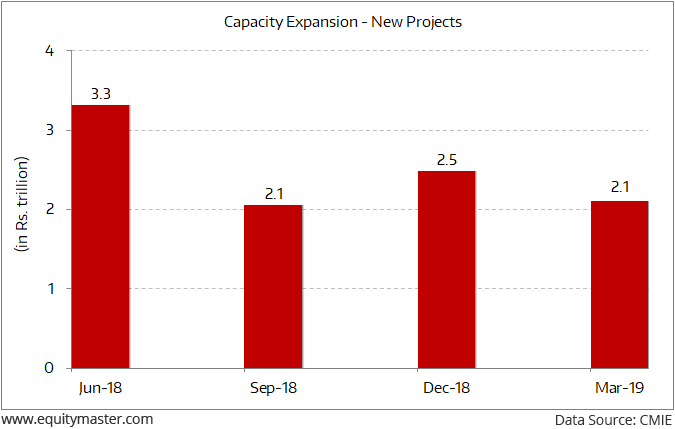
And as we can see in the chart below, capacity expansion in new projects has seen a gradual slowdown recently.
Infra Capacity Expansion Likely to Be the Key Focus of the Modi Government
Here's what Tanushree Banerjee wrote about it in one of the recent editions of The 5 Minute WrapUp...
- From Rs 3.3 trillion in June 2018, the number has come down sharply to Rs 2.1 trillion as of March 2019. I believe this will the first area the government will look to focus on. Apart from creating jobs in the infrastructure sector, it opens a lot of other avenues.
Better infrastructure will mean better connectivity to non-metros. This will attract manufacturing companies to set shop in these towns. It will give a boost to the urbanisation of the population.
This is a trend I see clearly playing out in the coming years.
Infrastructure spending -> Improved roads -> Increased two-wheeler sales.
This is just one of the 50 irreversible trends Tanushree believes will carry the Sensex to 1,00,000.



Comments
Log in or sign up to join the conversation.