

Share markets in India are presently trading marginally lower. Sectoral indices are trading on a negative note with stocks in the oil & gas sector and power sector witnessing maximum selling pressure.
The BSE Sensex is trading down by 90 points (down 0.3%), while the NSE Nifty is trading down by 46 points (down 0.4%). The BSE Mid Cap index is trading down by 1.2%, while the BSE Small Cap index is trading down by 1.6%.
The rupee is trading at 68.51 to the US$.
In news from the currency markets... Continuing its downtrend this week, the Indian rupee plunged by 30 paise in early trades today to hit a 19-month low of 68.54 against the US dollar. This is marked as the rupee's lowest level against the dollar since November 2016.
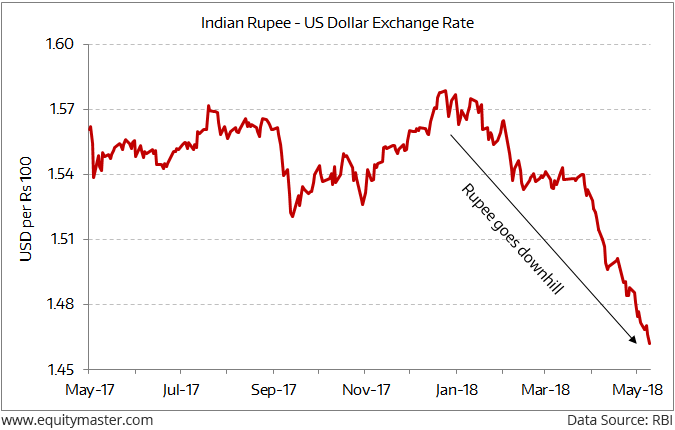
The above depreciation for rupee is seen on the back of a strong month-end dollar demand from importers and banks amid sustained foreign capital outflows. Note that the rupee has been witnessing selling pressure against the US dollar since the start of this calendar year. This is evident from the chart below, which shows the quantum of US dollars a 100-rupee note can buy and how this rate has been declining over the past few months:
Indian Rupee in a Steep Decline
What does the fall in rupee mean for the Indian economy?
A depreciation in rupee means importers buying goods and services at a higher rate than earlier. This doesn't bode well for a developing economy that relies heavily on imports.
Also, India imports most of its oil requirements. So, a fall in rupee leads to a consequent rise in the import bill. The depreciation of the rupee will also add to crude oil's rising cost.
On the corporate side, companies who have taken foreign loans from abroad will be impacted. The repayment obligations in terms of principal and interest will rise, leading to a dent in the cash flows and financials.
Further, companies who import a majority of their raw material requirements will get impacted provided they have not hedged their foreign currency exposure.
Looking at the brighter side, rupee depreciation brings a cheer on the exports front.
A depreciating rupee will provide a much-needed cushion to falling exports. However, a falling rupee will not be the only factor to boost exports. There are certain structural issues too which the government needs to address.
Ankit Shah has explained how the depreciation in rupee is linked to foreign investor outflows and forex reserves in one of his editions of Equitymaster Insider. You can read the entire article here (requires subscription).
In the news from the banking sector, as per the Reserve Bank of India's (RBI) 17th Financial Stability Report, India's banking system is faced with the possibility of 18 of 21 state-run banks breaching regulatory norms on capital in the event of severe stress and at least eight will be in trouble if their top three borrowers default.
The reports stated that government-owned banks are likely to be worst hit in the event of macro instability and extreme credit and liquidity risks as they remain the dominant players in the financial system but with poor profitability due to their bad-loan burden.
Going by the numbers, the report stated that state-run banks' gross bad loans may increase to 17.3% of the total by March 2019 under the severe stress scenario from 15.6% in March 2018. For private banks, the same may climb to 5.3% from 4% and for foreign banks to 4.8% from 3.8%.
Note that the share of large corporates, in total advances of the banking sector, has almost remained unchanged over past three years (at an average of 55%).
However, their contribution to incremental slippages has been huge. At one point, the big corporate borrowers accounted for nearly 90% of total NPAs of the sector.
Therefore, according to us, banks with large corporate books deserve a lower valuation if they can't keep NPAs in check.
While the bad loans struggle at PSBs has been going on since a decade, bureaucracy and a lack of autonomy have ensured the sub-optimal profitability and asset quality of these state-run banks.
That's the reason we've been wary of PSU banks since 2014. This was well before the market had caught a whiff of the NPA problem.
Comments
Log in or sign up to join the conversation.