

Stock markets in India are presently trading marginally higher. Sectoral indices are trading on a positive note with stocks in the power sector and realty sector witnessing maximum buying interest.
The BSE Sensex is trading up 101 points (up 0.3%) and the NSE Nifty is trading up 36 points (up 0.4%). The BSE Mid Cap index is trading up by 0.3%, while the BSE Small Cap index is trading up by 0.8%. The rupee is trading at 64.90 to the US dollar.
In the news from Goods and Services Tax (GST) space, the tax regime, in a recent development, has eased invoicing norms for retailers.
As per an article in the Economic Times, retailers under the tax regime won't have to issue long invoices detailing prices and taxes for each item. They will also not have to issue separate invoices for exempted items taxed at the 0% rate and can club all purchases in one bill.
The GST Council has approved these changes based on the recommendations of the law committee set up to review demands by stakeholders.
The above development will further ease the billing and compliance burden on retailers.
Note that while GST have benefitted the organized players in a big way, it is the unorganized segment who have taken a big hit. First, it was demonetization and now it is the implementation of GST. This hit is well reflected in the gross domestic product numbers. GDP growth has slumped to 5.7% in the June quarter from a high of 7.9% clocked in the June quarter of 2016.
So relaxations for small and medium businesses will certainly boost performance of such companies in various industries.
The transition to goods and service tax (GST) is a tough one. However, if implemented properly, the tax will reap huge benefits for such businesses in the long run. Also, the tax regime will aid India's tax revenues to a greater extent in the coming future. This augurs well for the country that has one of the lowest tax revenue as a percentage of GDP compared with other countries, as can be seen from the chart below:
India's Tax Revenues to Get a GST Boost
(Click on image to enlarge)
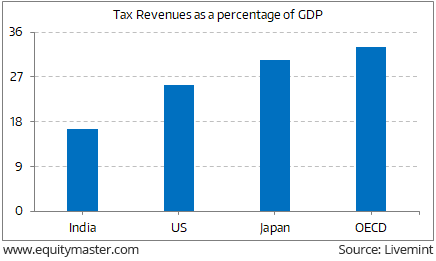
The higher tax revenue receipt will help bolster the country's financials and also provide further ammunition for the government to spend on social welfare and providing additional infrastructure to its citizens.
In other news, the government is expected to launch the Bharat-22 exchange-traded fund (ETF) by November-end. The development comes as an inter-ministerial panel headed by finance minister Arun Jaitley finalised the launch date and quantum of issuance of the exchange-traded fund yesterday.
As per the news, the initial ETF offer could be that of around Rs 60 billion, with an option for further subscription. The government aims to raise around Rs 240 billion through this route.
In August, the government announced Bharat 22 which consists of 22 stocks of CPSEs, PSBs and strategic holding of Specified Undertaking of Unit Trust of India (SUUTI).
The above development would indeed be a smart move by the government. It may fetch better valuations for some of the PSU stocks that otherwise have been dismal performers. It will also help the government get closer to its disinvestment target.
However, for the aam investor, we believe a bottom-up, stock-specific approach is the best way to get exposure to blue-chip stocks.


Comments
Log in or sign up to join the conversation.