

Stock markets in India are presently trading marginally higher. Sectoral indices are trading on a positive note with stocks in the healthcare sector and auto sector witnessing maximum buying interest. Telecom stocks are trading in the red.
The BSE Sensex is trading up 94 points (up 0.3%) and the NSE Nifty is trading up 3 points (up 0.05%). The BSE Mid Cap index is trading up by 0.6%, while the BSE Small Cap index is trading up by 0.5%. The rupee is trading at 65.10 to the US dollar.
In other news, Japan's consumer prices rose for the ninth straight month in September. Prices rose 0.7% from a year earlier, buoyed by a rise in energy costs such as fuel, light, and water charges.
However, inflation remained well below the Bank of Japan's (BOJ) 2% target.
While the above data bodes well for Japan, one shall note that the rise in core consumer prices is tepid. Companies in Japan are still hesitant to pass rising labor and raw material costs along to households.
Also, the BoJ has pushed back the timing for reaching its price target six times since it deployed its massive stimulus programme in 2013. It now hopes consumer inflation to hit its 2% target by March 2020, as signs of strength in the economy and a tight job market boost wages and give households more purchasing power, allowing firms to hike prices.
What remains are many issues that can hamper Japan's economic growth going forward.
Note that the recent win of Japanese Prime Minister Shinzo Abe in last week's election also signals the continuation of Abenomics - the ultra-loose monetary and fiscal policies. These policies have influenced excessive money printing, too much debt, and too much government intervention in Japan.
As Ankit writes in a recent edition of Equitymaster Insider... "With Abenomics, Japan has gone overboard trying to revive its economy. The Bank of Japan is a Top 10 holder in over 90% of Japanese stocks. And it remains one of the biggest buyer of Japanese stocks."
It would be interesting to see what impact the central bank's ultra-easy money policies will have on the economy going forward. Meanwhile, we'll keep you updated on all the recent developments in this space.
Crude oil is witnessing buying interest this week. Most of the gains are seen as top crude oil exporter Saudi Arabia said it was determined to end a supply glut.
Crude Oil Continues Uptrend
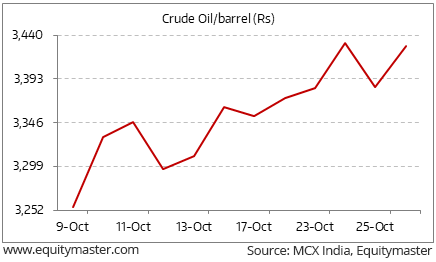
As per the news, Saudi Arabia's Energy Minister Khalid al-Falih said that the focus remained on reducing oil stocks in industrialized countries to their five-year average. He also raised the prospect of prolonged output restraint once an OPEC-led supply-cutting pact ends.
Apart from that, large drop in gasoline stockpiles also aided crude oil prices. As per the data reported by the American Petroleum Institute (API), Gasoline inventories fell by 5.8 million barrels, compared with analysts' expectations for a 17,000-barrel decline. Further, distillate fuel stockpiles, which include diesel and heating oil, fell by 4.9 million barrels, compared with expectations for an 860,000-barrel drop.
One shall note that the OPEC and non-OPEC producers including Russia have agreed to reduce crude oil output by about 1.8 million barrels per day (bpd) until March in order to reduce global oil inventories and support prices.
The group is now in talks to extend the above expiry in March.
To keep a tab on the movements in crude oil and other commodities, you can read the stock market commentary from the Daily Profit Hunter team. Their commentary tracks the developments in the global economy as well as stock, currency, and commodity markets.



Comments
Log in or sign up to join the conversation.