

After opening the day marginally lower, share markets in India have continued the downtrend and are currently trading below the dotted line. Sectoral indices are trading on a mixed note with stocks in the realty sector and stocks in the metal sector trading in green, while stocks in the IT sector are leading the losses.
The BSE Sensex is trading down by 33 points (down 0.1%), and the NSE Nifty is trading down by 10 points (down 0.1%). Meanwhile, the BSE Mid Cap index is trading down by 0.1%, while the BSE Small Cap index is trading up by 0.5%. The rupee is trading at 64.26 to the US$.
In news from the . India's crude steel output for the period April-May 2017 climbed to 16.39 million tonne (MT). The production for the same period last year stood at 15.68 MT, meaning a growth of 4.5% yoy (year-on-year).
However, on month-on-month basis, it was down 0.8% over April, when the country had produced 8.23 MT.
Production for sale of total finished steel during the two-month period rose 6.7%
Several measures, including the government's infrastructure push, along with 'Make in India' and other initiatives are set to bode well for the sector.
However, the government has consistently resorted to protectionist measures as regards the steel sector, to protect steel companies from international competition.
Consequently, India's steel imports dropped 36% in 2016-17 to 7.4 million tonnes (MT). Meanwhile, steel exports in 2016-17 registered a growth of 102%. But, the steel makers are chasing imports out by ramping up production. In the April-May period, domestic steel output rose as large private steel producers such as Tata Steel and JSW Steelramped up output.
India has become a net exporter of steel in 2016-17 as imports fell gradually. It has remained a net exporter in the two-month period between April-May.
No Takers for Domestic Steel
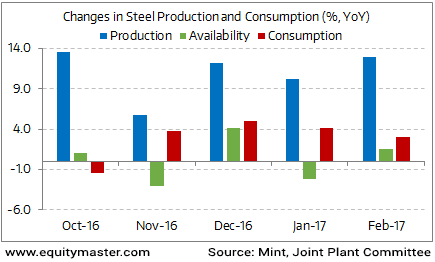
The quantum jump in exports comes as the government is providing extensive support to the domestic steel industry by way of trade remedial measures, including anti-dumping.
Early in May, the Cabinet gave nod to a new policy which aims to achieve steelmaking capacity of 300 MT by 2030 with an additional investment of Rs 10 trillion.
But the bigger concern is weak consumption growth. The consumption data over the past few months clearly show that there are no takers for domestic steel.
We do not think the trend is sustainable. And unless domestic consumption picks up, steel producers may have to take price cuts to utilize their capacities.
Moving on to news from . is in focus today, and tanked more than 2.5% in today's trade fueled by media reports suggesting its promoters wanting to offload their stake in the company.
As per the reports, the promoters were unhappy with the manner in which the company has been run since their exit three years ago.
However, Infosys has denied the reports, with CEO Vishal Sikka playing down concerns of promoters selling their stakes. The CEO also added that co-founder, NR Narayna Murthy has clearly denied the rumour and had no plans to sell his stake in the company.
Infosys founders, led by Murthy, had publicly accused the company's board of lapses in corporate governance, forcing the company to appoint a co-chairman to the board and a US$ 2 billion payout to shareholders in the fiscal year to March 2018.
Murthy had also criticised pay hikes given to chief executive Vishal Sikka and operations chief Pravin Rao, and severance payouts given to executives, including former finance head Rajiv Bansal.
While the founders and the management of the company are amidst an unsteady truce, simmering discontent between the founders and the current board could fire to the speculation that IT giant may be following in the footsteps of the Tata Group fiasco.
Corporate governance is very important when it comes to investing. While maintaining transparency, and having policies in place are some of the ways to gauge the same, investors would do well to keep away from companies whose executives continue rewarding themselves irrespective of how the business is performing.
While it may not be possible for an individual investor to meet and evaluate managements of companies, our Hidden Treasure team does exactly that.
Richa and her team travel the length and breadth of the country to personally meet the managements of dozens of companies every year. And this is after poring over the details of hundreds of small companies. The team constantly scours the small cap universe for fundamentally strong companies trading at attractive prices.



Comments
Log in or sign up to join the conversation.