

Share markets in India are presently trading marginally lower. Sectoral indices are trading on a mixed note with stocks in the capital goods sector and realty sector witnessing maximum selling pressure. Healthcare stocks are trading in the green.
The BSE Sensex is trading down 93 points (down 0.3%) and the NSE Nifty is trading down by 29 points (down 0.3%). The BSE Mid Cap index is trading down by 0.2%, while the BSE Small Cap index is trading down by 0.7%. The rupee is trading at 64.46 to the US$.
As per a leading financial daily, Prime Minister Narendra Modi is going to hold a high-profile meeting to review India's foreign direct investment (FDI) policy today. The meeting is aimed at boosting fund inflow and job creation in India and also discuss further easing of restrictions.
Earlier, last month, the government had decided to clear all FDI proposals requiring approval. It stated that proposals will be approved within a maximum of 10 weeks after the receipt of an application as per the standard operation procedure which replaces Foreign Investment Promotion Board (FIPB), which is abolished by the government.
The above measures by the government are aimed at improving investment climate in India.
Foreign Direct Investments (FDI) plays an important role in the economic development of a country. It is a source of long term capital that helps build critical infrastructures in the economy. It also aids in technology knowledge transfers, fosters innovation and helps raise productivity too. In short, having a steady flow of FDI inflows would help India to achieve necessary investments that will help accelerate economic growth and development.
Since 2014, the Modi led government has laid a great emphasis on welcoming global best practices to be employed in India.
The government began this with the launch of 'Make in India' initiative in September 2014. Further, the government has carried out FDI reforms in sectors like rail infrastructure, defence and in financial sector, medical devices and construction sectors etc.
In addition, initiatives such as introduction of composite caps in the FDI policy and raising the FIPB approval limit were also undertaken to promote ease of doing business in the country.
These measures, coupled with the above initiatives, have meant a rise in FDI in India during FY17. This can be seen from the chart below:
Rising Foreign Direct Investments Augurs Well for India
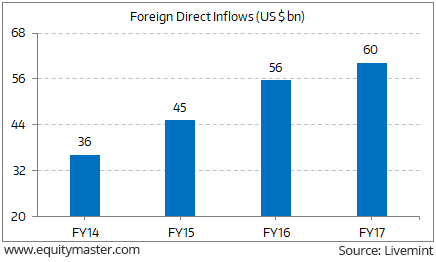
FY17 saw the highest inflows at US $60 billion in the past four years. It will be crucial for the country going forward to maintain this momentum of inflows to help drive the economic development of the Indian economy.
In the news from IPO markets, the initial public offer of Salasar Techno Engineering was oversubscribed 5.07 times yesterday - the second day of bidding.
The issue is going to follow fixed price IPO wherein the issue price is fixed at Rs 108 per share. The company is raising funds to meet the working capital requirements of the company including margin money, for general corporate purpose and to meet the issue expenses.
Apart from the above, SBI Life Insurance Company is also set to come up with an IPO as the insurance regulator IRDA has approved the company's application this week.
The company would be another major insurer to hit the IPO market after ICICI Prudential Life Insurance Co. Ltd.
The company may be looking to raise in the region of Rs 70 billion by selling about a 12% stake, making it the largest such share sale by a life insurer in India. Note that SBI Life is a joint venture between State Bank of India (SBI) and BNP Paribas Cardif with the former owning a majority 70% stake and the later 26%.
It remains to be seen how the issue is priced, more so in light of the market expecting brisk growth from the company. And considering that the insurance business is quite a different beast compared to most other companies, valuation tends to be a tricky affair.
To understand this terrain, you may want to download our report - Handbook of IPO investing, which has a special section on valuation of insurance companies. This will help you demystify the complexities of the industry before you attempt to invest in insurance IPOs.



Comments
Log in or sign up to join the conversation.