

After logging gap-up opening, share markets in India turned volatile and erased most of the early morning gains, even after the RBI in its MPC meet cut the repo rate by 75 bps to 4.40%.
Investors turned cautious after RBI Governor Shaktikanta Das said that there's a rising probability that large parts of the global economy will slip into recession.
The BSE Sensex is trading up by 110 points, while the NSE Nifty is trading up by 76 points.
The BSE Mid Cap index is trading up by 0.2%, while the BSE Small Cap index is trading up by 0.5%.
Sectoral indices are trading mixed with stocks in the banking sector and finance sector witnessing buying interest, while telecom stocks are witnessing selling pressure.
Note that, since the coronavirus outbreak, all BSE indices and NSE indices are down in the range of 25-35%.
The rupee is currently trading at 74.80 against the US$.
Gold prices are currently trading down by 0.4% at Rs 43,387.
In news from the banking sector, Yes Bank on Thursday said it has increased its fundraising size to Rs 150 billion from Rs 100 billion.
In a late evening release, the bank said it will raise the additional amount through shares, ADRs, GDRs or convertible bonds.
Yes Bank has already raised over Rs 100 billion from State Bank of India (SBI) and other key banks and financial institutions through sale of equity under its reconstruction plan approved by the government and the Reserve Bank of India (RBI).
The RBI has also extended a Rs 600-billion credit line to the private lender for meeting obligations.
Yes Bank share price is presently trading up by 3.7%.
Moving on to news from the macroeconomic space, the Reserve Bank of India today, lowered the key repo rate by 75 basis points (bps) to 4.4%, to help arrest the economic slowdown in the wake of the coronavirus outbreak.
The reverse repo rate now stands at 4%, down 90 bps, falling to the lowest ever. Before this, it had hit the lowest point of 4.74% in April 2009 in the wake of the global financial crisis.
The six-member Monetary Policy Committee (MPC) voted 4-2 in favor of the reduction of the repo rate by 75 bps, RBI Governor Shaktikanta Das said in an address to media.
Meanwhile, the liquidity adjustment facility (LAF) has been reduced by 90 bps to 4% while cash reserve ratio (CRR) has been slashed by 100 bps to 3%.
The central bank advanced the policy review and the MPC met over March 24, 25 and 26 to analyze the situation caused by the unprecedented lockdown of the nation and all business activities.
The RBI also allowed banks and other lending institutions to extend the repayment schedule and moratorium by three months to avoid large NPAs and reduce risk weights.
Earlier, the US Federal Reserve had lowered the interest rates, bringing it near zero, in another emergency move to help shore up the US economy amid the rapidly escalating global coronavirus pandemic.
The Fed had cut interest rates by half a percentage point on March 3, too, in its first emergency cut since the financial crisis of 2008.
Many other central banks have been taking the same measures to control coronavirus.
For instance, the Reserve Bank of New Zealand (RBA) slashed interest rates by 75 bps to a record low. The Reserve Bank of Australia poured US$ 3.6 billion in liquidity into Australia's financial system and said it was prepared to buy government bonds.
We will keep you updated on all the news from this space. Stay tuned.
Note that the coronavirus threat has meant sharp losses for global stock markets.
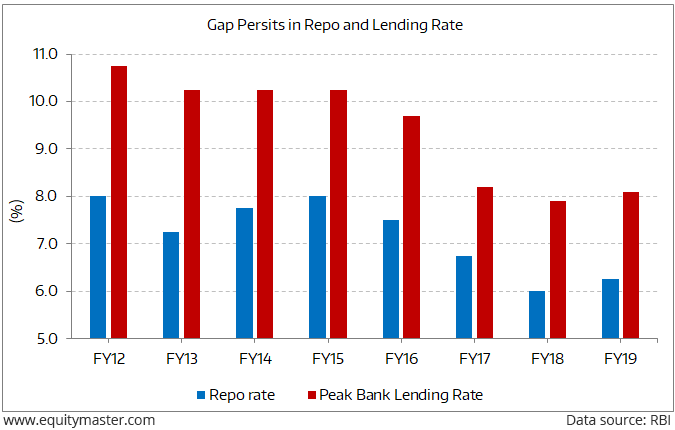
Speaking of the Indian economy, with the RBI cutting rates by a whopping 75 points, the focus of market participants has now shifted to whether the RBI's rate cut will translate into better economic activity in the near term.
Like this chart shows, RBI rate cuts have always had a big gap with bank lending rates.
Yet Another RBI Rate Cut May Not Result in Lower Lending Rates



Comments
Log in or sign up to join the conversation.