

Indian share markets witnessed some losses at the end of the day and ended their session marginally lower. Losses were largely seen in the FMCG sector and auto sector, while pharma stocks ended the day higher.
At the closing bell, the BSE Sensex stood lower by 27 points (down 0.1%) and the NSE Nifty closed lower by 17 points (down 0.2%). The BSE Mid Cap index ended the day up by 0.5%, while the BSE Small Cap index ended the day up by 0.4%.
Asian stock markets finished mixed as of the most recent closing prices. The Hang Seng was down 0.26% and the Nikkei was trading higher by 0.53%. The Shanghai Composite stood lower by 0.38%. The rupee was trading at 64.63 to the US$ at the time of writing.
In the news from pharmaceuticals space, as per an article in the Economic Times, five Indian companies are named in a new lawsuit over alleged price cartelisation in the US.
As per the news, Sun Pharma, Dr Reddy's Labs, Emcure Pharma, Zydus Cadila and Glenmark Pharmaceuticals are among 12 generic drug manufacturers sued jointly by 45 US states over charges of colliding with each other to fix prices of nearly 15 drugs.
The lawsuit has also named global pharma majors such as Teva, Sandoz, and Activis among other drug companies in the above probe, which is an extension of a 2014 investigation where six companies were under the scanner.
The development adds to the existing regulations and price pressures the pharma industry has been facing from the US lately. Note that USFDA alerts on Indian pharma companies have increased over the past few years. Earlier, regulators used to visit the plants every two years. Now they come every eight months.
Increasing inspections have led to a total of 41 import alerts in the past eight years - 33 of them (80%) in just the last four years (2013-16). This clearly signifies increased USFDA scrutiny on Indian pharma firms. If that wasn't enough, increasing pricing pressure in the generics segment has dented realisations.
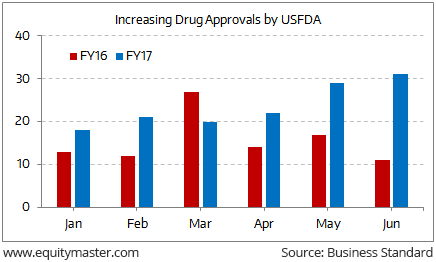
However, the recent development of USFDA expediting the drug approval process can bring some respite for Indian pharma companies. This comes as drug approvals for Indian companies have gone up 50% in the period from January to June 2017 compared to the same period last year, as can be seen from the chart below:
Expediting Drug Approval Process to be a Positive for Industry
While short-term pain is expected for the above named companies, companies with strong R&D capabilities and compliant plants will do well over the long term. The uncertainties make it important to be stock specific in the sector. It is important to look for companies that have the competence and staying power to overcome the challenges.
In other news, as per an article in the Economic Times, the assets under management of five equity mutual funds has crossed Rs 150 billion. Cumulatively, these five mutual funds manage assets worth Rs 890 billion.
Further, with buoyant capital markets and the mutual fund industry on a roll, asset management companies are also seeming eager to unlock value through initial public offerings. And the first mover in this race is Anil Ambani promoted Reliance Nippon Life Asset Management Company which concluded its Rs 15.4 billion offering recently.
In the news from the macroeconomic space, India has lined up 90 specific reforms for various ministries.
The reforms covering seven ministries are to be implemented by May next year with a focus on reducing the number of processes and moving them online.
Maximum improvements are targeted in the areas of construction permits and registering property, where India still has a low rank.
Also, a dozen reforms have been proposed in the area of starting businesses, where India is still ranked 156th.
The above developments come at a time when India witnessed a jump in the World Bank's Ease of Doing Business rankings and broke into the top 100. The improvement was seen on the back of big gains on a number of measures.
The above development makes India one of the top 10 best-improved countries.
Note that India was ranked at the 130th position in the last recording and the government has set itself a target of breaking into the top 50. However, India had risen only one position in the 2017 ranking.
For further improvement, what the business environment in India needs is to foster an environment that is more supportive of private sector activity. While this could take time, if efforts are sustained over the next several years, they could lead to substantial benefits for Indian entrepreneurs - along with potential gains in economic growth.
And here's a note from Profit Hunter:
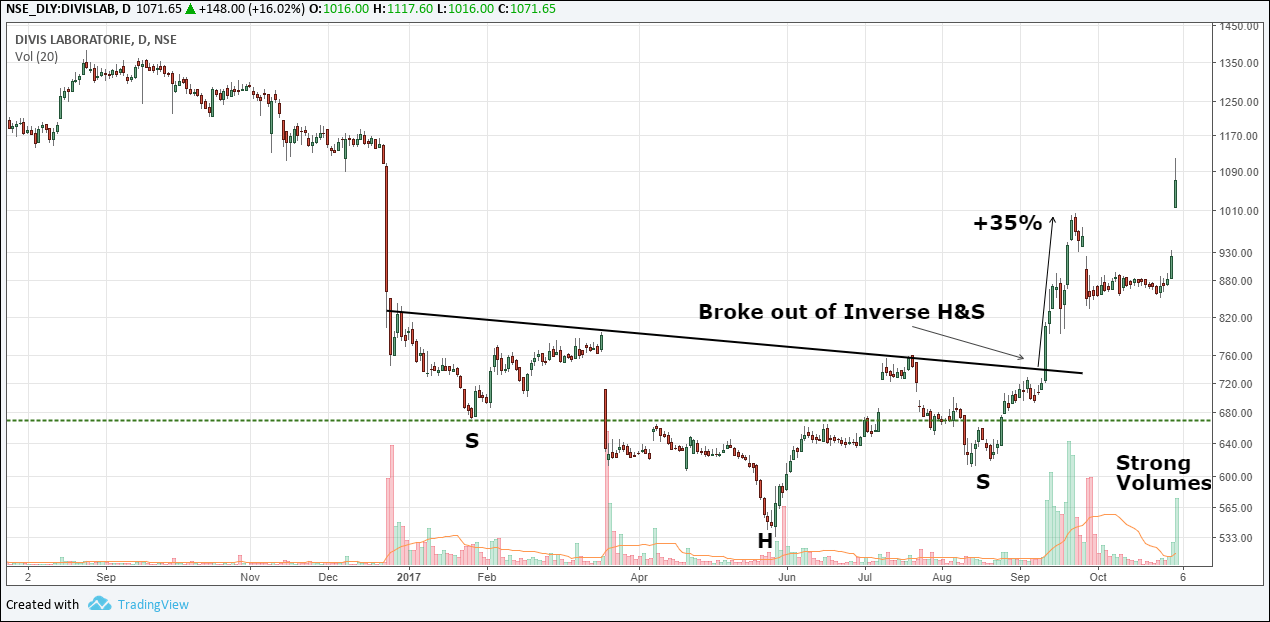
Divis Laboratories share prices soared 16% after USDFA plans to lift the import alert on its Visakhapatnam unit.
In September, we reviewed the stock and we observed its break-out of the inverse head and shoulder pattern on the daily chart. The inverse head-and-shoulder pattern is a bottom reversal pattern indicating a change in the trend. We mentioned that if the stock sustains above the neckline (black line) of the pattern, it might continue to trade up.
And this is what the stock did. Post break out, it rallied nearly 35% to a high of 1,004 in less than ten trading sessions. It corrected for a while, near 840 level, and held fort there for almost a month.
Yesterday, the stock broke out of the consolidation with strong volumes. And today, the stock opened gap up and rallied 16% to touch a high of 1,117.
After such a sharp rally, it will be interesting to see if the stock can maintain the momentum or find some selling from the current level.
Divis Lab Soared 16% for the Day
(Click on image to enlarge)



Comments
Log in or sign up to join the conversation.