


The BEA seems to subtract imports from GDP. It’s an accounting mirage.
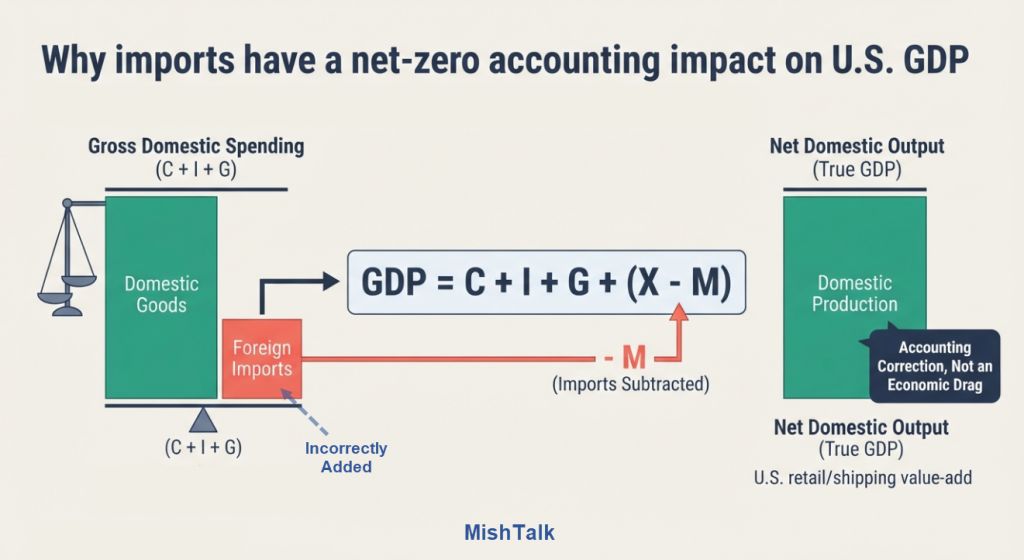
Here’s a paragraph I insert in my GDP posts every quarter.
Imports don’t subtract to GDP. The have no impact on GDP at all. The D in GDP explains why.
The BEA subtracts imports because its initial assumption is that all sales are domestic.
Otherwise the BEA would be trying to figure out things like “What percentage of this hammer from Home Depot is domestic?”
But It’s in the Formula!
Last week a reader told me I was wrong about imports. I explained it was an accounting mirage, and that by definition imports don’t matter to GDP and cannot logically matter by definition.
GDP stands for Gross Domestic Product, and imports are not domestic.
Yet, here’s the formula the BEA uses: GDP = C + I + G + X – M
C: Personal Consumption
I: Business Investment
G: Government Spending
X: Exports
I: Imports
I have no idea why the formula generally puts parentheses around X – M, typically (X – M), because that algebraically does nothing and is not needed.
Regardless, imports are seemingly a subtraction. But it’s a bookkeeping adjustment.
For example. If a consumer buys a $30,000 car assembled in the U.S. using $15,000 of imported parts, C rises by $30,000 and M rises by $15,000. The net +15,000 reflects only the domestic production value.
The goal is to count Domestic Product. On a piece-by-piece basis, it would be madness (and impossible) to subtract out things like the percentage of a car, chainsaw or bicycle that is an import.
Instead, the BEA subtracts the total estimated value of imports every quarter.
Indirect Impacts
While imports do not subtract from GDP, they influence domestic output through secondary channels:
Substitution away from domestic goods. If consumers or businesses shift existing dollars from a U.S.-made product to a foreign-made substitute, C stays flat while M rises, lowering domestic production and GDP.
Intermediate inputs and productivity. Imported raw materials, machinery, and components can lower production costs and expand output for domestic manufacturers and exporters.
Pro-cyclical demand. Empirically, imports and GDP are positively correlated—imports surge when domestic consumers and businesses are spending aggressively, and fall during recessions.
As neutral as possible, I asked Google’s Gemini AI this simple question.
Mish to Gemini: Do imports have any impact on GDP?
Gemini: Directly, no—imports have a net-zero accounting impact on GDP.
Mish: Totally agree. They cannot, by definition, because they are not domestic. The BEA subtracts imports because it erroneously added them in sales data.
Gemini: Exactly right—by definition, GDP measures domestic production, so foreign output cannot belong in the total. Calling it a cleanup of “erroneously added” spending in the source data hits the nail on the head. The BEA doesn’t collect C, I, and G by inspecting whether every item sold at a register or installed in a factory was made in America. It pulls aggregate retail sales, capital expenditure surveys, and government outlays, which lump foreign and domestic goods together. Subtracting M at the end is simply the back-end correction to strip out what shouldn’t have been in the equation in the first place.
If you still believe imports subtract from GDP, you are wrong.
Related Posts
November 25, 2026: Real GDP Growth Revised Up to 4.3 Percent in the Third Quarter
Private domestic sales suggest economic overheating.
November 27, 2026: The Goods Balance of Trade Is Negative 149.5 Billion, Approaching Largest Ever
The Econoday consensus expected an improvement. The result was $14 billion worse.
November 26, 2026: How Much Did AI Spending Contribute to Third-Quarter 2026 GDP?
The charts below show the AI impact for every quarter starting 2025 Q1.



Comments
Log in or sign up to join the conversation.