

By ignoring unintended consequences - spinning around global monetary or interest rate policy moves (especially the trend toward negative rates we took to task quite extensively last night); the optimists rationalizations have instead rapidly moved to weaken the Street's credibility to 'stay the course' with longs.
A sign of this was Larry Fink's (Black Rock) admonition in a letter to hundreds of corporate CEO's today, in which he chastised their focusing on shorter-term nuances like minor earnings changes or guidance, rather than reverting totally to extolling long-term virtues and 'strategic' goals for a company's distant future (he's right, but you know what that means when huge money managers talk of a longer-term focus).
That of course means sell the rallies (well we did so for most of 2015; as it was the right thing to do in the presence of not just Fed, but buyback-sustained lifts that had no correlation to equity values or prospects). It also means if one didn't get out, whether one sells now (even after the fact of rebound peak Monday the 1st of February almost like clockwork as aligns with our forecast evolution of all this) or doesn't, he's encouraging a 'long-term view'. That normally means he's thinking near-term vulnerability. Hence he's asking for 'corporate hand-holding', in a sense trying to make it easier to keep investors from increasing redemption pressures; at a time of year when normally you see money flowing in, not out.
We've detected not only all of this with respect to patterns (mostly in-advance); but importantly mentioned that buying of Utilities (or Preferred's for that matter) were symptomatic of a taste for safety as well as yield-chasing. That type of behavior normally reflects a reticence to buy equities, As it's very defensive.
The last couple reports clearly indicated why I thought the reflex rebound would dissipate entering February. Monday down reversal was pretty dicey, Although I'm sure glad we suggested using the early final-hour move to intraday highs for a good spot to layer-on more (or new) shorts; perhaps useful for new members.

Tonight, there are many analysts starting to (again after the fact) recognize at least a few of the many challenging issues; more than the market can cope with incidentally; so we'll just highlights those (primarily via video); as we've outlined almost all here previously. We wanted to emphasize the distributional finale of the reflex rebound from two weeks ago; so devoted a lot of time to doing that. It is now visible to all, so it's unnecessary for us to review it in detail again aside a few new aspects (again video addresses this). If you're a new member feel free to notice the key highlights which follows tonight's reflections.
The most important issue from a financial standpoint is the one focused on last evening: the threat of negative interest rates. I took-issue rather emphatically to a few trying to 'imagine' progressively higher equity prices from negative rates, as investors would have nowhere else to turn. I pointed-out primarily that such a perspective wants to revive the initial equity response to QE and stimulus; at the expense of caring about earnings and profits. My view: these do matter.

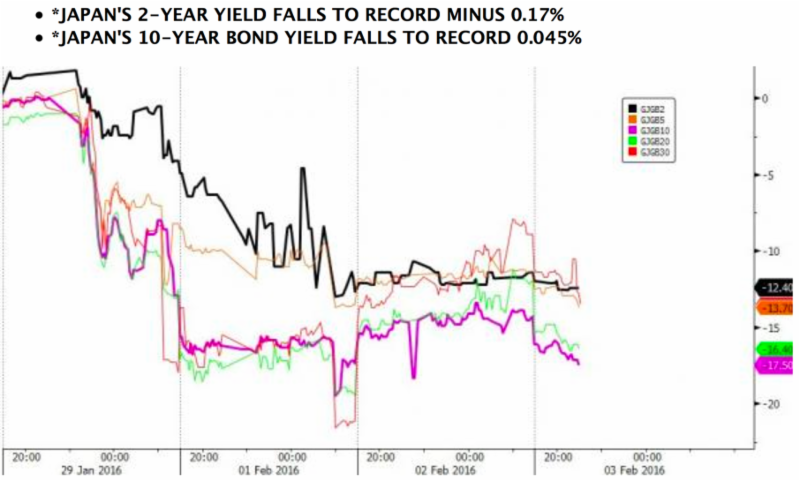
Two things have happened: one, the federal reserve has it now added twist to this year's stress test. They're asking lenders how they would handle prolonged periods of rates below zero. That they did so infers coordination with the ECB and perhaps the Bank of Japan, which introduced negative deposit rates as part of its attempt to spur the economy yesterday. Fed watchers cautioned that stress test are not an intended scenario, but you know better; especially after a market 'initially' celebrated the move by Tokyo. Earlier today the market likely viewed that as favorable; licking their chops at thoughts of new upside frenzies.
A funny thing happened on the way to the 'circus'; a Tokyo news service stated that the Bank of Japan is going to cancel JGB option Wednesday (about now in Tokyo time), scheduled for later this week. Really. Now who would be surprised at the.01% proposed yield not attracting bidders. Seriously; now they see what I call one (there are more) of the 'unintended consequences' of very poor policy designs. Several countries in Europe already have sub-zero deposit rates; and it is not popular and causes real strains within the European banking system as are generally not reported.

The second thing that happened: European bank shares plummeted, whether in sympathy or not. We've warned for months that Deutsche Bank particularly, had big loan-loss problems due to nobly funding the post-Cold War recovery in former 'captive nations' (most now in the EU or even NATO), as well as Russia itself. Of course the biggest investment was the former East Germany, and the huge construction projects in what is now known as Berlin East. Superb activity with the exception of the amazingly still-delayed 'capital city hub' white elephant known as Brandenburg Airport. But the point is almost all European banks are not only down but accelerating in their pace of decline. Spanish banks like the laughable Bankia (I mocked when in Barcelona because the new Apple Store in the same building as a very weak bank) are said to be in-danger again. The insular moving in the wake of the Muslim thrust into central Europe isn't helping numerous inter-European deals; or the UK's pending vote on staying in the EU.

Bottom-line: there are too many bottom-lines; including oil, currency, the virus; etc. Now one more thing, perhaps the only one that is proactive on the part of Government. That is the first-ever Earthquake Resiliency Summit, held today in Washington. They even talked about the Cascadia Subduction Zone off Oregon and Washington states (and British Columbia), and I'm impressed that at least some effort to improve sensors and preparedness in that area is forthcoming. I noted they emphasize earthquake risk can't be predicted; However to a degree it can. That's probably why they held a summit; fearing something's closer.

In-sum: all day I discussed the 'suspension' of Japan's JGB Auction as a prime reason to 'stay short or stay out', and we did just that. We'll hear tonight if Tokyo really is cancelling the Auction; but I believe it should be whether they do or not frankly. Again; downside of negative interest rates. Unintended consequence.
In-anticipation of a soft opening in Tokyo (especially if that's true; but either way for that matter) I thought the US market was declining more for that reason than the Oil decline, or the prospect of Latin America collapsing even further under a heavy weight of 'panic' resulting from the terribly sad impact of the Zitka virus.

Conclusion: all rallies should be 'false & abortive', and clearly contained within context of the overall primary bear market trend which dates from July but most recently accelerated starting in late December 2015. Panic is possible; and if it gets to that an assault on the lows of two weeks ago sooner rather than later is not out-of-question. Normally you get a calming and consolidation after a day such as Tuesday's decline; but the global financial news background may not be supportive or even much of a pause in this case. Stay tuned.
Tuesday (final) MarketCast
2 o'clock (intraday + overview) MarketCast
Comments
Log in or sign up to join the conversation.