

It went up after I downgraded it to Hold in April at Seeking Alpha, and it fell a bit after I initiated coverage of iShares Bitcoin (BTC.X) Trust ETF (IBIT) in February, but the decline is giving another opportunity to buy a very beaten-up asset. Today, I evaluate it again near the lows of February in a process of creating a potential double-bottom, concluding that it is a speculative Buy again.
A Look at IBIT
IBIT was the first ETF for Bitcoin, and it is managed by a big ETF provider, iShares, which is owned by BlackRock. The ETF is large at $51.2 billion, according to the iShares website for IBIT. The management fee is 0.25%. It holds one asset, Bitcoins, as well as a very small amount of cash. There is more information on the Fact Sheet, which is updated as of the end of Q1.
In addition to being large, having a strong manager in iShares and to costing a relatively low amount, the following at Seeking Alpha is currently 35,620 followers. This is similar to what it was in April and quite a large following. The ETF is very liquid, with the daily average trading volume over the past month exceeding 42 million shares (about $1.6 billion per day).
The Quant Rating at Seeking Alpha has declined to 1.10, a Strong Sell, due to poor momentum and high risk:
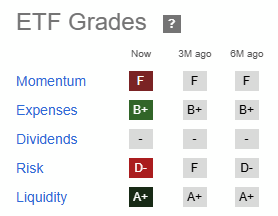
Quant ratings work and then they don't work when momentum shifts. iShares Semiconductor ETF (SOXX), which I discussed in a recent article and below as well, currently has a Strong Buy rating at 4.85 due to its A+ on Momentum. Extremes like both ETFs are experiencing are not good entry points necessarily. Precious metals ETF buyers are well aware of this based upon the recent action. Being contrarian does not always work either, though, and I explain here why the price momentum has been so bad. I also discuss the many risks to IBIT and Bitcoin.
Why Bitcoin Is Falling Again
The Wall Street Journal on June 4th detailed the slide in Bitcoin over the past week earlier this week, explaining how one of its "biggest cheerleaders" had sold some Bitcoin. The author was pointing to Strategy, Inc. (MSTR), and the news of the Bitcoin sale was revealed in an SEC filing on Monday, June 1, after the close. Through its at-the-market (ATM) program, it sold 802K shares of MSTR for $128.3 million (a price of $160 roughly). The bigger news was that the company announced the sale of 32 Bitcoins at a price of $77,135, leaving it with 843,706 Bitcoins as of May 31:
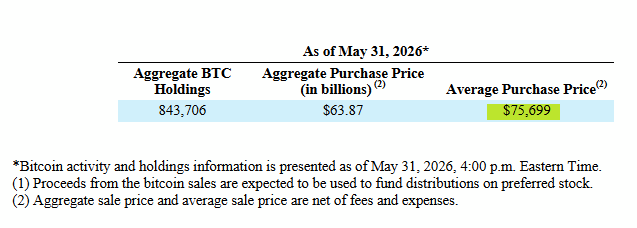
While defending any action by Michael Saylor is not something that I would want to do, I think that this was not that big of a deal in the long-run. First, the reduction was tiny at just $2.5 million and represented just 0.004% of the Bitcoin holdings of MSTR. Second, it was sold above the average purchase price. Third, the reason was given: "Proceeds from the bitcoin sales are expected to be used to fund distributions on preferred stock." This is a big issue for MSTR, which I don't include on my watchlist. MSTR closed at $129.37 on June 4th, down almost 19% from the price MSTR sold its stock to fund its preferred dividends.
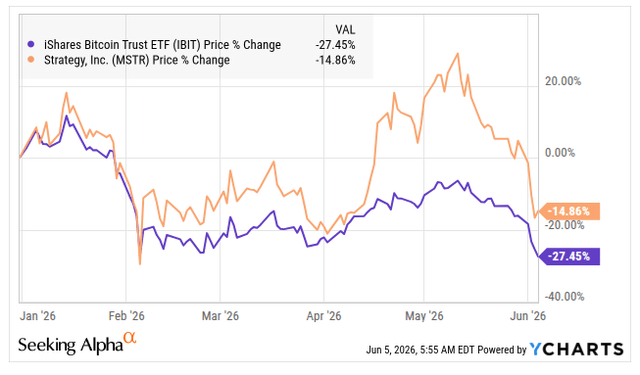
Looking at the action for MSTR since the end of May, when it closed at $159.09, it has plunged 18.7%. IBIT has dropped sharply so far in June, with an 13.5% decline through June 4th, but this decline seems to be assuming more sales by the large holder of Bitcoins. When I discuss the risks to Bitcoin and IBIT below, I explain how MSTR could become a big risk. Looking at the action so far in 2026, IBIT has declined a lot more than MSTR:
The sale by MSTR appears to have been a catalyst, but there have been outflows from the ETFs too. The WSJ article stated that the outflows have been $4 billion over the prior 12 days, according to Bloomberg.
IBIT Has Plunged
The chart above shows that IBIT has lost over 1/4 of its value in 2026, but it has declined far more substantially from its all-time high set in October:
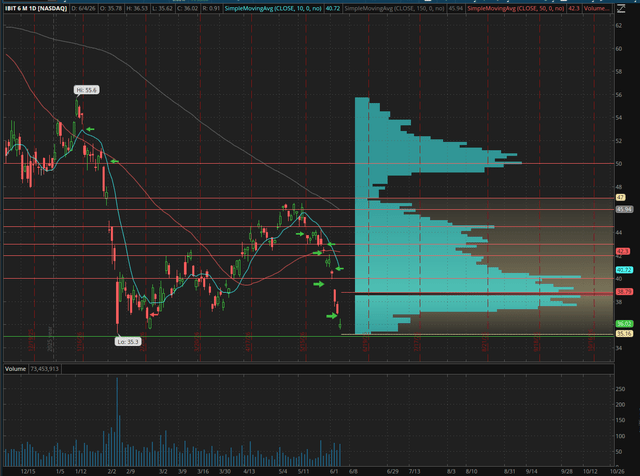
The 50% decline has taken place as the stock market has rallied to an all-time high. On June 4th, IBIT tested that multi-year low that was set earlier this year. It has left several gaps open, but the bounce in May failed to fill the open gaps set earlier this year that remain open.
IBIT has been trading only since early 2024, and it traded below $30 on its first day of trading and moved lower over the next few weeks. IBIT bottomed near $22 and then moved above $40 in March 2024. I view $35 as a potential double-bottom, and I think that $30, which was below the low in 2024 after that big rally early in the year, should provide further support. I see resistance currently near $40 up to $45.
Why IBIT May Rally
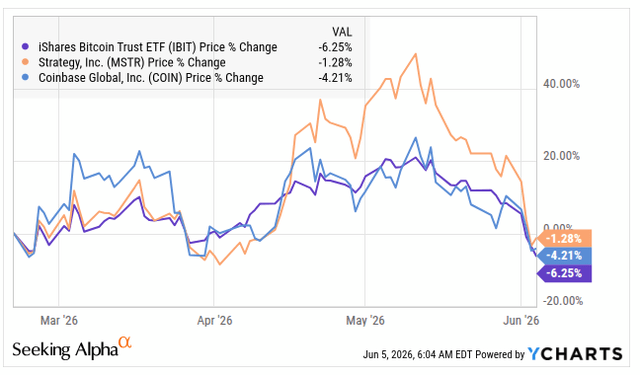
In that first piece in February, I pointed out that IBIT had declined a lot more than two similar-sized stocks tied to Bitcoin, Coinbase Global (COIN) and Strategy, Inc. I discussed MSTR above, and it remains a threat to MSTR, but it has sold off very sharply. If it begins to rally or holds these levels, investors may fear less the potential of more Bitcoin selling. Here is how COIN and MSTR have performed relative to IBIT since my IBIT Buy article in February:
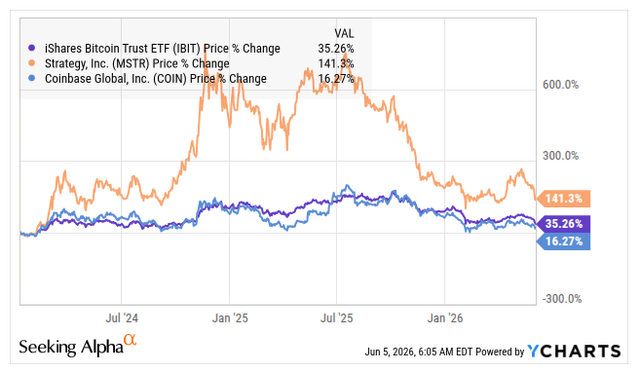
Since IBIT debuted in early 2024, it has outpaced COIN but underperformed MSTR:
When I initially looked at IBIT and was bullish, I discussed how continued inflationary concerns might help it. Traditionally, gold has been a very good hedge against inflation, but I was negative then on gold due to the massive rally. Earlier that month, I had discussed how the VanEck Gold Miners ETF (GDX) appeared to have reached its peak. It has declined substantially since then, though it did post a new all-time high after my article was published. Comparing IBIT to gold, silver and gold mining since the 2024 elections, IBIT sure has underperformed:
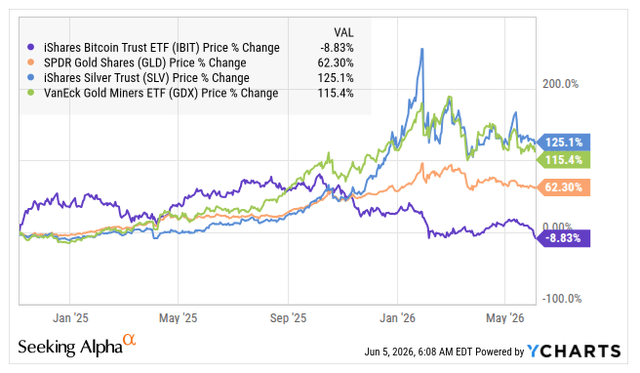
Going back to the launch of IBIT in early 2024, the underperformance, which began in Q4 last year, really stands out:
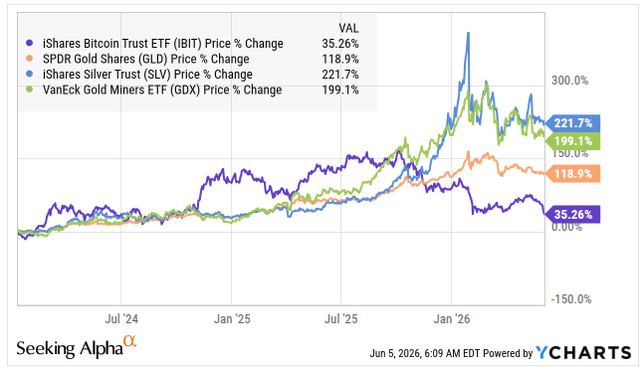
While IBIT is up, it is up a lot less than the gold standard of inflation protection, gold, and concerns about inflation or dollar weakness could help Bitcoin and IBIT.
Bitcoin took off before Wall Street could properly assess it as an investment. I have been encouraged by what I have seen at the CFA Society in terms of research. Bitcoin's acceptance by institutional investors could increase over time as analysts and researchers continue to assess it.
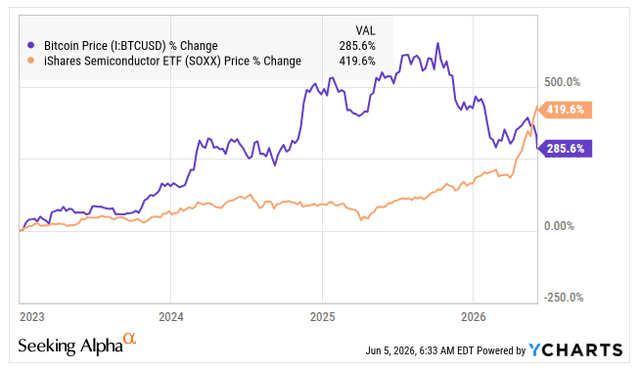
A final issue investors should consider is that AI may be a threat in multiple ways. First, AI uses a lot of energy, and energy prices are rising rapidly. So does Bitcoin mining! Second, it has been so easy for investors to chase semiconductors, which have soared, or to avoid software, which has plunged, that Bitcoin does not appeal. Bitcoin may rally if (when!) the parabolic rally for semiconductors ends. As I mentioned recently in an article about a semiconductors ETF, the AI IPOs may pressure the semiconductors, and perhaps a weakening of that part of the market will be helpful to Bitcoin and IBIT. Semiconductors, up now 100% in 2026 for SOXX, have had a parabolic move this year. I don't believe that there is any good correlation historically to Bitcoin. Sometimes when semiconductors are doing better, Bitcoin rallies, but this year and in late 2024, they moved in opposite directions. Here is the move in the two ETFs since the end of 2022:
Challenges Ahead for IBIT
While Bitcoin is down a lot from its peak, it is also up a lot. Looking at the chart since the end of 2019, it has soared 790%:
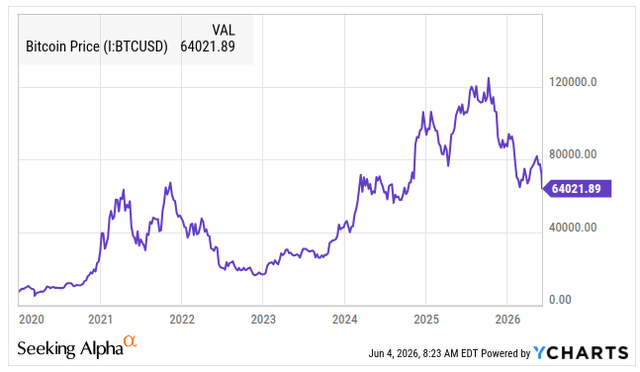
Yes, it has declined a lot from its peak (48%), but it is still up a lot. The massive gain outpaces what gold and silver and even semiconductors have done over that same time-frame. If Bitcoin keeps dropping, IBIT will decline.
Above, I discussed how the news from MSTR caused weakness recently. While it seems overdone to me, as I explained, MSTR is a leveraged holder and could be forced into selling more Bitcoin if the price keeps falling.
While Wall Street is starting to pay attention to Bitcoin and to try to assess its investment value, it may have a value that is a lot less than the current price. Unlike the precious metals, Bitcoin has absolutely no use. It is not art, jewelry or part of an industrial application. One thing that has not yet impacted it but that could is competition from other blockchain alternatives, like Ethereum or even databases that bypass blockchain architecture.Government regulation could cause a lower price as well.
Since I initiated coverage of IBIT, it has seen some competition from other Blockchain financial products. The Morgan Stanley Bitcoin Trust ETF (MSBT) launched earlier this year (April 7th) and has an expense ratio of just 0.14%. The ETF has now $248 million in assets, which is well below the assets in IBIT. The risk is additional competition, though this seems unlikely with MSBT trading below where it was trading when it launched. Notably, the ETF has only 197 followers at Seeking Alpha.
Finally, I mentioned how AI has caused some problems, but there is a possibility that artificial intelligence could break the security for Bitcoin. Quantum computing is a threat too.
Conclusion
In my downgrade of IBIT piece that I wrote in April, I shared that I had exited IBIT in my model portfolio. I have used this decline this week to reestablish a position that amounted to 8.2% of the ETF model portfolio as of the close on June 4th. This model portfolio is measured against 60% stocks (the S&P 500) and 40% bonds (the US Aggregate Bond index), so IBIT is stepping outside of the index against which it is measured. The model portfolio is currently very underweight stocks (32% exposure) and overweight fixed-income, though the exposure there is very short-term Treasuries as well as a mix of TIPS ETFs.
Predicting the future value of Bitcoin is quite challenging in my view, and I said this when I downgraded it to Hold from Buy. I am upgrading it again now, though it remains a risky asset. In my view, its appeal is to those who want to protect against dollar weakening or weakening among currencies, and this theme remains intact. IBIT, which holds exclusively Bitcoin, faces many risks that I have detailed, but it is very beaten up and could do much better like it did when I rated it a Buy in February. This should appeal potentially to those who want to protect against inflation risks or who own MSTR or COIN (or are short them and looking to hedge).



Comments
Log in or sign up to join the conversation.