

Industrial data for July showed that the positive overall trend in Hungary has continued. Following the boom in AI investment, electronic suppliers are still performing well. Short-term growth looks secure, but structural changes are needed to unlock long-term potential
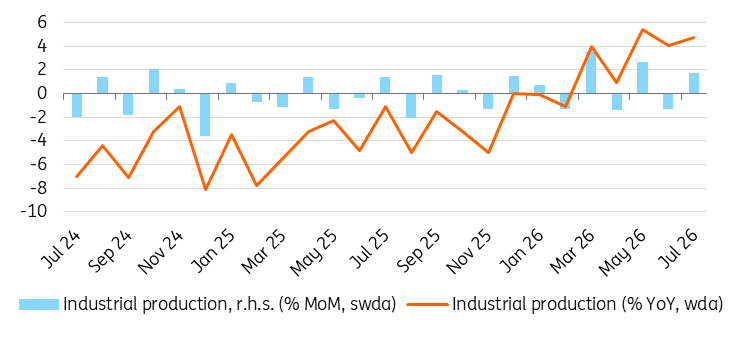
In line with market consensus, the Hungarian industry made a positive start to the third quarter. In turn, the familiar up-and-down pattern continued in July: a strong month was followed by a weaker one, and vice versa. Following a weak June, a stronger July was anticipated. In July, industrial production volume grew by 1.7% on a monthly basis, broadly in line with the consensus. The year-on-year index, adjusted for working days, showed a 4.7% increase, improving significantly from the previous month's data.
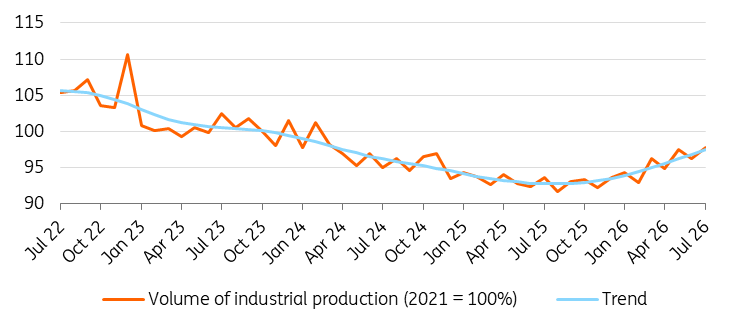
Since growth in July exceeded the decline in June, it can still be said that the sawtooth pattern is unfolding against the backdrop of an upward trend. As a result of this ongoing positive trend since the end of 2025, the fixed-base index, measured against the 2021 average, shows a lag of just 2.2% as of July this year. We are therefore slowly but surely approaching the monthly production average for 2021. This is welcome news after more than three years of decline and recession.
Volume of industrial production
Since this is a preliminary data release, many details have not yet been disclosed by the Hungarian Central Statistical Office (HCSO). Based on the commentary, however, the usual process is underway. With the addition of new capacity from transport equipment, production is performing well, as are electronics orders, which are surging due to the AI boom. However, aside from these, production volumes have declined year-on-year in most sub-sectors, including the significant battery and food manufacturing industries.
Performance of Hungarian industry
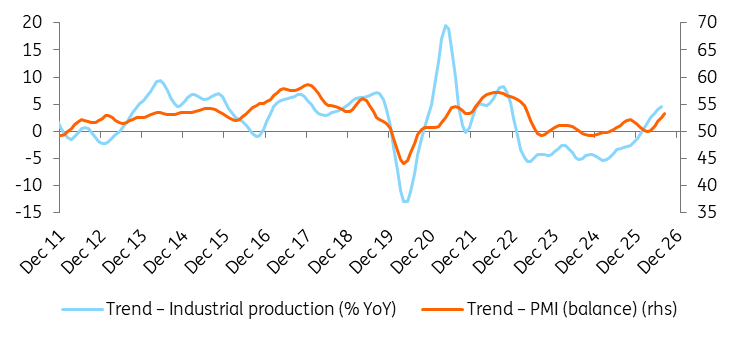
Soft indicators, which are based on surveys, suggest that the improving trend will continue. Although we believe we are going to see a downturn in August, presumably as a result of the energy crisis (the almost full shutdown of the Paks nuclear power plant) and voluntary production restrictions, the business confidence index shows an improving trend. It is expected that the Hungarian industry will perform poorly in August, but a recovery may follow in September. In other words, the sawtooth pattern may persist, and based on order books and capacity utilisation indicators, the upward trend may continue.
In terms of risks, the European economy’s better-than-expected resilience to shocks could lead to a positive surprise in the form of a recovery in external demand that is more dynamic than expected. Conversely, surging oil prices back towards $100, rising gas prices to around €75, and supply chain issues caused by the Strait of Hormuz pose downside risks.
Manufacturing PMI and industrial production trends
Looking further ahead, the Hungarian vehicle industry may also face major transformations in the wake of the recently announced and planned layoffs in the European auto industry. The loss of the European automakers' global market share and declining demand necessitate long-term adaptation. One way out of this situation could be to attract investments in the industrial and service sectors with higher added value. However, this will become a much more pressing issue towards the end of the 2020s.
Focusing on the nearer future, despite temporary disruptions, the industrial sector could end 2026 on a positive note, achieving annual average growth of around 3-4%. After three years of industrial recession, the sector could therefore make a positive contribution to GDP growth once again, despite geopolitical and energy market turbulence.



Comments
Log in or sign up to join the conversation.