


Hungary, Turkey and Kazakhstan will announce interest rate decisions next week, while Poland releases industrial output, labour market and retail sales data
Poland: Industrial output and labour market data in focus
September industrial output and labour market data will be released on Tuesday. Although the European and German economies show signs of recovery, Polish manufacturing remains fragile and uneven. Some sectors, including electrical equipment, machinery and equipment, and other transport equipment, are performing relatively well. Others, such as textiles, furniture and the automotive industry, continue to struggle. With the calendar effect neutral (the number of working days is the same as a year earlier) and a high comparison base, we forecast low single-digit growth in industrial production in September. At the same time, we expect PPI inflation to accelerate further, driven mainly by higher crude oil refining costs.
Poland’s labour market remains stable. It is no longer exceptionally tight, nor showing signs of weakening. Wage growth in the enterprise sector has moderated and is stabilising at around 6.0%, no longer exerting significant pressure on price growth. Employment continues to decline amid an ageing population and an insufficient inflow of younger workers to replace those retiring, particularly in manufacturing. Enterprise-sector data do not capture the employment of immigrant workers.
Thursday brings the release of September retail sales data. Despite some moderation, private consumption appears relatively resilient to the current energy shock and high retail fuel prices. To some extent, the impact of rising fuel prices on household finances is being cushioned by government measures temporarily reducing excise duty and VAT on fuels. Demand for durable goods remains solid, while some restraint is visible in day-to-day spending on necessities. Given the substantial savings accumulated in previous quarters, households should be able to smooth their consumption over time. Nevertheless, household consumption growth this year is projected to be slower than in 2025.
Hungary: NBH expected to keep rates unchanged
The National Bank of Hungary’s watchlist is fairly limited to fiscal policy and risk sentiment. In practice, however, it is difficult to assess these factors in the run-up to the October rate-setting meeting on Tuesday. Although inflation figures were dovish, market volatility in relation to geopolitical developments remains high. With no clear de-escalation in sight, risk sentiment won't allow the NBH to cut rates now.
Regarding fiscal policy, although the central bank is aware of the 2027 budget, as the NBH governor sits on the Fiscal Council that reviews and approves it, no public information will be available on this. Therefore, we do not believe this will provide an opportunity for immediate monetary policy easing. Given the timing, we anticipate another on-hold meeting. However, if the fiscal situation were to materially reduce the country-specific risk premium, we wouldn't rule out the possibility of a rate cut in November. Nevertheless, the Monetary Council won't commit to this just yet.
Turkey: Central bank expected to cut rates by 100bp
Thursday brings Turkey's October interest rate decision. Recent inflation data has boosted the likelihood of a rate cut.
In addition, investment fund volatility is likely to increase downside risks to activity in the last quarter, while we expect the macroeconomic impact to be manageable.
Given the September CPI reading and domestic demand weakness, we expect the central bank to cut the policy rate by 100bp in the October MPC meeting to 36%.
CCA: Kazakhstan expected to deliver another rate cut
For the 23 October decision in Kazakhstan, a 25bp cut to 16.00% is now our base case, as it meets the criteria we indicated after the September rate decision: headline inflation slowed by 0.5pp to 9.3% YoY, households’ price expectations improved, and the tenge’s strength continued to exceed expectations in September.
At the same time, a hold remains plausible, as the recent slowdown in CPI was overwhelmingly food-driven, while a renewed acceleration in overall inflation, taking it further away from the 5% long-term target, remains a risk. Importantly, the global backdrop of rising core rates also argues for keeping real rates high.
Regardless of the decision, we believe the scope for policy easing at this point is limited.
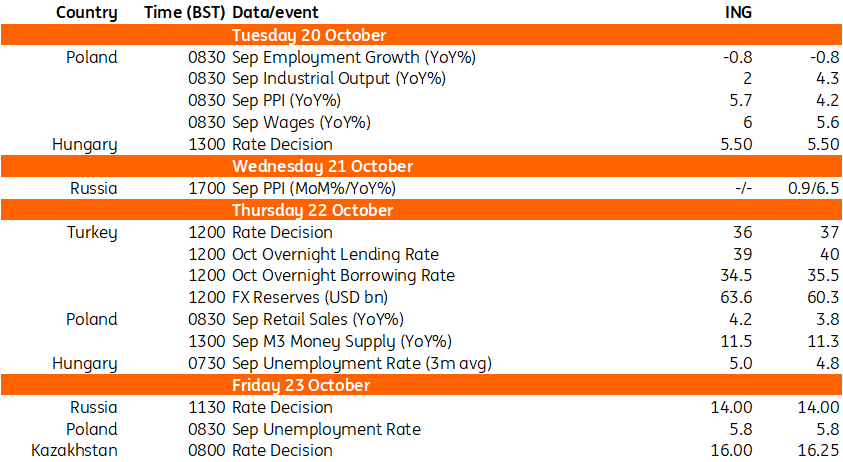
Key events in CEE & CCA next week



Comments
Log in or sign up to join the conversation.