

First, look at futures as of today (with the decline looking unabated):
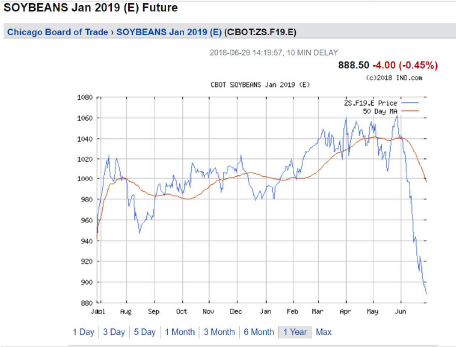
Source: ino.com.
I interpreted this graph as indicating a persistent drop in soybean prices due to tariffs, separate from weather conditions impacting near term prices. Reader mp123 writes:
The fact the entire soybean curve cost moved together, doesn’t really suggest anything other than the fact that beans are at or near full carry.
I have only one comment, provided by David Reichsfeld and Shaun Roache (2011):
We arrive at four main conclusions regarding the forecasting performance of commodity futures prices in this paper. First, futures price-based forecasts are hard to beat. Futures prices perform at least as well as a random walk for most commodities and at most horizons and, in some cases, do significantly better. But the second result is that the failure of futures prices to clearly (and statistically significantly) outperform this benchmark in almost all cases is a puzzle.
The spot price reflects the cost of carry and is more influenced by current physical market conditions (and less by expectations of the future) than is the futures price. In the absence of constraints on arbitrage, this should mean that futures prices outperform the random walk, on average. Third, many other naïve time series models, including some that maximize in-sample fit, tend to do much worse than a random walk. Parameter instability renders many time-series models as useless, at best. Fourth, the relative forecasting ability of futures prices deteriorates the longer the forecast horizon, which likely reflects lower liquidity at the back end of futures curves.
We also assessed the forecasting performance of futures prices relative to a random walk during different market conditions. Theory predicts that futures prices should do much better than the random walk when the market is in backwardation because the influence of current market conditions on spot prices is particularly strong during these periods. However, we do not find a significant difference in forecasting ability between periods of backwardation and contango. This result holds even when spot prices are significantly above futures prices, in strong backwardation.
In fact for soybeans, futures prices work particularly well, so that a random walk is outperformed at the 10% msl, for horizons up to a year.
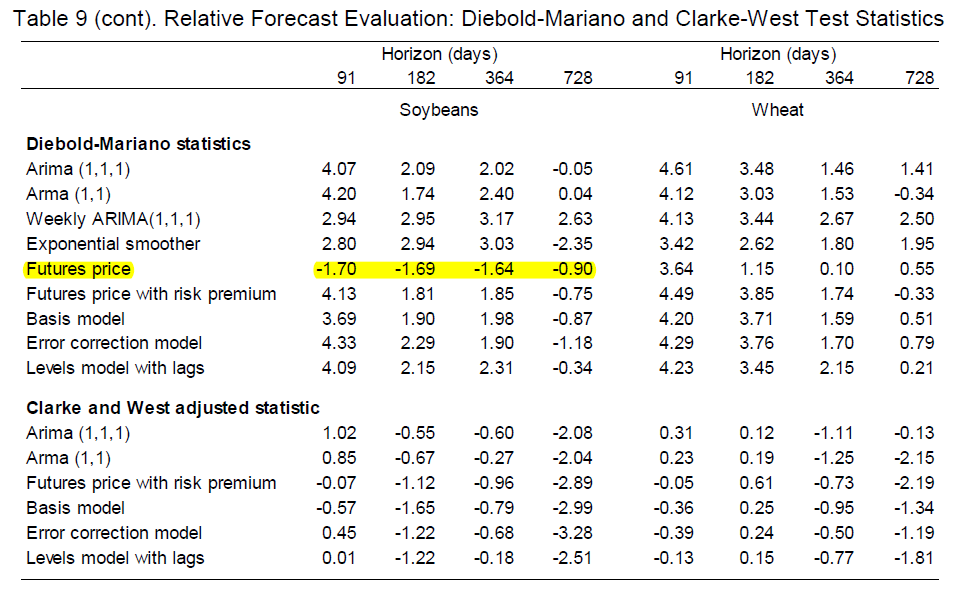
Source: Reichsfeld and Roache (2011).
So best guess of soybean prices in January 2019 is 889, down from 1040 that was futures as of beginning of March.

Comments
Log in or sign up to join the conversation.