

A few essential commodities that were tariffed by President Trump have proven to have seriously harmed the very industry he sought to protect, as aluminum has since “Liberation Day” just a year ago. The core argument given by the Administration is that aluminum is a matter of “national security”, required by the military, the domestic electrical grid, and transportation equipment industries. As of May 2026, the administration has doubled down on this strategy, increasing aluminum tariffs to a flat 50%. But aluminum is very expensive to produce, requires considerable amounts of cheap electricity, only made more expensive by 50% tariffs.
President Trump had motives other than national security in mind when he slapped these tariffs on Canadian aluminum imports. Canada hardly qualifies as a national security risk. Post WWII, the Aluminum Company of America set up smelting operations in Canada, knowing it would serve US national security and military requirements. So, it must be assumed that Canada was singled out for tariffs as some form of bargaining strategy on other trade issues. We will never know the true rationale employed.
Although bauxite is mined in several different countries, it is refined into alumina and smelted into aluminum in countries with low-cost electricity. Canada is, by far, the most important source of imports, mainly produced from low-cost electricity generated in Quebec and British Columbia.
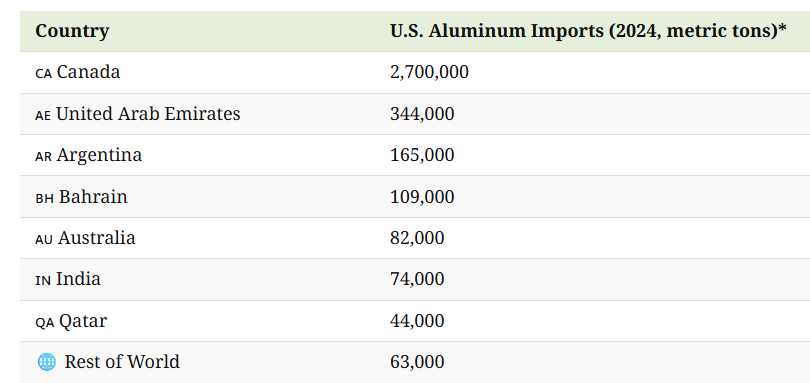
The introduction of tariffs works both ways, making it more costly for the domestic users and also encouraging exporting nations to seek tariff-free markets. This is precisely what is happening with respect to Canadian aluminum. Canadian exports to the US fell by 27% in 2025, and at the same time, the Canadian government is seeking to expand export markets in the EU and Asia as part of an overall strategy of reducing the economy’s heavy reliance on the US market. The US increased its reliance on imports from the Middle East, taking advantage of smelters in the region, only to be affected by the Iranian war and the closure of the Straits of Hormuz. Globally, aluminum prices shot up further as global disruptions resulted in a further decline in capacity.
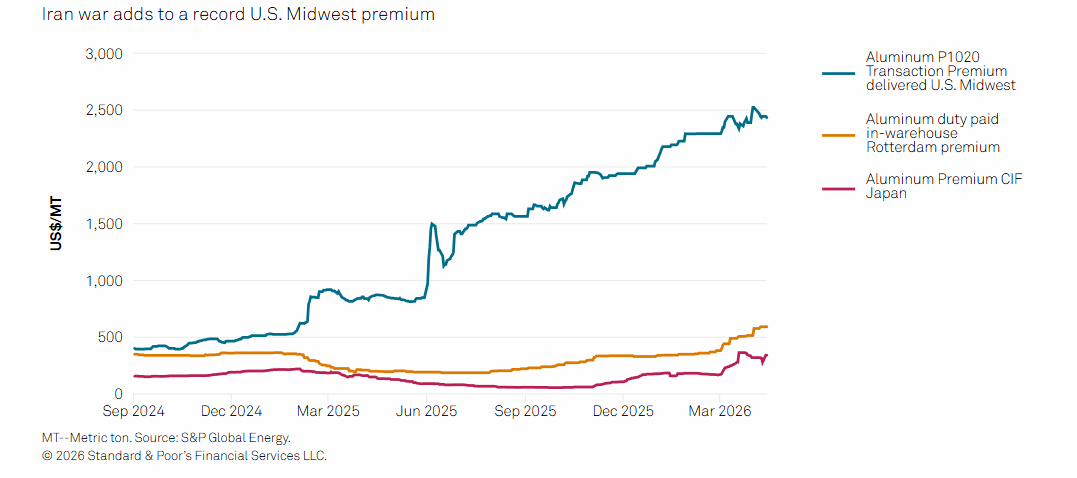
With the US relying on nearly 85% of its aluminum consumption on imports, and Canada supplying about 60% of those imports, the American auto industry is now feeling the pinch of the 50% tariffs on Canadian imports. The US vehicle producers used aluminum extensively in the production of all types of vehicles, but especially in trucks. The metal boosts fuel economy and reduces overall vehicle weight without impacting a vehicle’s strength or durability. The North American industry has increased its use of the metal since the introduction of tariffs for these reasons. Now, add on the fact that nearly 20% of US consumption originates from the Persian Gulf nations, and the auto makers have nowhere to turn to maintain current costs, let alone lower costs.
The industry does not have much spare capacity. We can expect further price pressures on imported aluminum while the geopolitical situation remains so risky. US domestic producers require considerable lead times to restart dormant smelters and find the additional electrical capacity to support the industry. It was foolhardy to imagine that tariffing aluminum imports would serve to increase domestic capacity and lower prices.



Comments
Log in or sign up to join the conversation.