


Unsplash
An ETF representing an entire country just put up 29% over the last year.
It is not a tech stock. It is not a meme name. It is Mexico.
The story has been hiding right below our southern border the whole time. Almost nobody in the US is paying attention because we are too busy watching the next tweet move the S&P 20 points in either direction.
Capital is moving. Factories are being built. The currency has already repriced.
Here is the deal.
The chart is sitting in a five-month consolidation with a clear target overhead.
The capital flow story explains why the chart looks the way it does.
The options chain is paying enough premium to make the trade work even if the breakout takes another six months to show up.
All three pieces matter.
That is what I want to walk through.
Forget the Politics. Follow the Money.
I went to school for economics, so let me get one thing out of the way up front.
I am not talking politics. I am not talking immigration policy. I am talking pure economics.
Money is moving into Mexico from everywhere. Japan, China, Germany, the Swiss, Sweden.
They are building factories down there. Monstrous factories. The kind that take years to construct and decades to pay off.
Mexico just passed China as our second-largest trade partner. Canada is still number one. Mexico is now number two. China dropped to three.
That is not a small headline. It is a structural shift in where global capital is being deployed, and almost nobody is talking about it on US financial TV.
The peso tells the same story.
It has moved from roughly 23 pesos per dollar down to 17. Currencies do not move that hard without a reason sitting underneath them.
The reason is the capital flow.
What the Chart Is Telling Us
EWW is the iShares MSCI Mexico ETF. Biggest, most liquid way to get exposure to the country through a single ticker. Roughly $2.2 billion in assets under management.
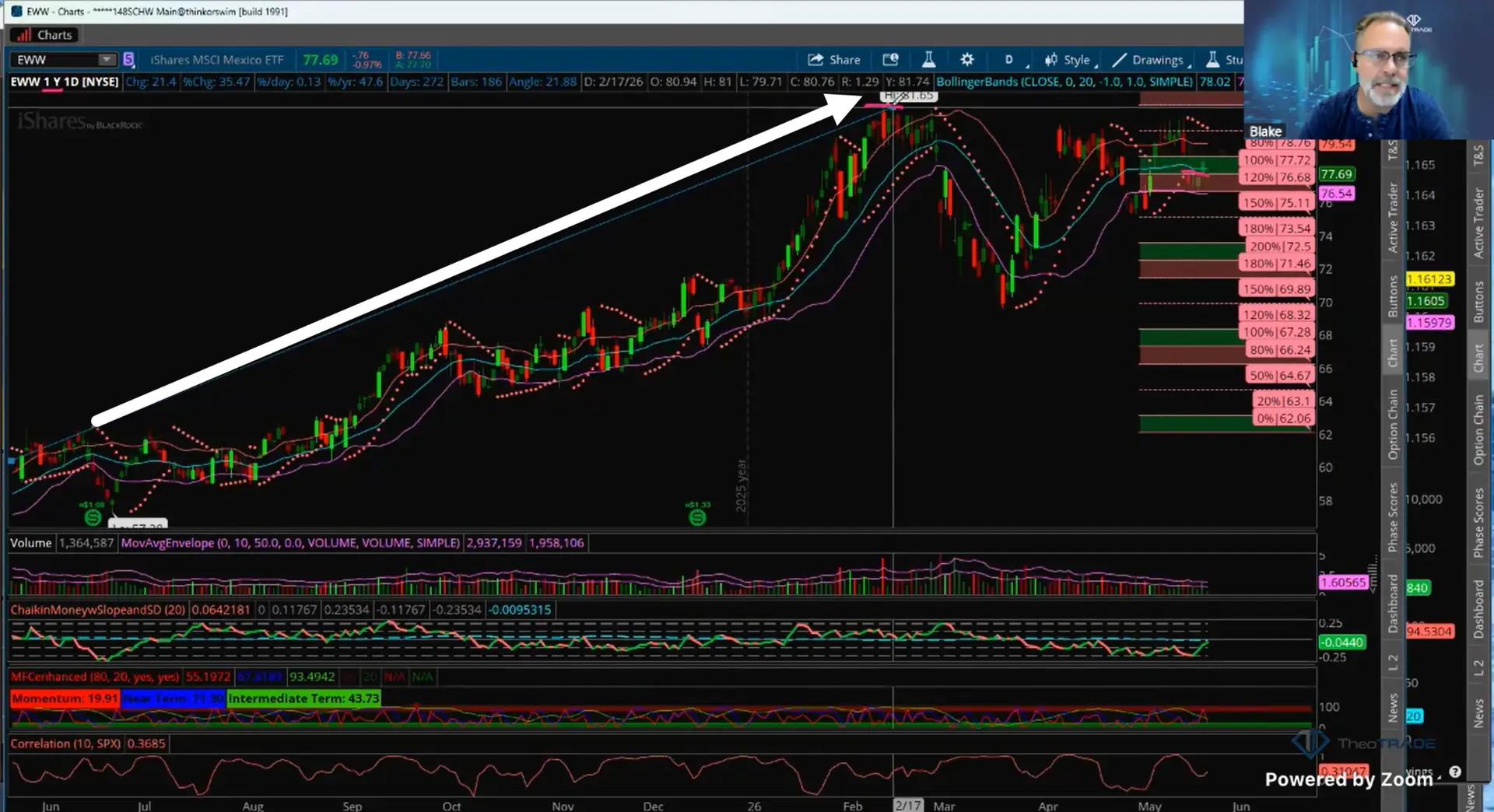
A year ago, this ETF was sitting near $58. It ran all the way to $81 at the peak.
That is a 35% move at the top and a 29% return year-over-year at current prices around $77.
Read that again. 29% on an ETF. Not a single stock, not a high-beta tech name. A country.
The chart has been consolidating in the $77 to $81 range for about five months. Call it an ascending triangle. Call it a cup and handle. The shape does not matter as much as what it does next.
If this breaks out to the upside, the measured move targets $92.50. Another 16% to 17% on top of the move already in the books.
Why This Setup Pays You to Wait
Here is where it gets fun.
EWW pays a semi-annual dividend yielding 3.4%. The next payment is expected in June.
The options chain is liquid enough to run a wheel strategy without getting eaten alive on the spread.
Here is the setup I am looking at off this morning’s chart.
Sell the $77 put for roughly $2.65, splitting the bid-ask. That is a 3.5% premium return for about a month.
If the ETF stays above $77, you keep the premium and move on to the next one.
If price falls and you get assigned, your cost basis works out to $74.35 once you net the premium against the strike. Add the dividend in June, and you are at 6.5% to 7% before the chart has done a single thing.
If the breakout to $92.50 actually plays out from a $74.35 cost basis, you are looking at another 24% on top of all that income.
Every outcome short of a full collapse pays you something. That is the kind of structure I want behind a trade.
A Country ETF That Behaves Like a Tech Stock
EWW carries a beta of 0.71 against the S&P 500. It moves with about 70% of the volatility of US equities.
A 29% one-year return with 30% less volatility than the S&P 500, and a 3.4% dividend on top, is not supposed to exist on a country ETF.
This one does. The underlying capital flow story is real, and the peso strength is doing a lot of the heavy lifting on the returns.
Most traders look at country ETFs and assume they are slow and boring. EWW broke that assumption all year long, and the setup for the next leg is still sitting right there.
Three Ways to Play It
There are three ways to get exposure depending on account size and how much risk you want to wear.
The straight buy. Own the ETF outright, collect the dividend, ride the breakout if it comes. Cleanest expression of the thesis.
The wheel. Sell the at-the-money put for the premium, get assigned if the price falls, then sell calls against the position once you own it.
Highest income approach for traders who want to be paid for waiting.
The broader Latin America play. ILF gives exposure to the wider region if Mexico-specific concentration feels too tight.
Not the same growth rate as Mexico on its own, but the setup is similar and the consolidation is still in play.
The Takeaway
The money is already moving. The factories are already being built. The peso has already repriced.
This is not a prediction trade. It is a positioning trade.
You are stepping into a vehicle where the capital flow is verifiable, the chart structure is clean, and the income gets paid whether the breakout happens this month or three months from now.
US equities will do what they do. The tweet cycle will keep doing what it does.
I would rather own the country where the factories are being built than chase the same five tech stocks everyone else is fighting over.


Comments
Log in or sign up to join the conversation.