

Five charts show the AI impact for every quarter starting 2025 Q1.
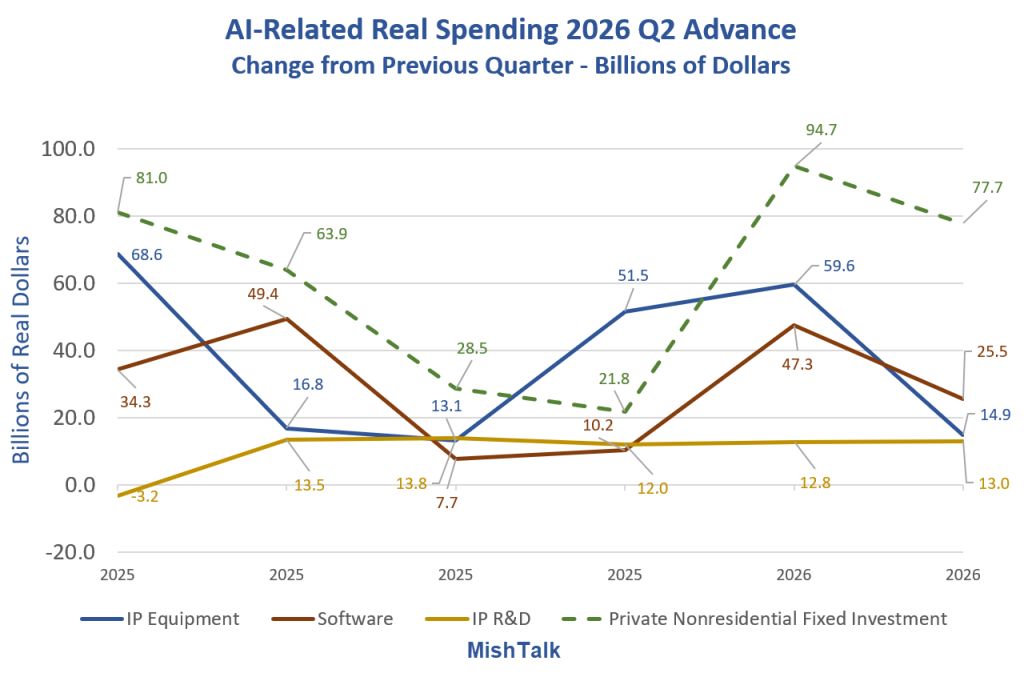
Private Nonresidential Fixed Investment 2026 Q2 Advance Estimate, IP Equipment, Software, R&D
The BEA reports Real Gross Domestic Product (GDP) increased at an annual rate of 1.5 percent in the second quarter of 2026 (April, May, and June). In the first quarter, real GDP increased 2.1 percent.
AI-Related Spending Change in Billions
Private Nonresidential Fixed Investment: 77.7 billion
IP Equipment: 14.9 billion
Software: 25.5 billion
IP R&D: 13.0 billion
Net change IP Equipment + Software + IP R&D: 53.4 billion out of a total 77.7 billion.
Real Private Fixed Investment
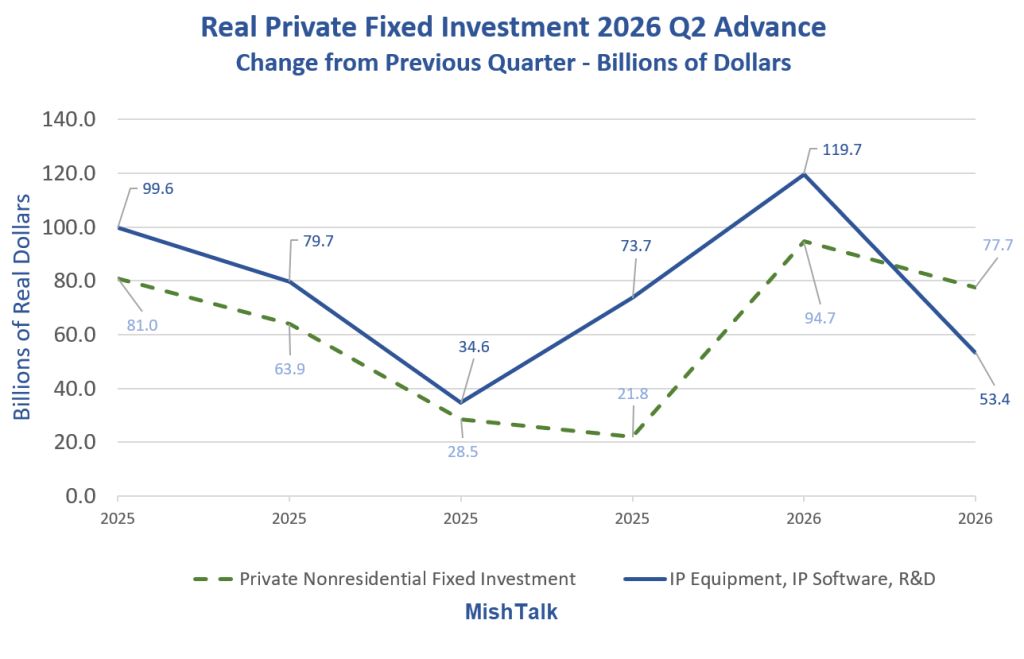
Private Fixed Investment 2026 Q2 Advance Estimate
Real Private Fixed Investment Spending Change in Billions
Private Nonresidential Fixed Investment: 77.7 billion
IP Equipment, IP Software, R&D: 53.4 billion
AI Percent of Real Private Fixed Investment
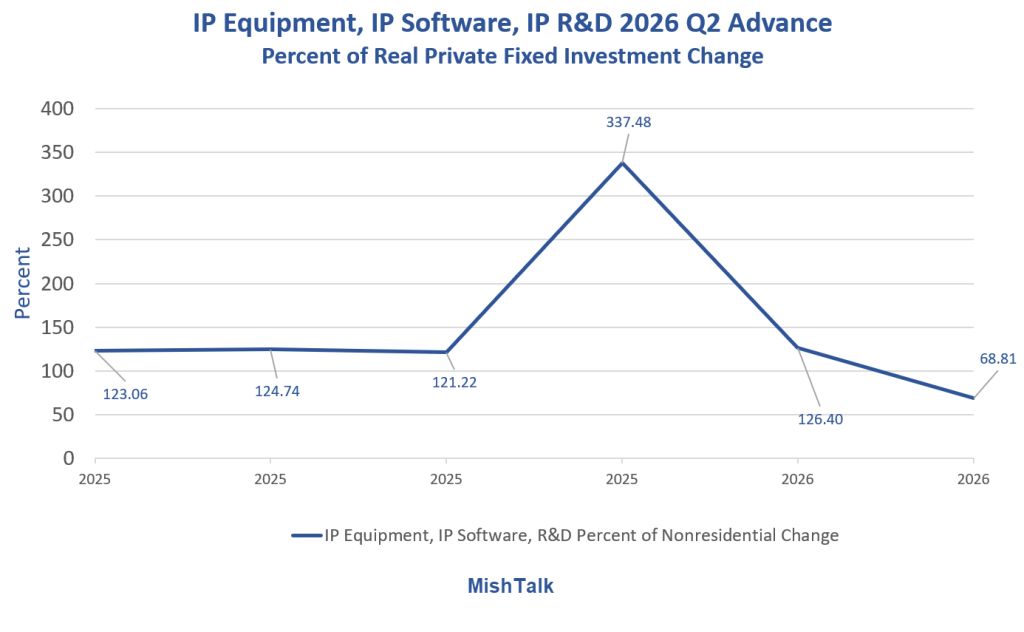
AI-Related Percent of Change in Real Private Fixed Investment
2025 Q1: 123.06 percent
2025 Q2: 124.74 percent
2025 Q3: 121.22 percent
2025 Q4: 357.48 percent
2026 Q1: 126.40 percent
2026 Q2: 68.81 percent
For 2026 Q2, AI was 68.81 percent of the total change in real private fixed investment.
From the above percentages and the BEA published contributions to GDP we can calculate the AI percentage point contribution to GDP.
The AI percentage point contribution to GDP = AI-Related Percent of the change in Real Private Fixed Investment * the BEA published Private Nonresidential Contribution (yellow bars below).
AI Percentage Point Contribution to GDP
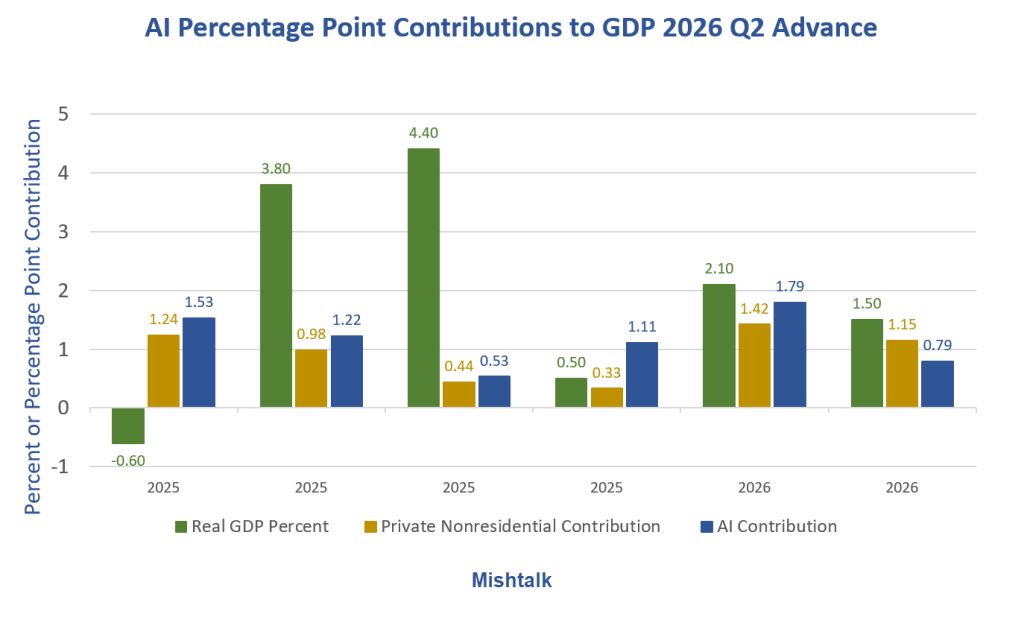
For 2026 Q2, the BEA says the private nonresidential contribution to real GDP was 1.15 percentage points.
Given that AI was 68.81 percent of private nonresidential, that makes the AI contribution 0.6881 * 1.15 PP = 0.79 PP.
Real GDP for 2026 Q2 was 1.50 percent of which AI provided 0.79 percentage points.
0.79 PP of 1.50 percent is 52.75 percent of total real GDP.
AI Percent of Real GDP
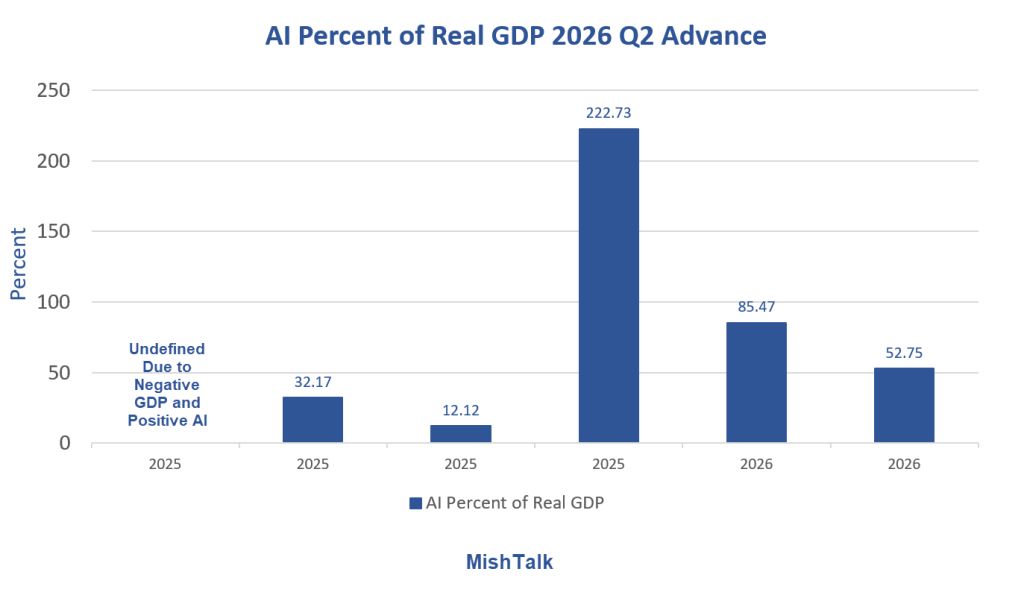
AI Contribution to Overall Real GDP
2025 Q1: Undefined
2025 Q2: 32.17 percent
2025 Q3: 12.12 percent
2025 Q4: 222.73 percent
2026 Q1: 85.47 percent
2026 Q2: 52.75 percent
AI-related expenses provided well over 50 percent of GDP in the first half of 2026.
Two Key Questions
How sustainable is the AI growth?
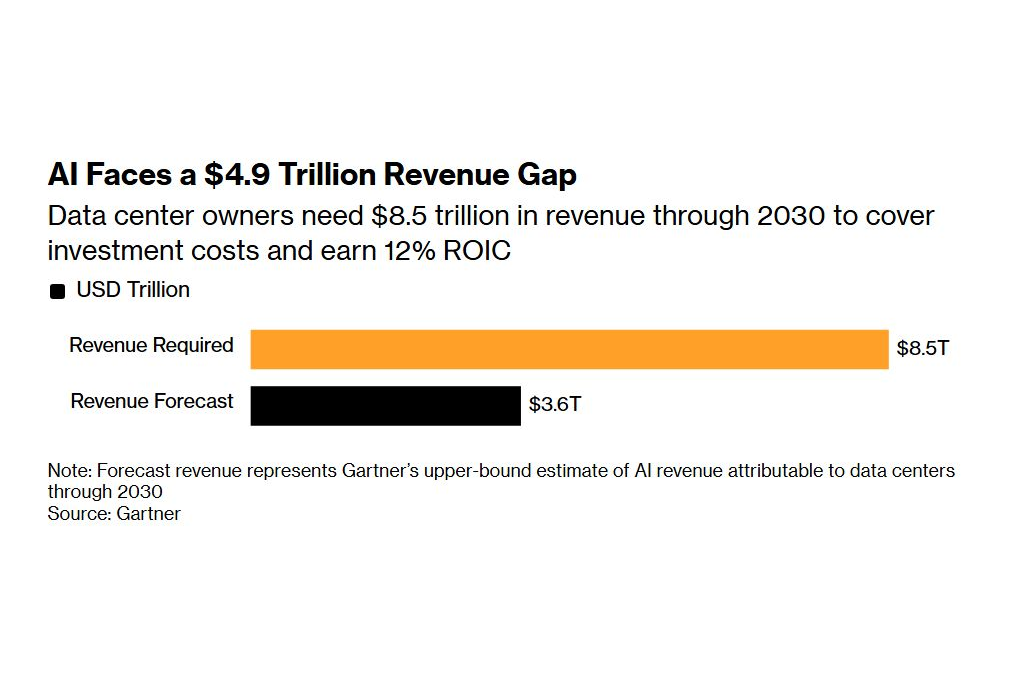
How much of the AI expenditure is malinvestment that will be written off?
We know the answer in general terms to the first question. It’s not.
The second question is much more problematic.
Logically, I like to view things this way. GDP is essentially overstated by the amount of malinvestment.
But that’s not the way it works in practice. No one ever subtracts malinvestment. Instead, malinvestment eventually takes away from future growth.
Bombing the Desert
As with private malinvestment, government spending, no matter how useless or counterproductive adds to GDP.
Trump wants hundreds of billions of dollars more in “defense” spending to make up for the wasted missiles.
It would make more sense to spend money on nearly anything than what we are doing in the Mideast.
Over the past two decades we have blown trillions of dollars and all we have to show for it is more enemies and higher inflation.
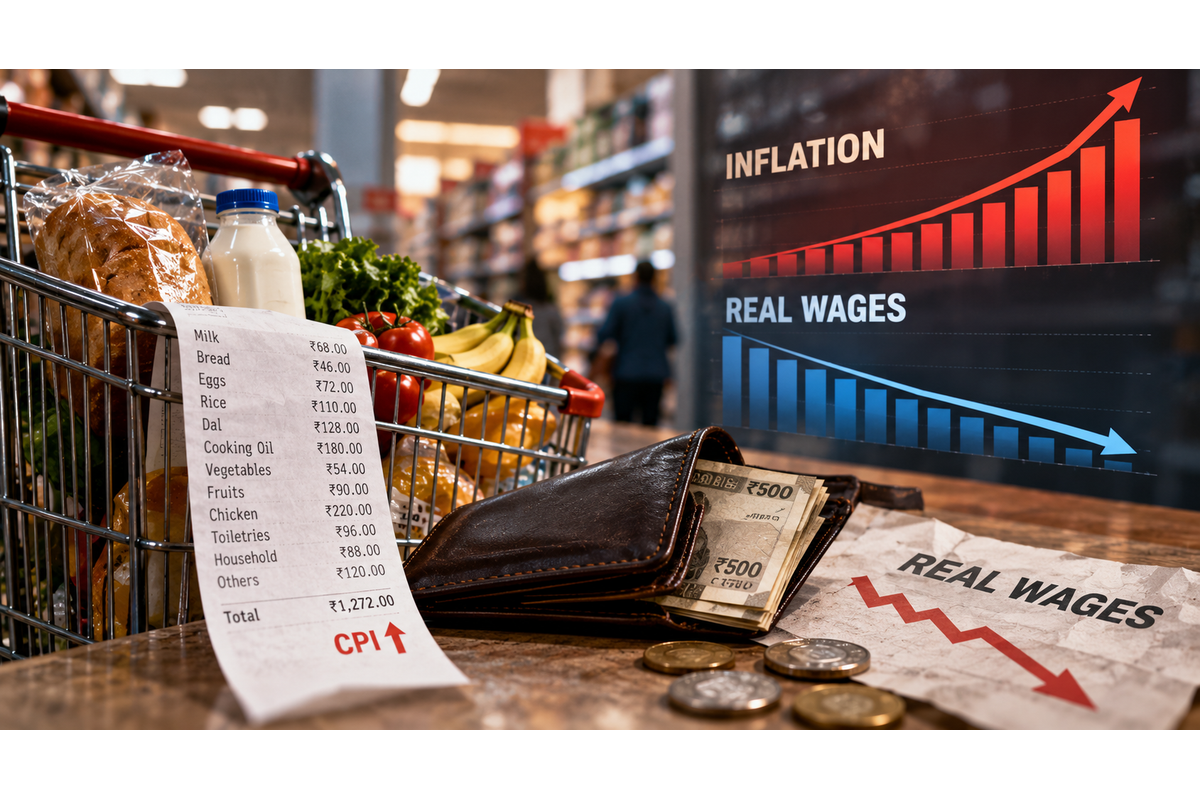
It’s no wonder the Fed is struggling with inflation and consumers are miserable.
Related Posts
July 29, 2026: Fed Chairman Tries to Explain Why an Interest Rate Pause Isn’t a Pause
Give Warsh an A+ for question avoidance.
July 29, 2026: The Market Tells Fed Chairman Kevin Warsh “You Blew It Already”
The 30-Year Long Bond Yield Is the Highest in 19 Years.
July 30, 2026: GDP Growth Slows to 1.5 Percent in Second Quarter vs 2.3 Percent Consensus
Yet, private domestic sales suggest economic overheating.
Comments
Log in or sign up to join the conversation.