


Below are some of the most interesting things I came across this week.
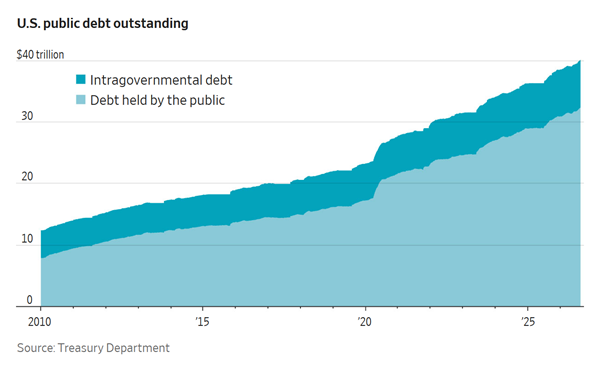
The total federal debt outstanding crossed the $40 trillion mark this week. The Wall Street Journal has a terrific, chart-based piece on the dynamics that got us here. (And if you’re having trouble trying to fathom how large a number $40 trillion is, this may help.)
LINK
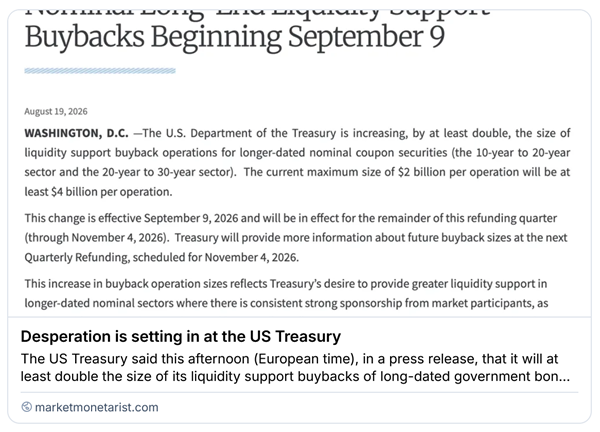
Rising long-term interest rates on this massive pile of debt inspired the Treasury to announce a surprise increase in its buyback operations. Lars Christensen writes, “The Treasury is shifting issuance towards the short end because the long end has become expensive. The Fed is buying at the short end… The distinction between reserve management and monetary financing of the deficit becomes a question of intent.”
LINK
Ray Dalio argues this is exactly what the lead up to a debt crisis looks like: “Early in the final stage of the Big Debt Cycle, the market action reflects this dynamic via interest rates rising led by long-term rates, the currency declining especially relative to gold, and the central government’s treasury department shortening the maturities of its debt offerings because of a shortage of the demand for long-term debt.”

CHART
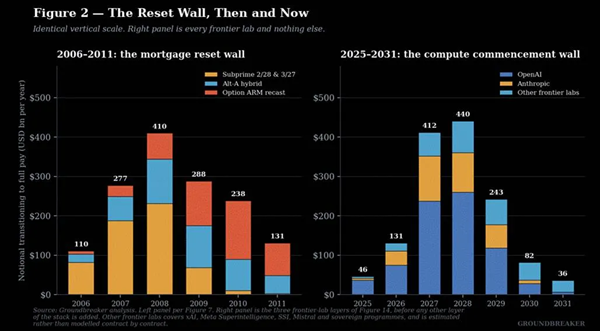
Some have argued that long-term interest rates are rising at least in part due to the rapid increase in long duration corporate bonds being issued by the hyperscalers but that dynamic has issues of its own. “The most damning exhibit of the GFC era was the mortgage reset wall. The AI build-out has a reset wall of its own: a schedule of non-negotiable payment shocks hiding inside the trillions of dollars of compute contracts signed by OpenAI and other frontier labs,” reports Groundbreaker.
LINK
Moreover, advances in AI already threaten to damage demand for costly cloud-based compute. Joachim Kelement writes, “We need many fewer data centres than we think. If we can already replace 70% to 80% of the tasks that are expected to run on LLMs with SLMs, the hyperscalers have simply no revenue growth in the future that is nearly enough to justify the capex.”




Comments
Log in or sign up to join the conversation.