


Below are some of the most interesting things I came across this week.
LINK
Regarding the growing fears surrounding recent AI security incidents, Brian Gross writes, “People built the test, removed restraints, defined the objective, left a route open and decided not to stop what was happening. Calling the result ‘rogue AI’ does more than sensationalize it. It allows those human decisions to disappear quietly from the story.”

LINK
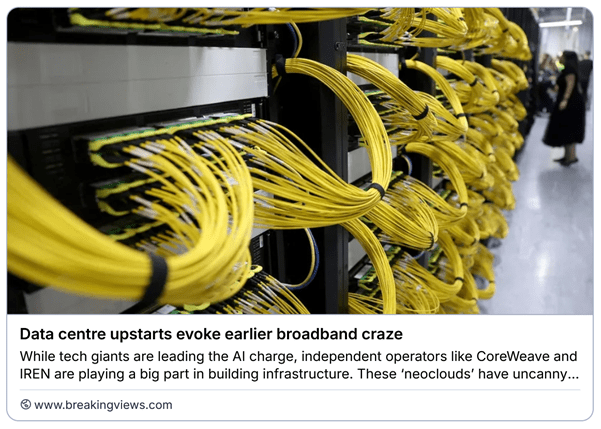
These AI labs are turning to neoclouds for much of their computing needs. As Edward Chancellor notes, this is reminiscent of the alternative telecoms that soared and crashed during the internet bubble: “The alternative telecoms firms did not fail simply because they oversupplied a market whose demand projections were exaggerated. Technological improvements also massively increased the carrying capacity of installed fibre-optic networks.”
LINK
Funding these labs is also growing more challenging. As Rod Dubitsky reports, “SoftBank is in a Sisyphus trap, relentlessly pushing the OpenAI boulder uphill. The danger comes when reality sets in, the money runs out and the boulder comes tumbling down.”

CHART
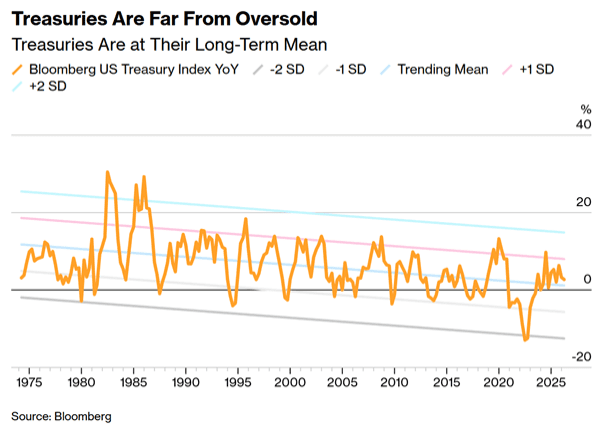
Meanwhile, debt costs in a broader sense continue to grow. “Treasuries mean-revert, which means they oscillate around their long-term average. They are back to that average, but they typically then overshoot. Treasuries could thus sell off more before they became materially oversold,” writes Simon White.
LINK
Moreover, the increased fragility of global supply chains points to sustained price pressures pushing yields higher. John Authers writes, “Add supply chains only as strong as their weakest part to a deglobalizing trend in which countries aim for self-sufficiency and exploit any chokepoints at their disposal, and shocks become a feature, not a bug.”




Comments
Log in or sign up to join the conversation.