

Tyler Prahm - Unsplash
Just how low can stocks go? That was the question posed by the Wall Street Journal on Monday morning, March 9, 2009. Just like this year, March 9th fell on a Monday, following a Friday where the S&P 500 closed sharply lower on economic fears.
That’s where the similarities end. In 2009, the S&P 500 closed below 700 for the first time since 1996; this year, it’s trading not far below 7,000, or roughly ten times higher. Back then, strategists were debating if the index would crater another 27% to reach 500. Having already dropped 56% from its 2007 highs, another leg down felt entirely plausible, but in hindsight, it was the low. Compare that to today: when was the last time you saw mainstream analysts calling for a 27% drop, even with equities right near record highs?
The analysis from that article serves as a reminder of the investor tendency to extrapolate current trends into the future. If stocks are up, they’ll stay up; if they’re sliding, the bottom is always miles away. Analysts often add a 'countertrend' hedge in their forecasts just to cover their bases, but take today’s 'temporary sell-off' forecasts with a grain of salt. They’re only echoing what the market has been doing. The only way to know for sure is to watch, listen, and let the tape tell the story.
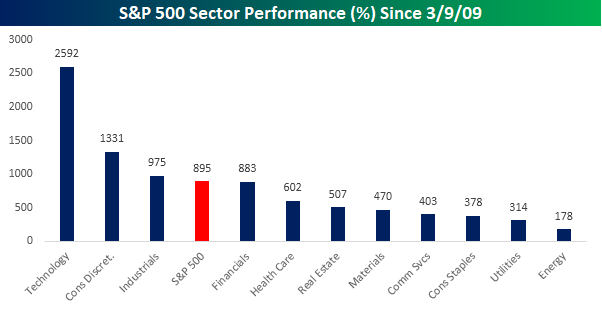
The ride since March 2009 has been incredibly rewarding for those who stayed the course. Since that Monday close, the S&P 500 has rallied 895% (excluding dividends), and more than half of all sectors have risen more than fivefold. Technology has been the top-performing sector with a gain of over 2,500%, followed by Consumer Discretionary, which is up by just over half of that amount. Rounding out the top three, Industrials is the only other sector that has outperformed the S&P 500 since the March 2009 low. While all eleven sectors are higher since March 2009, Energy (178%) and Utilities (314%) have been the worst performers, along with Consumer Staples (378%) and Communication Services (403%), which are the only other sectors that are up less than half as much as the S&P 500.
Have you ever heard anyone say that big gains are right around the corner? Of course not. Looking back at the last 17 years, it seems like the market has done nothing but go up. How many times have you heard someone say that the easy money has been made?
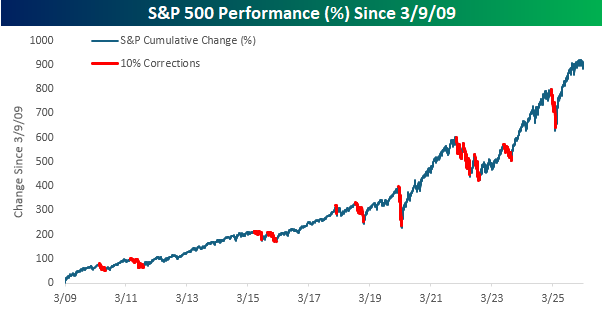
Investing always looks easy in retrospect, but in the moment, it never is. And the last 17 years? The S&P 500 has experienced two bear markets, three other near bear markets (-18%+ from a peak), and a total of 12 different declines of at least 10%. It’s nothing like the period from 2007 to 2009, but there were plenty of moments when putting new money into the market felt like anything but easy. That’s the trick. It’s only easy in retrospect.



Comments
Log in or sign up to join the conversation.