

The detailed Hungarian GDP data for the first quarter paints a moderately positive picture. The main driver of the accelerated growth rate was the pre-election effect. While the change in power has the potential to result in prolonged momentum, there are also risks to the downside.
Hungary’s growth picked up in the first quarter, but much of the strength appears driven by temporary, pre-election factors rather than a clear, sustained recovery. Our latest economic growth forecast for 2026 projects a 1.5% increase. This generally gloomy outlook is partly due to the impact of the energy price shock, and partly due to the fading of the one-off factors seen in the first quarter. Overall, consumption could drive the Hungarian economy this year, while investment may show modest growth and net exports could significantly hinder GDP expansion.
One-offs in the present, threats in the future
Based on the detailed data, the outlook for the Hungarian economy has not changed much. A number of specific positive factors are emerging that are behind the strong economic performance. Whether the surge in consumption proves sustainable depends on how long the 'honeymoon period' lasts. For now, however, consumer confidence continues to rise, which is certainly a positive sign. Stagnation in investment is preferable to a sustained decline. However, the review and temporary suspension of certain public investments by the previous administration could lead to a downturn in the short term, before investment activity begins to pick up towards the end of the year. Moreover, export growth may be limited by geopolitical uncertainty, rising production costs and potential supply chain issues due to the effective closure of the Strait.
Real GDP in Hungary (2021 = 100%)
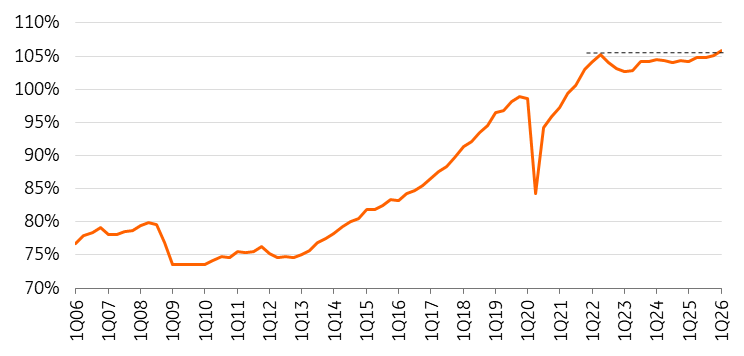
Hungarian economy starts finding its momentum
The Hungarian Central Statistical Office (HCSO) has not revised its flash first-quarter GDP figures. The Hungarian economy continued to grow by 0.8% on a quarterly basis in the January–March period. The seasonally and calendar-adjusted year-on-year index shows an increase of 1.7%. Over the past four quarters, the Hungarian economy has shown growth on a quarterly basis but has also grown in five of the past six quarters. Based on this, it can be concluded that the Hungarian economy has finally emerged from a prolonged period of stagnation.
Hungarian GDP growth
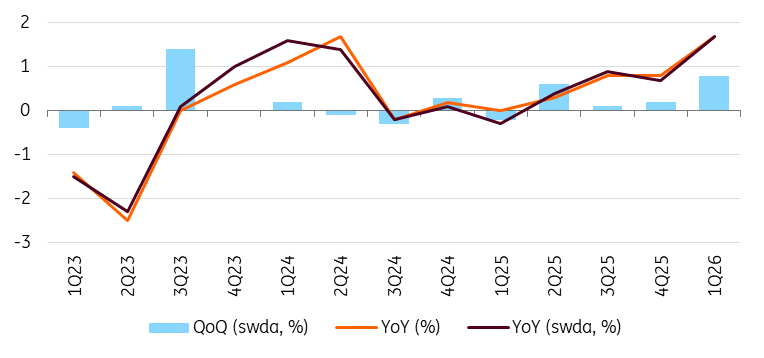
Detailed data on quarter-on-quarter changes
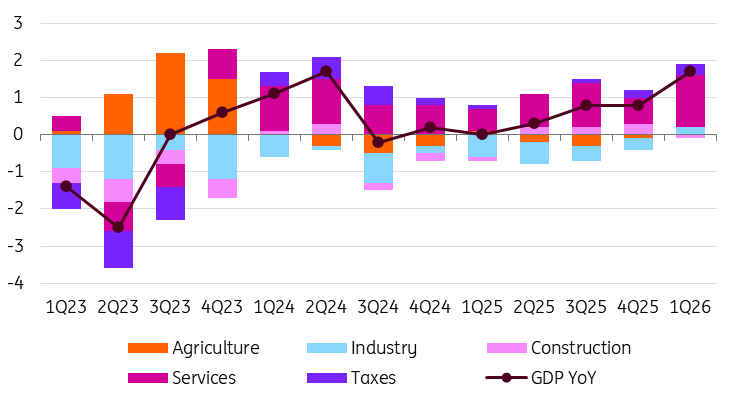
First, we will examine the most important quarterly growth indicators. On the production side, agriculture expanded significantly. Although it accounts for only a small proportion of the overall economy, this contributed to the strong start to the year. Meanwhile, the industrial sector grew by 1.1%, which was broadly in line with expectations based on monthly industrial production data, especially given its strong performance in March. The construction sector showed a significant decline, also in line with monthly data.
The service sector as a whole performed well too, with growth observed in nearly every sub-sector, with a few exceptions. There was a particularly significant surge in professional, scientific and technical activities. This may be partly due to technical orders related to the “Home Start” programme and partly due to the increase in marketing and research activities ahead of the elections. Additionally, the “accounting rush”, which is typically observed every four years at this time, may have played a role in ensuring that government payments could be made on time before the election. The drastic increase in the budget deficit in March supports this idea.
Contributions to GDP growth – production side (% YoY)
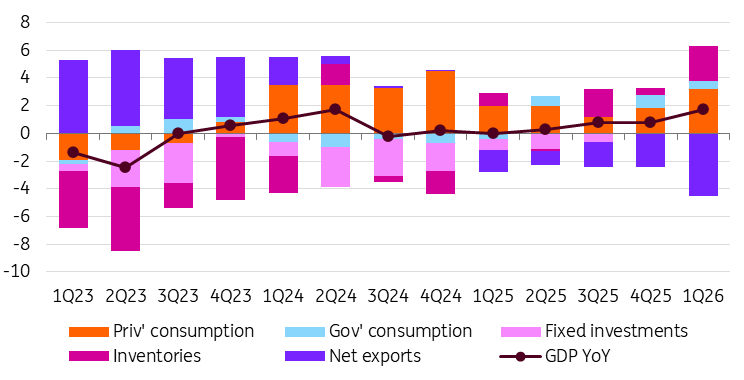
The performance on the production side is largely reflected on the expenditure side. Industry expanded substantially, and industrial exports grew accordingly on a quarterly basis. Although this expansion amounts to only 0.7%, it is the most dynamic growth rate of the past three and a half years. Gross capital formation also surged significantly, with gross inventory rising by 9% compared to the last quarter of 2025, while investment activity stagnated. In other words, growth is the result of the inventory effect. This may be due to the launch of new production capacities, where initial production or test runs are aimed at building inventory rather than generating sales for now. Furthermore, investments that are essentially complete but have not yet been phased into the books may also have been accounted for here.
The country’s energy consumption surged at the beginning of the year due to the extreme cold weather, leading to a significant increase in goods imports on a quarterly basis. Last and most importantly, the real driving force behind economic growth was consumption. At 1.5%, the quarterly increase was the highest growth rate since the third quarter of 2024. This surge comes from slowly rising consumer confidence combined with a significant increase in real disposable income.
Contributions to GDP growth – expenditure side (% YoY)
Positive signs from most of the sectors
As for the traditional year-on-year growth indicators, all sectors except construction and real estate activities expanded, thereby contributing to GDP growth of 1.7% to varying degrees. While the 2.3% growth in services can be described as strong, the 1.3% growth in manufacturing also represents a significant improvement.
Based on year-on-year indices, domestic demand increased significantly in the first quarter of 2026, while exports continued to shrink and imports grew substantially. In other words, the structure of economic growth has not changed compared to recent quarters; it has simply become more imbalanced. Net exports alone slowed the economy’s year-on-year performance by 4.5ppt, a figure offset by a 6.2ppt contribution from domestic demand. Consumption and inventory accumulation provided nearly equal contributions as drivers of growth.


Comments
Log in or sign up to join the conversation.